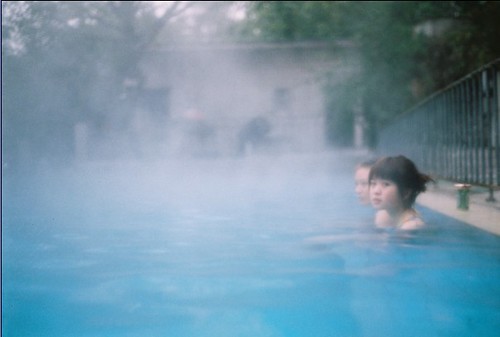
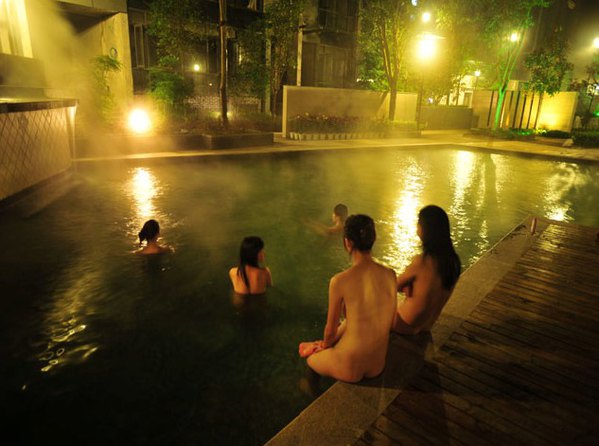
Showing posts with label clothing optional. Show all posts

Sunday, June 29, 2014

A Clear Sighted Soak?

Sichuan contains China's border between the lower lying areas of China proper and the mountainous entrants to the Tibetan plateau. A quick look at the map shows high mountains cut by deep valleys as the Indian sub-continent pushes further north.

In looking into the Himal hot springs of Sichuan, the autonomous prefectures of Garzê (or Ganzi) is covered in this pretty extensive section. By far the biggest prefecture of Sichuan province, Garzê was until early 20th century part of Tibetan Kham. Firmly in the mountainous terrain, the local majority Tibetans are spread over 18 counties.

Sniffing
First and foremost amongst these, is Kangding which serves as the administrative center of Garzê autonomous prefecture.


Situated 5 km from 'downtown' Kangding is the hot spring of Erdaoqiao (Erdao for short):
'The grounds are quite expansive and encompass many different bathing areas—a great place to soak away the aches and pains of a day's hiking or horse trekking.
Baths vary in temperature, from 38°C, 40°C, 42°C, up to 50°C (100 ~ 122°F) and if that's still not hot enough, there's also a sauna'.
A first hand experience:
'The first sniff of the spring had sarah imagining a bacon and egg sandwich but unfortunately the rotten egg smell of popping sulfuric gases was emitted from a pool like enclosure where our hot spring lay. All the surfaces were particularly grimy and the roof was encrusted with ice, the pool was covered by a thick layer of mist and the colour emitted was akin to the lights of a midnight dip in a swimming pool. Despite the -6 degree temperatures we smartly lowered ourselves into the hot spring and held our heads above the water. Before long Sarah noticed that my silver necklace had turned to a copper colour and rapidly changing to black. We weren't sure of the concentration of acid but sarah uses it in the workshop to blacken metal and if it touches her skin she is supposed to hop under the chemical shower'.
Tripadvisor has a page on Erdao, doesn't look too appealing. But the following picture could also assist (let's hope the source correctly identified this as Erdao ....).


Other sources for info on Erdao hot springs but then in Chinese can be obtained here.

Laoyulin is also mentioned to be 5 km from Kangding and the excellent Dr Rock blog by Micheal Sydney mentions the existence of a hot spring and possibly Micheal revisits the same hot spring 4 years later:
'Just a few brick cubicles covered with cheap corrugated green plastic'.
The area is becoming more of a destination for trekkers wanting to visit Sichuan's highest mountains known as Gongga (see below). An article by the China Daily gives more insight in local development combined with tourism espousing on the benefits. The 2008 article suggests a local will improve the soaking site.

Further away (21 km) from Kangding is the national park of Mugecuo. Wikitravel mention
'Dip your feet in the medicine pool (actually a hot spring) for a small fee, or have an egg boiled'.
Chinatravel notes the existence of more than 20 springs and
'Boiling springs here can be categorized into many kinds, such as Buddha Spring, Clear-sighted Spring, Stomach-improving Spring, and Feet Bath Spring, etc. The water of Buddha Spring has no peculiar smell; it is good for heart and eyes if infused with tea. Clear-sighted Spring, Stomach-improving Spring, and Feet Bath Spring are respectively helpful for the treatment of eye disease, tummy bugs and rheumatism, as well as for health keeping. From ancient times till now, the spring water here is reputed as "divine Water"'.
Even more hot springs are supposed to be apparent according to the blog entry by Memories on a shoestring
'We had a light meal at a hotspring area. Apparently Mugecuo Scenic Area has nearly 100 hot springs which have different curative effects. I did not try the hotspring. It cost RMB20 to enter inside. Each of us bought an egg to eat. It is half-boiled egg for RMB3'.
The blog entry comes with many photo's of the scenic area. From the photo's of the lunch break one can see that quite an effort has been made to upgrade these to afford visitors a soak if only of the podo variety ...


Odorless
In Garzê county one can find the hot spring of Dargye which has alts in the name of Rongpatsa, Rongpaca, Rongpatsang and Yartsa. Located 25 km from the county headquarters, it is near the gompa with the same name and the village of Rongbatsa.
Daniel Winkler describes the place as follows:
'Odorless hot water wells up with bubbles from the white granite sand ground. Dig in your feet and you will enjoy a bubble bath. Alas, the temperature of the pool is slightly below body temperature (35°C / 95°F). However, the clear water and the magnificent view of glaciated mountains make this spring a special treat. May be I should mention that this is the men's pool. There is also a woman section down below near sinter outcroppings'.
He adds a nice picture which though the same place as below, it clearly gives a different feeling to the soak.


'Shedding their robes, monks from the Dargye monastery
in Sichuan wash in a hot spring'.
Source.

Strictly
Lithang (Litang) county, to the west of Kangding contains two less well-known hot springs.


Sori hot spring is included in Daniel Winkler's hot spring
overview. Then there is most probably this experience:
'That was when I noticed local Tibetans in a hot spring across the river. I wandered over to check it out and found the water temperature to be just right. The extremely hot spring water had been mixed with the icy river water. There were several pools—the ones farther up the trail were strictly for womenfolk, so I stayed with the men. Tibetans don't bother with bathing suits—and neither did I—much to the amusement of my companions'.
Possibly not even Sori hot spring, but nonetheless a nice description of a good soak!

A little more clarified is the hot spring of Batang, 5 km west of Lithang.

'There are a number of places to bathe there, but don't expect to be a wash in nature - the hot water is piped into white - tiled tubs'.
Elsewhere this web site makes mention of many hot springs.

Avoid
Daniel Winkler's
hot spring list leads to another two soaks, Dzogchen (Zogqen) in Dêgê county and Rubu Chaka (Rubuchaka and variations in spelling of this) in Daocheng county. The former is heavily mentioned on other websites as well. The Daocheng Things to See section of Chinabackpacker mentions
'It was reported [in 2003] that many cockroaches were found in the bathroom. Avoid going there during the night when cockroaches are extremely active, and can be found everywhere, even in your clothes and shoes. Believing in Buddhism, local Tibetans do not bother to eliminate them'.
It's unclear whether this is advice to stay clear or the opposite.  
Elsewhere a more recent photo shows a different more developed picture of what Daniel might have experienced.
And this hotel booking site shows that apparently the good times of cockroaches at night have passed ...

Hottest
The website of the New Long March described a trip from Zhongdian into Yunnan. As they cross into Xiangcheng county, Sichuan they come to the village of Ranwu, which has a hot spring which was
'developed at great expense but in very poor taste. ... The spring is only a few meters away from the pools, the smaller of which is the hottest hot spring I have ever used in China. The water was formerly monopolised by a local Living Buddha; after he had washed, the water flowed into a lower pool which the locals used'.
'Ru Buchaca named because place names spa, Ru cloth Tibetan word for "friend", "Chaka" Tibetan is the spa, alias Charles co Wenquan Ru. Ganzi is a well-known high-temperature steam springs, hot springs at the outlet water temperature is 68 ℃, up to 80 ℃, flow rate up to 7000 m3 day and night, hot springs water is clear, colorless and odorless, contains no sulfur, drinking, with physical fitness, longevity, medicinal, regulating endocrine function, treatment of skin effect'.
No. 2 is the Best
In Luding county (100 km from Kangding) one can find what seems to be Sichuan's most frequented hot spring for the mountainous part of the province. Located near Sichuan's highest mountain, Gongga (Minya Konka) and in China's biggest glacier park (?), are the hot springs of Hailuogou which for the convenience of foreigners has been (re?) named Conch Gully.
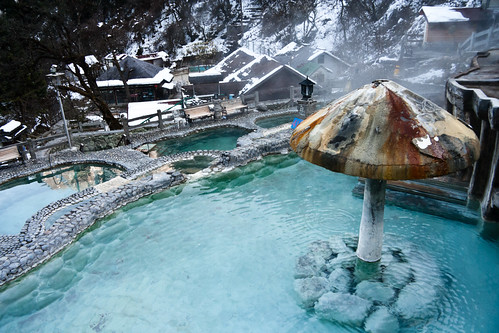
Hailuoguo's no. 2 (source: RichardLuyy)

Hailuoguo even makes it to the top 10 hot spring resorts of China (source). 

Despite all the claims to it's naturalness the springs themselves are part of a tourism set up such as the Gongga God Hot Spring Hotel. In total there are 3 hot springs in Hailuogou according to the article entitled 'Attractions: Four unique hot springs in China', one of them being Hailuogou.
That said it are so-called camps at hot springs 1 and 2 that attract most visitors.
Sabrina while blatantly copying on her blog copies:
'... most of the visitors favor hot springs in No.2 Campsite because they are rustic, with more natural taste'.
In this article discussing 'green' tourism in Ghanzi prefecture, the park around Hailuoguo is mentioned a number of times for the lack of 'green' planning.
'Several hot-spring resorts inside the park have tacky buildings and decorations totally alien to their setting. "These are truly ugly to me," Hitesh Mehta, a Canadian landscape architect, said in his presentation.
"They are beautiful," he said, pointing to the photos of traditional wood houses seen at Moxi Town just outside the park. "Unfortunately there are not many left."
Facing the criticism, Xiao Feng, director of the administration of the park, explained that these problems were mainly caused by several independent tourism operators inside the park and their bad management. At present, the administration is purchasing their property back to solve these problems.
However, many conference participants expressed doubts as to the local authorities' humble attitudes towards investors from the outside world.
"They spoil investors for sure," Chen Xujun said. "Most of them become indifferent to the local environment and welfare of the local communities."'
Then there is this info:
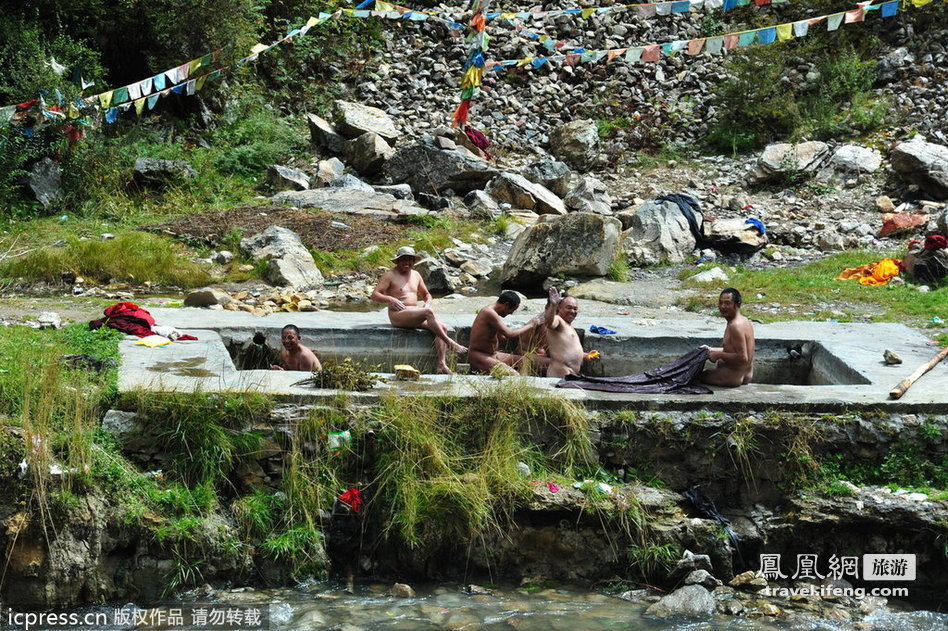
'According some doctors, the boiled water has high medicinal values, such as curing skin disease and arthiritis, and eliminating fatigue'.
Fire
Another county in Garzê with geothermal features is that of Danba. Also known as Rongzhan, the main place to visit for these features is the mountainous area of Dangling. Chinabackpacker:
'The hot-springs in Dangling are located in two areas, one at Benmu which is the rich in sulphur, and means 'fire bath' in Tibetan. The other site is at Kabu, encirlced by grassland which in Tibetan translates as 'grassland bath'. The two springs are approxiamately 4 kilometres south of the Dangling village, and the water flow never cease all year round, day and night the liquid output amouts to about 3000 tonnes. The water close to the hotspring mouth can reach up to 75 degrees Celcius. Chemical tests show that the springa belong to the type neutral, heavy sodium carbonic acid with healing properties. It contains many minerals that are epecially beneficial to the likes of headaches, stomach and intestinal diseases, diabeties, arthiritis. Surrounding the hot-springs is a picturesque primeval forest, sitting in the hot-spring bath, washing away the weariness from the travelling, indulging in the most that the hot-spring can offer. And when it's winter, the enjoyment only gets better as you take the pleasure of bathing in open snow: indulge in the winter scenery while bathing in the warm spring water, and if you are lucky enough and it snows, you can slowly relish yourself with the spectacle as snow flower fill the sky while you let your body relax in the warm bathe'. 

Source Translated with google, you make sense:
'September 22, 2012, known as the "natural bonsai" Yak Valley Scenic Area is located 21km southwest of the county, Ganzi Tibetan Autonomous Prefecture in Danba East Valley township, road side there is a very famous natural hot spring baths, but also the rare nude bath one place'.
And though it looks idyllic there are always qualms. Timemaker:
The first stop was a natural hot spring by the road. The hot steam was perfect for warming my frozen hands. I didn’t want to soak in the water though; I read that sick locals like to visit hot springs. It was especially uninviting when the driver told me you can cure STDs by soaking in the hot spring for a week'.
It probably reflects more on the writer as especially in Chinese there are many good references. 
It is well and truly Tibetan country here so you'll see complete encampments during season of locals enjoying these springs. 

Note that if I am correct just behind the hot spring pictured a road has been laid ... Drates. A paradise lost?

Sunday, February 23, 2014

Blind faith in back to nature?

Chongqing 
As well as being provincial capital Chongqing was formerly a part of Sichuan province.

It is said that Chongqing is famous for it's hot springs:
'There are dozens of them located throughout the city. The water temperatures at them are kept at 35-37 degrees Celsius (95-98 degrees Fahrenheit). People have been coming to Chongqing for centuries to visit the local hot springs due to the high mineral content of the waters. It is said that the alkali minerals found in the waters have beneficial medicinal properties, which are said to be effective in curing arthritis, and skin diseases'.
This website mentions that in 2012 Chongqing was awarded the accolade 
‘Global Capital of Hot Springs’,
whatever that means. The award was given by the 65th General Assembly and World Scientific Congress of FEMTEC which I have never heard of. Apparently it might stand of Federation for Hydrotherapy and Climatotherapy

With dozens of them located within the confines of the city we can't expect very natural conditions and that's not the reason I've decided to include these hot springs in this blog. After reading you'll know ...

As well as there being so many located close to the city, the locals also have problems in giving them names and as such we end up with the hot springs of the four wind directions.

Tradition
Info on the North hot spring:
'There are ten springs altogether in the park and the temperature of the water is a constant 35-37 degrees C. The water contains alkali minerals that are considered as having beneficial medicinal properties. The warm water offers an excellent way to relax from the stresses of day to day existence and it also benefits those who suffer from skin problems, arthritis and many other common ailments. Apart from a standard swimming pool there are 75 indoor bathrooms, a newly built triangular indoor swimming pool and a play pool for children'.
Elsewhere we understand that the hot springs here have a tradition of more than 1600 years.

The North hot springs form part of Beibei district. 
Since mid-2013 Banyan Tree have a hot spring resort here:
'Located within the Banyan Tree Spa Chongqing Beibei, there are separate indoor hot spring baths for male and female guests, while the outdoor hot spring pool offers a unique bathing experience'.
There is also another contender in the upmarket area of the northern spring, Brilliant Resort & Spa. Flowery images of the springs are to be found on the website of photographer Micheal Freeman:

 
Elsewhere there is the Haiyu hot spring hotel, tripadvisor giving it four stars.

South & Central
Info on Chongqing's South hot spring.
'The Southern Hot Springs Park has about 110 bathrooms and three swimming pools - outdoor and indoor swimming pools with one for children. The hot springs contain abundant minerals and taking a hot spring bath can rejuvenate body metabolism and cure some diseases, such as those of the skin, arthritis and rheumatism'.


Info on Chongqing Central hot spring is a lot sparser, in fact there's just one mention.

Tongliang is the name given to the western hot spring(s?). The hot springs are
'... located at Xiquan Town, twenty kilometers south of Tongliang county . ... As early as the Yuan Dynasty (1279-1368), the poet Meng Huai wrote a few lines in admiration of the spring'.
Nice pic, but what's the subscript mention?
'@chongqing's XX spring
wiz rachel
by:zong
infact,the water was cold and dirty that day'.
By Ruby's illusion


Back to nature?
Ba'nan
is the name given to
the hot spring otherwise known as the East hot spring.  

Ba'nan district seems hold a different tradition to most hot springs, certainly in China. Since 2008, Ba'nan organizes hot spring festivals, though it's unsure what this actually entails. They must be pretty desperate because that years issue was reported as follows:
'The 2nd edition of the « Ba'nan Hot Springs Tourism Cultural Festival » near Chongqing has opened on monday. The organizers invited eight pretty models to celebrate the back-to-nature theme by bathing naked...'.
It's unclear whether this was a poor attempt to gain coverage or reflects the reality of soaking here.
However, in the 'Getting Naked: Nudism in China' article, published in 2010, Ba'nan hot spring merits this paragraph:
'... in Sichuan Province, nudism seems to be all the rage. Chongqing Girls Nude Bathing Area sounds more like the title of a dodgy DVD, but it’s actually an area set aside for women in the Ba’nan District’s tranquil East Spring Village. The pool has been in use since the Ming Dynasty, and its water is said to cure blindness. If you fancy a dip, you’ll be pleased to know that it’s open to tourists. Female ones'.
Why only females beats me. Despite this often referred to article, there seems little or none other proof that this practice really exists.

That was until I found this Chinese language website which refers to the Eastern / Ba'nan hot spring and provides photographic proof both of the men and the women's baths:


Stemming from the same period (Nov. 2011), this Chinese language website notes that due to a variety of reasons the hot springs were closed, but locals still took the waters by climbing over the fence. It also suggests more idyllic bathing:


Many more references to al-fresco bathing in Chongqing, f.i. this from the soakingspirit tumblr, which gives an insight into the history of the site, apparently it became famous after curing blindness.

Big plans are underway for this set of springs, though the development report is chaotic.

Elsewhere in Ba'nan district there is the New Orient Hot Spring Hotel which tripadvisor gives a meagre 3 and a half star. And the Sunshine Hot Spring Resort (tripadvisor unrated), while those who favour dong as in Dong Hot Spring Scenic resort may wish to stay there, tripadvisor: 4 stars

Ordinary people
Then there are hot springs in
Tongjing, Yubei district not one of the four wind direction hot springs.
'Tongjing Hot Spring is world famous, hailed as the best hot springs in China'.
Whether this accolade fits the reality or not, plans are under way to re-open these already sprawling facilities in 2014:
'It is expected to become the most beautiful scenic area featuring a hot spring in west China and also the first 5A hot spring tourist attraction in Chongqing.
Unlike some scenic areas, the price is affirmed to be affordable for ordinary people after transformation and will not rise significantly'.
Other hot springs are
The Beidiyiyuan, Jiulongpo District (mention) is often shortened to Beity. Tripadvisor rates this resort as 4,5 stars, though it seems more focus is on the hotel part. Not all is well though?
'hotel is truly 5* nice nice room with special hot spring bath tub included downside to many light switches approx. 14 of them in the room to manage them insane'.
Also located in Jiulongpo district is the  Sun Kingdom Hot Spring Golf Club (source), which is very much a golfing hotel with little or no reference to a hot spring.

Then there is the Tianci Hot Spring resort, more info can be obtained from this website. Tripadvisor give it 4 and a half stars.

Haitangxiaoyue sometimes referred to as Ronghui are said to be Chongqings best urban hot springs. Having 32 pools source Tripadvisor notes 5 stars for this resort complex. Though search for Ronghui and the rating drops!
'This place blows away any spa we’ve been to in the U.S.! It was huge with tons of different types of pools, including wine, green tea, milk, and more. You could easily spend a whole day here, and for two of us it was about $55 U.S.! If we had more time I definitely would have taken advantage of a massage, which was something like 168 rmb ($27 U.S.). Everything was co-ed, so swimsuits were required'.

Thursday, October 10, 2013

Chilime Tatopani, Nepal. Source

In hot water. Of Bulnai, Mongolia. Blogged by Costin.

 An instagram by tanqingju. Tibet's Dezhong hot spring

A family portrait:
'Le délice des sources chaudes tout nus'. 
Tsenkher, Mongolia. Source

Thursday, November 8, 2012

Heads and Toes

Qinghai
The high altitude plateau of Tibet falls under a number of different administrative divisions, the major two being Tibet Autonomous Region on the one hand, the other Qinghai province.

The province of Qinghai is named after it's large saltwater lake and under the name of Amdo has been part of China since the mid-eighteenth century. However other than the area's on it's northwestern border, the main population and thus culture exists of Tibetan.


Consisting of mostly high plains and mountains Qinghai also has some hot springs, though in researching these, I believe many have remained unmentioned whereas others are known by a variety of names. This source mentions no less than 200 hot springs exist ..., so I might be missing quite a few.
Qinghai, having less restrictions on foreign travelers, one would believe that there is more information available concerning this provinces' hot springs. But that's not always the case.

Sweet!
Xining, the capital of Qinghai province, has some hot springs. This
blog entry mentions a hot spring below a building which resulted in a
'fun night'.
The Qihai Holiday Dynasty has a 'bath service', which according to this reference concerns the Neiyu hot spring.


Elsewhere is the mention (link not working) of the oddly named Syrup Beach (Yaoshuitan) hot spring, located in Huangzhong county. The whole description is gibberish:
'This is known in the Qinghai-Tibet Plateau Beach hot syrup, after the domestic advanced scientific means to analyze the water quality, beach hot syrup was informed that the body must contain a large number of lithium, magnesium, strontium, chromium, manganese, boron, silicate and other trace without Su - , a high medicinal value, internal to the stomach have a good health, outside the bath on ringworm, scabies, urticaria, arthritis has become a good curative effect, so people it called "Shinsen syrup." '
The often used standard syrupy soak slide (source).

This translation of this web page includes:
'According to legend, Goddess Marriage "Seven Fairies heavenly days will arrest heaven after normalization, where the body vulgar body can not tolerate because of heaven, the Jade Emperor to life Taibaijinxing lower bound enchant a Shinsen sent seven the fairy often go bathing, and later seven fairies really recovered immortal body. Since then, the look was spring in here day and night flowing ...'

A real royal soak
Note should be made of the massive tragedy which struck Qinghai in the beginning of April 2010 when an earthquake had it's epicenter in the county of Yushu, which lies in the Tibetan Autonomous prefecture with the same name.
 

In light of the geological movement it's unclear whether or not the Yushu Princess Wen Cheng hot spring is still flowing; quite often hot springs can simply disappear. This hot spring is reckoned by this site to be one of the 10 beautiful places in Qinghai province.

Closer to Yushu town is Batang hot spring; Batang translates as "hot water ditch" (source). It adds:

'In the village (more a slightly denser cluster of houses amidst the grasslands) was a place advertised as a “hot springs” and could be more accurately described as simply a “spring-fed swimming pool.” But the location was lovely, and I sat out in the open and admired the view and wrote in my journal'.
Though only an hour from Yushu, the hot springs are another 2-3 hour walk up the mountain (to 3900 m), or with a motorcycle (link now defunct!):
'How do all five of us get to the hot springs with one motorcycle? Well, you ride piggyback. One guide with two passengers on back drives the motorcycle ahead. The other two hike. The motorcycle is left on the trail for the two hikers behind while the first group continues to hike. Then the following two pick up the bike and drive it ahead and then leaves the bike'.
In the end it's a very rustic place where Tibetans come and camp out in the summer. Jonas describes it as follows:
'After bypassing yet another angry dog, you start to see strange water seepages along the trail, and suddenly a hot springs pool appears below a khata-draped boulder. Then another. But this is only the start; you walk down to the riverside meadows and cross the torrent on steppingstones, then climb a low hillside. And here you find not only more hot-springs pools, but a miniature geothermal wonderland, replete with mini-geysers, bubbling springs and pools and strange mosses and technicolor soil. You strip and enter the water; perfect temperature. It starts to snow. The pool is shallow; you tuck as much of your body underwater and sigh happily; you can feel yourself relaxing. Life is good'.
Here's another link with photo, but description in Chinese ...

And another referrring to Yushu prefecture hot spring, Qinghai.

Racy
In Hainan prefecture, Guide county lies the hot spring of Zhacang. Often referred to be it's county name, Zhacang is probably the most referred to hot spring of Qinghai or hot spring visited by Tibetans. The main reason for this is what mainstream China seems to find as scandalous behaviour, soaking half naked. There are quite a few photo's on internet (for instance here). Just photo google Guide + hot spring.

More info on west-saga including the legend attributed to Guide hot spring coming into existence:
'in the beginning at the creation of the world ten suns hung in the sky, which burn hot weather everywhere, people can not live. At that time a hero called Houyi shot down nine suns with his consummate archery, leaving one sun in the sky; in this way the disaster was settled down. But the nine suns didn't take that lying down; they got into the ground scattering on the ancient China and displaying their prowess. The one in Yongzhou stayed in the underground of Wende Hot Spring; it was scorching hot, which made ground water often boiling and spurting out of the ground to form a hot spring'.

An example of the less racier, from Guide hot spring entry on sohu.com (Chinese). 

There is the proof in a scientific document, as well as an ever increasing amount of information added to the net. 

Practical info from this blog entry on Zhacang notes: 
'Zhacang spa is located 15 km from the Guide county, surface water temperatures average 40 degrees year-round, the highest water temperature of hot spring is up to 90 degrees;  Zhacang hot spring water quality is excellent, is said to have a significant effect, in particular, the men and women bathing customs handed down to us from our ancestors, let people feel very fresh and look forward to'. 
Includes a number of photo's for instance this: 


Wikitravel even has an entry: 
'Entry was free in August 2011。 The water is very very hot in the summer and locals indicate it's better in the winter. At the time of writing the village had suffered a flood and much of the associated infrastructure had been damaged however you could still have a wash in the water. Be prepared for naked old Tibetan men and women'.
Beware though, the following was in the make:
'Building a comprehensive health center in Zhacang hot spring of Guide County, which is mainly gymnastic and medicated bath, and which integrates food, accommodation, amusement into a whole'.
Luckily the link doesn't seem to be working, meaning that the plans have changed ...?


Elsewhere in the county are the hot springs of Qunaihai and Xinjie (1), though the sources mention the existence of 11 hot springs in Guide county alone ....

Zanabazar and soup
A hot spring is said to be 60 km southwest of Gonghe, also part of Hainan prefecture.
'near the town of Wenquan'
That seems to be an understatement as Wenquan translates directly from Chinese as hot springs. 
The same source (mentioned above) focuses on the life of Zanabazar, the first living Buddha of Mongolia. It describes a meeting between Zanabazar and the then Dalai Lama near Hoang-Ho Hot Springs, which the source speculates are the same hot springs. 
On internet there is even a short list of the hot springs visited by Zanabazar!

Possibly describing the same hot spring Lauren Marie has some very curious observations. Stating that at first the trip from Xining took 7 hours, then setting out the next day in searching for a soak:
'Asked him where the hot springs were. Should have been more suspect when he told us the springs were free.
We followed his directions 200 meters past the last house in town (the town is approximately 400 meters long) and came upon a giant steaming pile of trash. We though, "oh, maybe the springs are BEHIND this trash pile!" Yet, behind that is just more steaming trash. Not a Turkish bath in sight. Turns out the residents here dump their trash in the hot springs, creating a primordial soup of interesting plastic bits. The water was warm, probably 80 degrees, but a bit stagnant with algae and trash. So, we decided to follow the stream a bit further down to where there was a rock structure that we were hoping might be some sort of outdoor bath.

It was, but for sheep. Of course you need to wash your sheep every day! We came upon a corral of sheep that a few men were desperately trying to herd into a hot spring bath to be bathed - I guess. We joined in the pushing and stick beating until all the sheep were through. Then we decided to wander down river a bit.
We hiked for a ways up into snowy mountains, and then Anna and I turned back while the boys continued their hike. On the way back we figured we'd check out the source of the hot spring and came upon a pool where a couple of little boys were having a bath. Their older brothers were sitting on cinderblocks with their feet dangling in. Anna and I followed suit and pulled up some cinderblocks and sat for a while. The water felt really nice at the time, although my feet haven't really warmed up since that hike'.

Possibly located in Hainan prefecture is the hot spring of Chiga. Legerton and Rawson (2) describe in no less than 15 pages a visit to these hot springs and the soaking culture.
'Chiga hot springs were nothing more than sweltering geothermal mineral water collected into a series of six natural pools at the opening of a steep clay canyon'.
The complete story (as well as other reports in the book) are fascinating. Locals, be they Tibetan, Chinese or Uighur bathe for months on end to relieve ailments.


From the Tibet Qinghai photo sharing forum. Could it be Chiga (might be Zhacang ..)? By Melvynyeo:
'This is the local hot spring. Man and woman naked together in the same spring. They don't seem to mind us taking photos'.

The Laughing Soak?

Madoi (Maduo) county, Golog prefecture possess just the one hot spring, which unfortunately goes unnamed. This site (now broken link?) also provides a photo overview of the county with a surprising photo of the hot spring.

Then in Huangnan prefecture, Tongren (or Repkong/Rebkong) is described as a 'gem':
'We enter a sacred cave, candlelit and filled with medicinal water. It is packed with Tibetan women from a nearby campground, having an evening soak. The heat, moisture and company in the cave are incredibly soothing.
To our delight, the women serenade us with Tibetan folk songs. Peels of laughter erupt when one particularly bold woman stood up and—bare-chested—mimicked a dance to accompany the popular song, "Our Merit Increases" (Bsod nams yar 'gro lags). On departing, we are treated to a parody of the traditional departing gesture: presenting a white silk scarf, or khata'.
The copyrighted photo by Julia Calfee:
'Tibetan women bathing in hot spring grotto for medicinal purposes outside Tongren'
Elsewhere there is another photoblog (to approach chinese minority: men and women on together bathe) of the same hot spring (I think) with an exceedingly difficult to follow narrative (but decidedly positive). Can you make head or toes of the following?
'In these hot springs,one of them can not only cure many diseases, but also men and women with hot spring bath. Laughter is just that - a naked young woman is the Tibetan laughed at me and doing up her hair. She sat rock on the side, legs extended in the hot wind around the water vapor, wry-necked in doing her long hair. There are also two next to her and her age similar to the Tibetan woman, while Bath side laugh at me. the scene reminds me of a piece of classical Western art. Tug oil paintings so remarkable that many people praised, keep it in time, and I now it is the reality.The hotspring gives auspicious happiness, pure and kind-hearted people of the Spa, not only washed the dirt and disease. it is also a particular tibetan custom'.
Then in Tongren county there is the hot spring of Qukuhu:
'There are peculiar landforms here. It is Qukuhu Medical Hot Spring at the north of the park with the temperature between 45-65ºC. The spring water can cure skin disease and rheumatic arthritis. There is another medical spring that is compound natural mineral water and called holy water by people'.
Freezing winter

In Haixi prefecture is the hot spring of Nachitai (Nacitai) otherwise known as Kunlun. Listed as an attraction of Golmud there is significant info available on this hot spring. This description is more concise:

'We will see a holy spring called Kunlun Holy Spring that just stand by the way. The spring gushes all the year even in the freezing winter. It is said to have a marvelous curative effect on people'.
Notes:
(1) Mianping, Z. (1997)
An Introduction to Saline Lakes on the Qinghai-Tibet Plateau. Kluwer Academic Publishers, Dordrecht, the Netherlands.
(2) Legerton, C and J. Rawson (2009) Prayers on the plateau. From: Invisible China: A journey through ethnic borderlands. pp. 161-176. Chicago Press Review, Chicago, United States of America.

Friday, June 24, 2011

Soaking with the Mosuo

The Mosuo and bathing
Lijiang is probably one of China's biggest tourist Mecca's but if not for the Ninglang Yi automonous county it would hardly be worth a mention in this blog. However that's not the case.

Located at a distance of no less than 8 hours, Ninglang county, surrounding the Lugu (Luguhu) lake, is a bit isolated and as such has become home to the Mosuo people
(an officially not recognized minority) who might just well be this region's biggest drawcard. The backdrop not being sufficient enough, tourists from all over China come to witness the culture where to be woman is king:
'In an effort to promote Lugu Lake as an interesting tourist spot, the Chinese government advertised the area as "the Woman's Kingdom", a fully matriarchal society, and implied that the women are sexually loose, taking male partners often, and at will. Books with promiscuous covers and amateur paintings with naked and scantily clad women are sold in every shop. Locals are forced to wear "traditional costumes" with the threat of ¥20 per day fines for non-compliance'.
While intrigued by this kind of different culture, one might ask why come all the way here to bear witness to this? Surely a book such as that of by Yang Namche Namu and Christine Mathieu (2) is enough to understand the culture, though it also describes the beauty of the countryside.

But no. Answers to this inexplicable reason to visit Lugu Lake and the surrounding Mosuo heartland are more complex.

At the heart of the argument are distinctions about superiority apparently. Matriarchal is backward, patrimonial is modern. That's how Dru C. Gladney (1) sums up the mainstream view in the book 'Dislocating China: Muslims, Minorities and other Subaltern Subjects', while giving examples of the exoticizing and eroticizing of minorities in modern China (see other entries on Yunnan), which are additional motives for seeking out Mosuo culture.

These motives, I have to admit, are not exclusive to China. See portrayal of Nat. Geo. which have no problems with near naked Ni-Vanuatu for instance, but all white-skinned unclothed persons are neatly blurred. See also my own posting on this subject in Soaking in Southeast Asia: Cliffhanger.


Though much is made of the difference between Mosuo and Chinese culture in Namu and Mathieu's book, notable is the mention of Mosuo enjoying hot springs au-naturel and how this is being prevented by the (Chinese?) authorities (2). More on this development in historical context:
'During the Cultural Revolution, local officials thought this practice [bathing naked] was uncivilized and they added walls to separate men and women. Over time, however, the Mosuo began taking down the walls until the point that they hardly existed. When the area was open for tourism in the 90s, the government forcibly separated male and female bathers. Eventually, the area was reopened for communal bathing after the government realized its value to the local Mosuo people'.
Possibly to exemplify the contrast between the culture's, more has been made of the naked soaking than in reality existed; i.e. a supposed superiority of the Mosuo over Han Chinese due to the former's inability to distinguish between the clothed and unclothed human form without erotizication.

That said, the cultural differences still add to the Lugu lake area attractions:
'In addition the Mosuo of all ages engage in naked bathing at the Waru hot spring, seeing the body as simply a part of the normal pattern of things. For many Chinese, such visits permit a view of fascinating customs found in a beautiful part of the country ...'(3)
Or as in this publication:
'In early 1988, I saw a young man from Sichuan anguishing in the courtyard of the local government; his expensive camera with a telephoto zoom lens had been forfeited when, from behind a towering rock, he photograped the naked bathers in a roofless hot spring in northern Yongning' (4).
Mosuo's soaks
After extensive web search, I still have to proceed beyond the one hot spring, which the above mentioned authors (2) situate near Yongning village. It is often referred to as Wenquan, however Wenquan is just Chinese for hot spring. More commonly it is named after the nearby village of Yongning or Waru (3), I'll stick to the latter. Besides positioning the soak 10 km north of Yongning Tourchina adds:
'Now this place is equipped with proper facilities for people wanting to soak and relax in this comfortable hot spring'.
As opposed to before when ...?


This cached reference describes the (perceived?) past:
'So at any time of the night or day, up to hundreds of naked men and women can be seen bathing together. They play together and have fun. Mosuo people have a very relaxed attitude towards the naked human body and they do not regard nudity as a taboo'.
'A group of Mosuo women and tourists bathing in the famous hot springs of Yongning, Yunnan province, China. August 2007'.

A current firsthand experience by a long-distance rider:
'Had the place all to myself, and soaked for over an hour. The water felt warm, but not hot, smelled heavily of minerals, and actually fizzed like soda pop. ... After the soak I kept riding to see if there was anything up ahead. There was another hot springs – Lao (old) Hot Springs – a few kilometers up the road. Later someone back at Lige said that was the “better” hot springs because the water was hotter, but it sounded pretty crowded'.
So maybe two hot spring sites?

Dane-en-chine has a blog entry in which he describes as much the way there and mentions two hot springs locations near to each other:
'In the hot spring village (Mosuo name is Agua and Chinese name is Wen Chuan) there are 2 bathes. We had a look at both. We don’t like the oldest too much ruined.
The new one where we went has a collective basin share in two parts one for women one for men, just separated by an enormous wooden beam,. It's open air so it is very pleasant.
When we ask to go to the collective bath the owner is surprised and refuses by saying to us "lao bai xin" what wants to say "common people" what in his eyes we are not!
The local people come here to take your bath; they use a lot of soap so the water is too soapy. There are private rooms with bath smaller and cleaner.
We began by the common and finish by the private. No massage just hot bath this water is good for the skin'.
Oddly they include a picture of bathing naked locals with a clothed westerner!

In the Footsteps of Dr. Rock from 2005 adds:
'There is now a "resort" here where pools have been built for tourists. There will probably be other pools built by the time you read this'.
And now for the bad news from 2009:
'Construction of an airport near China's last matriarchal society in the southwestern Yunnan Province has started, authorities said yesterday'.
Innocence ends?

Well, probably one of the very few pictures of men soaking naked in China! Again Yongning hot spring. Look at this link to a photo (sfw) when the soakers still had a view. So decorum meant dividing the pool and put a wall up.

Notes:
(1) Gladney, D.C. (2004) Dislocating China: Muslims, Minorities and other Subattern Subjects. Published by Hirst and Co, London, United Kingdom
(2) Namu, Y.E. & Mathieu, C. (2003) Leaving Mother Lake: A Girlhood at the Edge of the World. U.S.A.
(3) Arlt, W. G. & X. Honggang Tourism Development and Cultural Interpretation in Ghanzi, China. In: Ryan C, & G. Humin (Eds.) (2009) Tourism in China: Destination, Cultures and Communities. Routledge, New York, U.S.A.
(4) Shih, C-k (2010) Quest for Harmony: the Moso Traditions of Sexual Union and Family Life. Stanford University Press, Stanford, U.S.A.