Showing posts with label Joseph Rock. Show all posts

Sunday, June 29, 2014

A Clear Sighted Soak?

Sichuan contains China's border between the lower lying areas of China proper and the mountainous entrants to the Tibetan plateau. A quick look at the map shows high mountains cut by deep valleys as the Indian sub-continent pushes further north.

In looking into the Himal hot springs of Sichuan, the autonomous prefectures of Garzê (or Ganzi) is covered in this pretty extensive section. By far the biggest prefecture of Sichuan province, Garzê was until early 20th century part of Tibetan Kham. Firmly in the mountainous terrain, the local majority Tibetans are spread over 18 counties.

Sniffing
First and foremost amongst these, is Kangding which serves as the administrative center of Garzê autonomous prefecture.


Situated 5 km from 'downtown' Kangding is the hot spring of Erdaoqiao (Erdao for short):
'The grounds are quite expansive and encompass many different bathing areas—a great place to soak away the aches and pains of a day's hiking or horse trekking.
Baths vary in temperature, from 38°C, 40°C, 42°C, up to 50°C (100 ~ 122°F) and if that's still not hot enough, there's also a sauna'.
A first hand experience:
'The first sniff of the spring had sarah imagining a bacon and egg sandwich but unfortunately the rotten egg smell of popping sulfuric gases was emitted from a pool like enclosure where our hot spring lay. All the surfaces were particularly grimy and the roof was encrusted with ice, the pool was covered by a thick layer of mist and the colour emitted was akin to the lights of a midnight dip in a swimming pool. Despite the -6 degree temperatures we smartly lowered ourselves into the hot spring and held our heads above the water. Before long Sarah noticed that my silver necklace had turned to a copper colour and rapidly changing to black. We weren't sure of the concentration of acid but sarah uses it in the workshop to blacken metal and if it touches her skin she is supposed to hop under the chemical shower'.
Tripadvisor has a page on Erdao, doesn't look too appealing. But the following picture could also assist (let's hope the source correctly identified this as Erdao ....).


Other sources for info on Erdao hot springs but then in Chinese can be obtained here.

Laoyulin is also mentioned to be 5 km from Kangding and the excellent Dr Rock blog by Micheal Sydney mentions the existence of a hot spring and possibly Micheal revisits the same hot spring 4 years later:
'Just a few brick cubicles covered with cheap corrugated green plastic'.
The area is becoming more of a destination for trekkers wanting to visit Sichuan's highest mountains known as Gongga (see below). An article by the China Daily gives more insight in local development combined with tourism espousing on the benefits. The 2008 article suggests a local will improve the soaking site.

Further away (21 km) from Kangding is the national park of Mugecuo. Wikitravel mention
'Dip your feet in the medicine pool (actually a hot spring) for a small fee, or have an egg boiled'.
Chinatravel notes the existence of more than 20 springs and
'Boiling springs here can be categorized into many kinds, such as Buddha Spring, Clear-sighted Spring, Stomach-improving Spring, and Feet Bath Spring, etc. The water of Buddha Spring has no peculiar smell; it is good for heart and eyes if infused with tea. Clear-sighted Spring, Stomach-improving Spring, and Feet Bath Spring are respectively helpful for the treatment of eye disease, tummy bugs and rheumatism, as well as for health keeping. From ancient times till now, the spring water here is reputed as "divine Water"'.
Even more hot springs are supposed to be apparent according to the blog entry by Memories on a shoestring: 
'We had a light meal at a hotspring area. Apparently Mugecuo Scenic Area has nearly 100 hot springs which have different curative effects. I did not try the hotspring. It cost RMB20 to enter inside. Each of us bought an egg to eat. It is half-boiled egg for RMB3'.
The blog entry comes with many photo's of the scenic area. From the photo's of the lunch break one can see that quite an effort has been made to upgrade these to afford visitors a soak if only of the podo variety ...


Odorless
In Garzê county one can find the hot spring of Dargye which has alts in the name of Rongpatsa, Rongpaca, Rongpatsang and Yartsa. Located 25 km from the county headquarters, it is near the gompa with the same name and the village of Rongbatsa.
Daniel Winkler describes the place as follows:
'Odorless hot water wells up with bubbles from the white granite sand ground. Dig in your feet and you will enjoy a bubble bath. Alas, the temperature of the pool is slightly below body temperature (35°C / 95°F). However, the clear water and the magnificent view of glaciated mountains make this spring a special treat. May be I should mention that this is the men's pool. There is also a woman section down below near sinter outcroppings'.
He adds a nice picture which though the same place as below, it clearly gives a different feeling to the soak.


'Shedding their robes, monks from the Dargye monastery
in Sichuan wash in a hot spring'.
Source.

Strictly
Lithang (Litang) county, to the west of Kangding contains two less well-known hot springs.


Sori hot spring is included in Daniel Winkler's hot spring
overview. Then there is most probably this experience:
'That was when I noticed local Tibetans in a hot spring across the river. I wandered over to check it out and found the water temperature to be just right. The extremely hot spring water had been mixed with the icy river water. There were several pools—the ones farther up the trail were strictly for womenfolk, so I stayed with the men. Tibetans don't bother with bathing suits—and neither did I—much to the amusement of my companions'.
Possibly not even Sori hot spring, but nonetheless a nice description of a good soak!

A little more clarified is the hot spring of Batang, 5 km west of Lithang.

'There are a number of places to bathe there, but don't expect to be a wash in nature - the hot water is piped into white - tiled tubs'.
Elsewhere this web site makes mention of many hot springs.

Avoid
Daniel Winkler's
hot spring list leads to another two soaks, Dzogchen (Zogqen) in Dêgê county and Rubu Chaka (Rubuchaka and variations in spelling of this) in Daocheng county. The former is heavily mentioned on other websites as well. The Daocheng Things to See section of Chinabackpacker mentions
'It was reported [in 2003] that many cockroaches were found in the bathroom. Avoid going there during the night when cockroaches are extremely active, and can be found everywhere, even in your clothes and shoes. Believing in Buddhism, local Tibetans do not bother to eliminate them'.
It's unclear whether this is advice to stay clear or the opposite.  
Elsewhere a more recent photo shows a different more developed picture of what Daniel might have experienced.
And this hotel booking site shows that apparently the good times of cockroaches at night have passed ...

Hottest
The website of the New Long March described a trip from Zhongdian into Yunnan. As they cross into Xiangcheng county, Sichuan they come to the village of Ranwu, which has a hot spring which was
'developed at great expense but in very poor taste. ... The spring is only a few meters away from the pools, the smaller of which is the hottest hot spring I have ever used in China. The water was formerly monopolised by a local Living Buddha; after he had washed, the water flowed into a lower pool which the locals used'.
'Ru Buchaca named because place names spa, Ru cloth Tibetan word for "friend", "Chaka" Tibetan is the spa, alias Charles co Wenquan Ru. Ganzi is a well-known high-temperature steam springs, hot springs at the outlet water temperature is 68 ℃, up to 80 ℃, flow rate up to 7000 m3 day and night, hot springs water is clear, colorless and odorless, contains no sulfur, drinking, with physical fitness, longevity, medicinal, regulating endocrine function, treatment of skin effect'.
No. 2 is the Best
In Luding county (100 km from Kangding) one can find what seems to be Sichuan's most frequented hot spring for the mountainous part of the province. Located near Sichuan's highest mountain, Gongga (Minya Konka) and in China's biggest glacier park (?), are the hot springs of Hailuogou which for the convenience of foreigners has been (re?) named Conch Gully.

Hailuoguo's no. 2 (source: RichardLuyy)

Hailuoguo even makes it to the top 10 hot spring resorts of China (source). 

Despite all the claims to it's naturalness the springs themselves are part of a tourism set up such as the Gongga God Hot Spring Hotel. In total there are 3 hot springs in Hailuogou according to the article entitled 'Attractions: Four unique hot springs in China', one of them being Hailuogou.
That said it are so-called camps at hot springs 1 and 2 that attract most visitors.
Sabrina while blatantly copying on her blog copies:
'... most of the visitors favor hot springs in No.2 Campsite because they are rustic, with more natural taste'.
In this article discussing 'green' tourism in Ghanzi prefecture, the park around Hailuoguo is mentioned a number of times for the lack of 'green' planning.
'Several hot-spring resorts inside the park have tacky buildings and decorations totally alien to their setting. "These are truly ugly to me," Hitesh Mehta, a Canadian landscape architect, said in his presentation.
"They are beautiful," he said, pointing to the photos of traditional wood houses seen at Moxi Town just outside the park. "Unfortunately there are not many left."
Facing the criticism, Xiao Feng, director of the administration of the park, explained that these problems were mainly caused by several independent tourism operators inside the park and their bad management. At present, the administration is purchasing their property back to solve these problems.
However, many conference participants expressed doubts as to the local authorities' humble attitudes towards investors from the outside world.
"They spoil investors for sure," Chen Xujun said. "Most of them become indifferent to the local environment and welfare of the local communities."'
Then there is this info:
'According some doctors, the boiled water has high medicinal values, such as curing skin disease and arthiritis, and eliminating fatigue'.
Fire
Another county in Garzê with geothermal features is that of Danba. Also known as Rongzhan, the main place to visit for these features is the mountainous area of Dangling. Chinabackpacker:
'The hot-springs in Dangling are located in two areas, one at Benmu which is the rich in sulphur, and means 'fire bath' in Tibetan. The other site is at Kabu, encirlced by grassland which in Tibetan translates as 'grassland bath'. The two springs are approxiamately 4 kilometres south of the Dangling village, and the water flow never cease all year round, day and night the liquid output amouts to about 3000 tonnes. The water close to the hotspring mouth can reach up to 75 degrees Celcius. Chemical tests show that the springa belong to the type neutral, heavy sodium carbonic acid with healing properties. It contains many minerals that are epecially beneficial to the likes of headaches, stomach and intestinal diseases, diabeties, arthiritis. Surrounding the hot-springs is a picturesque primeval forest, sitting in the hot-spring bath, washing away the weariness from the travelling, indulging in the most that the hot-spring can offer. And when it's winter, the enjoyment only gets better as you take the pleasure of bathing in open snow: indulge in the winter scenery while bathing in the warm spring water, and if you are lucky enough and it snows, you can slowly relish yourself with the spectacle as snow flower fill the sky while you let your body relax in the warm bathe'. 

Source Translated with google, you make sense:
'September 22, 2012, known as the "natural bonsai" Yak Valley Scenic Area is located 21km southwest of the county, Ganzi Tibetan Autonomous Prefecture in Danba East Valley township, road side there is a very famous natural hot spring baths, but also the rare nude bath one place'.
And though it looks idyllic there are always qualms. Timemaker:
The first stop was a natural hot spring by the road. The hot steam was perfect for warming my frozen hands. I didn’t want to soak in the water though; I read that sick locals like to visit hot springs. It was especially uninviting when the driver told me you can cure STDs by soaking in the hot spring for a week'.
It probably reflects more on the writer as especially in Chinese there are many good references. 
It is well and truly Tibetan country here so you'll see complete encampments during season of locals enjoying these springs. 

Note that if I am correct just behind the hot spring pictured a road has been laid ... Drates. A paradise lost?

Friday, June 24, 2011

Soaking with the Mosuo

The Mosuo and bathing
Lijiang is probably one of China's biggest tourist Mecca's but if not for the Ninglang Yi automonous county it would hardly be worth a mention in this blog. However that's not the case.

Located at a distance of no less than 8 hours, Ninglang county, surrounding the Lugu (Luguhu) lake, is a bit isolated and as such has become home to the Mosuo people
(an officially not recognized minority) who might just well be this region's biggest drawcard. The backdrop not being sufficient enough, tourists from all over China come to witness the culture where to be woman is king:
'In an effort to promote Lugu Lake as an interesting tourist spot, the Chinese government advertised the area as "the Woman's Kingdom", a fully matriarchal society, and implied that the women are sexually loose, taking male partners often, and at will. Books with promiscuous covers and amateur paintings with naked and scantily clad women are sold in every shop. Locals are forced to wear "traditional costumes" with the threat of ¥20 per day fines for non-compliance'.
While intrigued by this kind of different culture, one might ask why come all the way here to bear witness to this? Surely a book such as that of by Yang Namche Namu and Christine Mathieu (2) is enough to understand the culture, though it also describes the beauty of the countryside.

But no. Answers to this inexplicable reason to visit Lugu Lake and the surrounding Mosuo heartland are more complex.

At the heart of the argument are distinctions about superiority apparently. Matriarchal is backward, patrimonial is modern. That's how Dru C. Gladney (1) sums up the mainstream view in the book 'Dislocating China: Muslims, Minorities and other Subaltern Subjects', while giving examples of the exoticizing and eroticizing of minorities in modern China (see other entries on Yunnan), which are additional motives for seeking out Mosuo culture.

These motives, I have to admit, are not exclusive to China. See portrayal of Nat. Geo. which have no problems with near naked Ni-Vanuatu for instance, but all white-skinned unclothed persons are neatly blurred. See also my own posting on this subject in Soaking in Southeast Asia: Cliffhanger.


Though much is made of the difference between Mosuo and Chinese culture in Namu and Mathieu's book, notable is the mention of Mosuo enjoying hot springs au-naturel and how this is being prevented by the (Chinese?) authorities (2). More on this development in historical context:
'During the Cultural Revolution, local officials thought this practice [bathing naked] was uncivilized and they added walls to separate men and women. Over time, however, the Mosuo began taking down the walls until the point that they hardly existed. When the area was open for tourism in the 90s, the government forcibly separated male and female bathers. Eventually, the area was reopened for communal bathing after the government realized its value to the local Mosuo people'.
Possibly to exemplify the contrast between the culture's, more has been made of the naked soaking than in reality existed; i.e. a supposed superiority of the Mosuo over Han Chinese due to the former's inability to distinguish between the clothed and unclothed human form without erotizication.

That said, the cultural differences still add to the Lugu lake area attractions:
'In addition the Mosuo of all ages engage in naked bathing at the Waru hot spring, seeing the body as simply a part of the normal pattern of things. For many Chinese, such visits permit a view of fascinating customs found in a beautiful part of the country ...'(3)
Or as in this publication:
'In early 1988, I saw a young man from Sichuan anguishing in the courtyard of the local government; his expensive camera with a telephoto zoom lens had been forfeited when, from behind a towering rock, he photograped the naked bathers in a roofless hot spring in northern Yongning' (4).
Mosuo's soaks
After extensive web search, I still have to proceed beyond the one hot spring, which the above mentioned authors (2) situate near Yongning village. It is often referred to as Wenquan, however Wenquan is just Chinese for hot spring. More commonly it is named after the nearby village of Yongning or Waru (3), I'll stick to the latter. Besides positioning the soak 10 km north of Yongning Tourchina adds:
'Now this place is equipped with proper facilities for people wanting to soak and relax in this comfortable hot spring'.
As opposed to before when ...?


This cached reference describes the (perceived?) past:
'So at any time of the night or day, up to hundreds of naked men and women can be seen bathing together. They play together and have fun. Mosuo people have a very relaxed attitude towards the naked human body and they do not regard nudity as a taboo'.
'A group of Mosuo women and tourists bathing in the famous hot springs of Yongning, Yunnan province, China. August 2007'.

A current firsthand experience by a long-distance rider:
'Had the place all to myself, and soaked for over an hour. The water felt warm, but not hot, smelled heavily of minerals, and actually fizzed like soda pop. ... After the soak I kept riding to see if there was anything up ahead. There was another hot springs – Lao (old) Hot Springs – a few kilometers up the road. Later someone back at Lige said that was the “better” hot springs because the water was hotter, but it sounded pretty crowded'.
So maybe two hot spring sites?

Dane-en-chine has a blog entry in which he describes as much the way there and mentions two hot springs locations near to each other:
'In the hot spring village (Mosuo name is Agua and Chinese name is Wen Chuan) there are 2 bathes. We had a look at both. We don’t like the oldest too much ruined.
The new one where we went has a collective basin share in two parts one for women one for men, just separated by an enormous wooden beam,. It's open air so it is very pleasant.
When we ask to go to the collective bath the owner is surprised and refuses by saying to us "lao bai xin" what wants to say "common people" what in his eyes we are not!
The local people come here to take your bath; they use a lot of soap so the water is too soapy. There are private rooms with bath smaller and cleaner.
We began by the common and finish by the private. No massage just hot bath this water is good for the skin'.
Oddly they include a picture of bathing naked locals with a clothed westerner!

In the Footsteps of Dr. Rock from 2005 adds:
'There is now a "resort" here where pools have been built for tourists. There will probably be other pools built by the time you read this'.
And now for the bad news from 2009:
'Construction of an airport near China's last matriarchal society in the southwestern Yunnan Province has started, authorities said yesterday'.
Innocence ends?

Well, probably one of the very few pictures of men soaking naked in China! Again Yongning hot spring. Look at this link to a photo (sfw) when the soakers still had a view. So decorum meant dividing the pool and put a wall up.

Notes:
(1) Gladney, D.C. (2004) Dislocating China: Muslims, Minorities and other Subattern Subjects. Published by Hirst and Co, London, United Kingdom
(2) Namu, Y.E. & Mathieu, C. (2003) Leaving Mother Lake: A Girlhood at the Edge of the World. U.S.A.
(3) Arlt, W. G. & X. Honggang Tourism Development and Cultural Interpretation in Ghanzi, China. In: Ryan C, & G. Humin (Eds.) (2009) Tourism in China: Destination, Cultures and Communities. Routledge, New York, U.S.A.
(4) Shih, C-k (2010) Quest for Harmony: the Moso Traditions of Sexual Union and Family Life. Stanford University Press, Stanford, U.S.A.

Monday, May 10, 2010

A Clear Sighted Soak?

Sichuan contains China's border between the lower lying areas of China proper and the mountainous entrants to the Tibetan plateau. A quick look at the map shows high mountains cut by deep valleys as the Indian sub-continent pushes further north.

In looking into the Himal hot springs of Sichuan, the autonomous prefectures of Garzê (or Ganzi) is covered in this pretty extensive section. By far the biggest prefecture of Sichuan province, Garzê was until early 20th century part of Tibetan Kham. Firmly in the mountainous terrain, the local majority Tibetans are spread over 18 counties.

Sniffing
First and foremost amongst these, is Kangding which serves as the administrative center of Garzê autonomous prefecture.


Situated 5 km from 'downtown' Kangding is the hot spring of Erdaoqiao (Erdao for short):
'The grounds are quite expansive and encompass many different bathing areas—a great place to soak away the aches and pains of a day's hiking or horse trekking.
Baths vary in temperature, from 38°C, 40°C, 42°C, up to 50°C (100 ~ 122°F) and if that's still not hot enough, there's also a sauna'.
A first hand experience:
'The first sniff of the spring had sarah imagining a bacon and egg sandwich but unfortunately the rotten egg smell of popping sulfuric gases was emitted from a pool like enclosure where our hot spring lay. All the surfaces were particularly grimy and the roof was encrusted with ice, the pool was covered by a thick layer of mist and the colour emitted was akin to the lights of a midnight dip in a swimming pool. Despite the -6 degree temperatures we smartly lowered ourselves into the hot spring and held our heads above the water. Before long Sarah noticed that my silver necklace had turned to a copper colour and rapidly changing to black. We weren't sure of the concentration of acid but sarah uses it in the workshop to blacken metal and if it touches her skin she is supposed to hop under the chemical shower'.
Tripadvisor has a page on Erdao, doesn't look too appealing. But the following picture could also assist (let's hope the source correctly identified this as Erdao ....).


Other sources for info on Erdao hot springs but then in Chinese can be obtained here.

Laoyulin is also mentioned to be 5 km from Kangding and the excellent Dr Rock blog by Micheal Sydney mentions the existence of a hot spring and possibly Micheal revisits the same hot spring 4 years later:
'Just a few brick cubicles covered with cheap corrugated green plastic'.
The area is becoming more of a destination for trekkers wanting to visit Sichuan's highest mountains known as Gongga (see below). An article by the China Daily gives more insight in local development combined with tourism espousing on the benefits. The 2008 article suggests a local will improve the soaking site.

Further away (21 km) from Kangding is the national park of Mugecuo. Wikitravel mention
'Dip your feet in the medicine pool (actually a hot spring) for a small fee, or have an egg boiled'.
Chinatravel notes the existence of more than 20 springs and
'Boiling springs here can be categorized into many kinds, such as Buddha Spring, Clear-sighted Spring, Stomach-improving Spring, and Feet Bath Spring, etc. The water of Buddha Spring has no peculiar smell; it is good for heart and eyes if infused with tea. Clear-sighted Spring, Stomach-improving Spring, and Feet Bath Spring are respectively helpful for the treatment of eye disease, tummy bugs and rheumatism, as well as for health keeping. From ancient times till now, the spring water here is reputed as "divine Water"'.
Even more hot springs are supposed to be apparent according to the blog entry by Memories on a shoestring: 
'We had a light meal at a hotspring area. Apparently Mugecuo Scenic Area has nearly 100 hot springs which have different curative effects. I did not try the hotspring. It cost RMB20 to enter inside. Each of us bought an egg to eat. It is half-boiled egg for RMB3'.
The blog entry comes with many photo's of the scenic area. From the photo's of the lunch break one can see that quite an effort has been made to upgrade these to afford visitors a soak if only of the podo variety ...


Odorless
In Garzê county one can find the hot spring of Dargye which has alts in the name of Rongpatsa, Rongpaca, Rongpatsang and Yartsa. Located 25 km from the county headquarters, it is near the gompa with the same name and the village of Rongbatsa.
Daniel Winkler describes the place as follows:
'Odorless hot water wells up with bubbles from the white granite sand ground. Dig in your feet and you will enjoy a bubble bath. Alas, the temperature of the pool is slightly below body temperature (35°C / 95°F). However, the clear water and the magnificent view of glaciated mountains make this spring a special treat. May be I should mention that this is the men's pool. There is also a woman section down below near sinter outcroppings'.
He adds a nice picture which though the same place as below, it clearly gives a different feeling to the soak.


'Shedding their robes, monks from the Dargye monastery
in Sichuan wash in a hot spring'.
Source.

Strictly
Lithang (Litang) county, to the west of Kangding contains two less well-known hot springs.


Sori hot spring is included in Daniel Winkler's hot spring
overview. Then there is most probably this experience:
'That was when I noticed local Tibetans in a hot spring across the river. I wandered over to check it out and found the water temperature to be just right. The extremely hot spring water had been mixed with the icy river water. There were several pools—the ones farther up the trail were strictly for womenfolk, so I stayed with the men. Tibetans don't bother with bathing suits—and neither did I—much to the amusement of my companions'.
Possibly not even Sori hot spring, but nonetheless a nice description of a good soak!

A little more clarified is the hot spring of Batang, 5 km west of Lithang.

'There are a number of places to bathe there, but don't expect to be a wash in nature - the hot water is piped into white - tiled tubs'.
Elsewhere this web site makes mention of many hot springs.

Avoid
Daniel Winkler's
hot spring list leads to another two soaks, Dzogchen (Zogqen) in Dêgê county and Rubu Chaka (Rubuchaka and variations in spelling of this) in Daocheng county. The former is heavily mentioned on other websites as well. The Daocheng Things to See section of Chinabackpacker mentions
'It was reported [in 2003] that many cockroaches were found in the bathroom. Avoid going there during the night when cockroaches are extremely active, and can be found everywhere, even in your clothes and shoes. Believing in Buddhism, local Tibetans do not bother to eliminate them'.
It's unclear whether this is advice to stay clear or the opposite.  
Elsewhere a more recent photo shows a different more developed picture of what Daniel might have experienced.
And this hotel booking site shows that apparently the good times of cockroaches at night have passed ...

Hottest
The website of the New Long March described a trip from Zhongdian into Yunnan. As they cross into Xiangcheng county, Sichuan they come to the village of Ranwu, which has a hot spring which was
'developed at great expense but in very poor taste. ... The spring is only a few meters away from the pools, the smaller of which is the hottest hot spring I have ever used in China. The water was formerly monopolised by a local Living Buddha; after he had washed, the water flowed into a lower pool which the locals used'.
'Ru Buchaca named because place names spa, Ru cloth Tibetan word for "friend", "Chaka" Tibetan is the spa, alias Charles co Wenquan Ru. Ganzi is a well-known high-temperature steam springs, hot springs at the outlet water temperature is 68 ℃, up to 80 ℃, flow rate up to 7000 m3 day and night, hot springs water is clear, colorless and odorless, contains no sulfur, drinking, with physical fitness, longevity, medicinal, regulating endocrine function, treatment of skin effect'.
No. 2 is the Best

Hailuoguo's no. 2 (source: RichardLuyy)

In Luding county (100 km from Kangding) one can find what seems to be Sichuan's most frequented hot spring for the mountainous part of the province. Located near Sichuan's highest mountain, Gongga (Minya Konka) and in China's biggest glacier park (?), are the hot springs of Hailuogou which for the convenience of foreigners has been (re?) named Conch Gully.
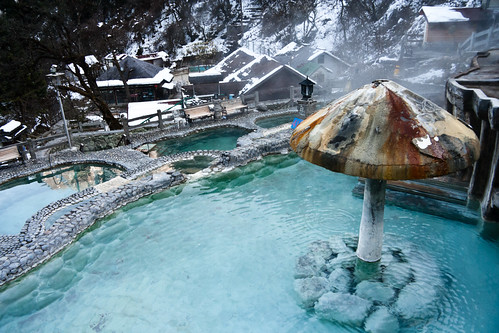
Hailuoguo even makes it to the top 10 hot spring resorts of China (
source). 

Despite all the claims to it's naturalness the springs themselves are part of a tourism set up such as the Gongga God Hot Spring Hotel. In total there are 3 hot springs in Hailuogou according to the article entitled 'Attractions: Four unique hot springs in China', one of them being Hailuogou.
That said it are so-called camps at hot springs 1 and 2 that attract most visitors.
Sabrina while blatantly copying on her blog copies:
'... most of the visitors favor hot springs in No.2 Campsite because they are rustic, with more natural taste'.
In this article discussing 'green' tourism in Ghanzi prefecture, the park around Hailuoguo is mentioned a number of times for the lack of 'green' planning.
'Several hot-spring resorts inside the park have tacky buildings and decorations totally alien to their setting. "These are truly ugly to me," Hitesh Mehta, a Canadian landscape architect, said in his presentation.
"They are beautiful," he said, pointing to the photos of traditional wood houses seen at Moxi Town just outside the park. "Unfortunately there are not many left."
Facing the criticism, Xiao Feng, director of the administration of the park, explained that these problems were mainly caused by several independent tourism operators inside the park and their bad management. At present, the administration is purchasing their property back to solve these problems.
However, many conference participants expressed doubts as to the local authorities' humble attitudes towards investors from the outside world.
"They spoil investors for sure," Chen Xujun said. "Most of them become indifferent to the local environment and welfare of the local communities."'
Then there is this info:
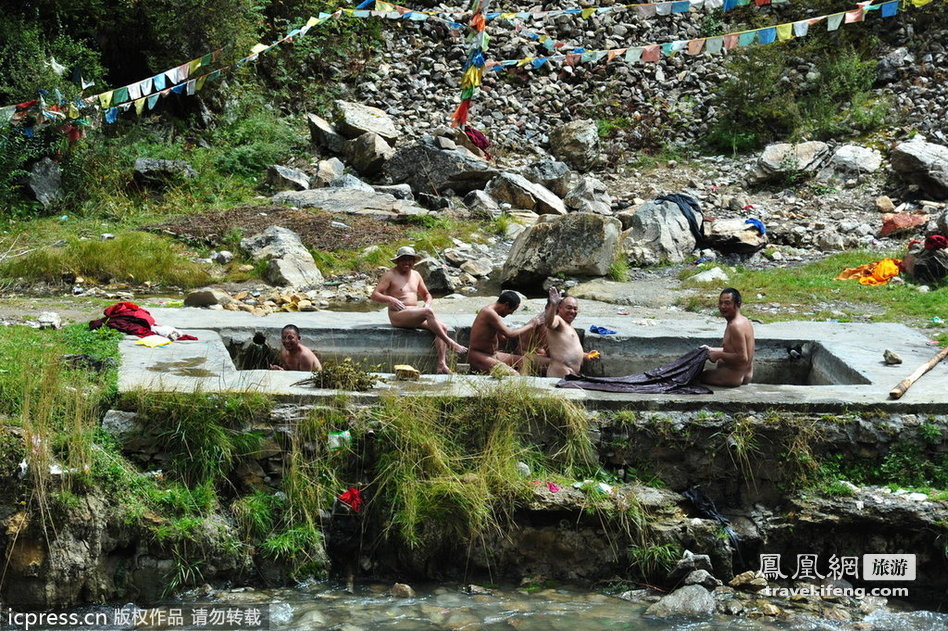
'According some doctors, the boiled water has high medicinal values, such as curing skin disease and arthiritis, and eliminating fatigue'.
I'm feeling a bit fatigued myself ...

Updated June 2014

Sunday, March 28, 2010

Soaking with the Mosuo

The Mosuo and bathing 
In the opposite direction (northwards from Lijiang) towards Sichuan province lies the lake referred to as Lugu (Luguhu). Here it are the (officially not recognized minority) Mosuo who function as the main drawcard. The backdrop not being sufficient enough, tourists from all over China come to witness the culture where to be woman is king:
'In an effort to promote Lugu Lake as an interesting tourist spot, the Chinese government advertised the area as "the Woman's Kingdom", a fully matriarchal society, and implied that the women are sexually loose, taking male partners often, and at will. Books with promiscuous covers and amateur paintings with naked and scantily clad women are sold in every shop. Locals are forced to wear "traditional costumes" with the threat of ¥20 per day fines for non-compliance'.
While intrigued by this kind of different culture, one might ask why come all the way here to bear witness to this? Surely a book such as that of by Yang Namche Namu and Christine Mathieu (2) is enough to understand the culture, though it also describes the beauty of the countryside.
But no. Answers to this inexplicable reason to visit Lugu Lake and the surrounding Mosuo heartland are more complex.

At the heart of the argument are distinctions about superiority apparently. Matriarchal is backward, patrimonial is modern. That's how Dru C. Gladney (1) sums up the mainstream view in the book 'Dislocating China: Muslims, Minorities and other Subaltern Subjects', while giving examples of the exoticizing and eroticizing of minorities in modern China, which are additional motives for seeking out Mosuo culture. These motives, I have to admit, are not exclusive to China. See portrayal of Nat. Geo. which have no problems with near naked Ni-Vanuatu for instance, but all white-skinned unclothed persons are neatly blurred. See also my own posting on this subject in Soaking in Southeast Asia: Cliffhanger.

Though much is made of the difference between Mosuo and Chinese culture in Namu and Mathieu's book, notable is the mention of Mosuo enjoying hot springs au-naturel and how this is being prevented by the (Chinese?) authorities (2). More on this development in historical context:
'During the Cultural Revolution, local officials thought this practice [bathing naked] was uncivilized and they added walls to separate men and women. Over time, however, the Mosuo began taking down the walls until the point that they hardly existed. When the area was open for tourism in the 90s, the government forcibly separated male and female bathers. Eventually, the area was reopened for communal bathing after the government realized its value to the local Mosuo people'.
Possibly to exemplify the contrast between the culture's, more has been made of the naked soaking than in reality existed; i.e. a supposed superiority of the Mosuo over Han Chinese due to the former's inability to distinguish between the clothed and unclothed human form without erotizication.
That said, the cultural differences still add to the Lugu lake area attractions:
'In addition the Mosuo of all ages engage in naked bathing at the Waru hot spring, seeing the body as simply a part of the normal pattern of things. For many Chinese, such visits permit a view of fascinating customs found in a beautiful part of the country ...'(3)
Or as in this publication:
'In early 1988, I saw a young man from Sichuan anguishing in the courtyard of the local government; his expensive camera with a telephoto zoom lens had been forfeited when, from behind a towering rock, he photograped the naked bathers in a roofless hot spring in northern Yongning' (4).
Mosuo's soaks
After extensive web search, I still have to proceed beyond the one hot spring, which the above mentioned authors (2) situate near Yongning village. It is often referred to as Wenquan, however Wenquan is just Chinese for hot spring. More commonly it is named after the nearby village of Yongning or Waru (3), I'll stick to the latter. Besides positioning the soak 10 km north of Yongning Tourchina adds:
'Now this place is equipped with proper facilities for people wanting to soak and relax in this comfortable hot spring'.
As opposed to before when ...?
This cached reference describes the (perceived?) past:
'So at any time of the night or day, up to hundreds of naked men and women can be seen bathing together. They play together and have fun. Mosuo people have a very relaxed attitude towards the naked human body and they do not regard nudity as a taboo'.

'A group of Mosuo women and tourists bathing in the famous hot springs of Yongning, Yunnan province, China. August 2007'.
By Sara Gouveia.

A current firsthand experience by a long-distance rider:
'Had the place all to myself, and soaked for over an hour. The water felt warm, but not hot, smelled heavily of minerals, and actually fizzed like soda pop. ... After the soak I kept riding to see if there was anything up ahead. There was another hot springs – Lao (old) Hot Springs – a few kilometers up the road. Later someone back at Lige said that was the “better” hot springs because the water was hotter, but it sounded pretty crowded'.
So maybe two hot spring sites? In the Footsteps of Dr. Rock from 2005 adds:
'There is now a "resort" here where pools have been built for tourists. There will probably be other pools built by the time you read this'.
And now for the bad news from 2009:
'Construction of an airport near China's last matriarchal society in the southwestern Yunnan Province has started, authorities said yesterday'.
Innocence ends?

Notes:

(1) Gladney, D.C. (2004) Dislocating China: Muslims, Minorities and other Subattern Subjects. Published by Hirst and Co, London, United Kingdom
(2) Namu, Y.E. & Mathieu, C. (2003)
Leaving Mother Lake: A Girlhood at the Edge of the World. U.S.A.
(3) Arlt, W. G. & X. Honggang
Tourism Development and Cultural Interpretation in Ghanzi, China. In: Ryan C, & G. Humin (Eds.) (2009) Tourism in China: Destination, Cultures and Communities. Routledge, New York, U.S.A.
(4) Shih, C-k (2010) Quest for Harmony: the Moso Traditions of Sexual Union and Family Life. Stanford University Press, Stanford, U.S.A.

Tuesday, March 23, 2010

Shangri La Soaks

Zhongdian
In the northern most section of Yunnan province, lies Diqing Autonomous prefecture, where the dominating minority consists of mostly Tibetans and Lisu. Tourists is important here such that the Chinese town (officially the county of) of Zhongdian (Gyalthan to the Tibetans) has been re-named as Shangri La, the mystical nowhere land, which in itself refers to the incorrect use of Shambala by the author of lost Horizon, James Hilton, which is a state of enlightenment rather than a physical place (1).

Grotty
One of the tourist things to do is hike round Meili mountain, located in Zhongdian county. On the way there is the hot spring of Xidang (Xi Dang, Xidan). In contrast to the trek the hot springs are not so photogenetic:
'The hot springs themselves could be experienced in a series of small, seriously grotty (to borrow a Rough Guide favorite) shacks'.
Funny how this was published on the Not so Lonely Planet site by Andris and Cara!
Dmalling is disappointed:
'The hot springs were sort of like a bathtub -- just a concrete basin with a faucet that tapped into the hot water in the ground. The basins were housed in what looked like a bathroom. Getting your feet wet is really the extent of what you could do here, no swimming in a warm refreshing pool'.
One of the
best blogs ever (presonal view) retraces Dr Joseph Rock's footsteps, amongst others around Meili mountain. I wonder what the Dr himself would have thought of the hot springs? His disciple describes it as follows:
'These few bathing sheds were run by a Sichuanese guy who seemed extremely bored with his post. It was very cold and damp there, so the warm baths were a welcome chance to get the circulation going - at least temporarily'.
Closer to Town
More accessible are two soaking sites not far from Zhongdian itself. The most popular of the two is
Tiansheng Qiao (Rangjung Dosam), roughly 10 km south of Zhongdian. Besides the hot spring, the area is known for it's natural bridge formation. Combining these tourist attractions means the need for development. Usually celebrating the natural soaks of the wider western Himal area Daniel Winkler remarks:
'Big hot pool, steam cave, cooling off in the river, awesome setting. These springs, although developed, are great!'

Photo with no description.
Taken from above the natural bridge, the hot springs (large circular pool) are on the opposite bank.


Floaties
Only 6 km from
Tiansheng Qiao is the hot spring of Xiagei. SeeYunnan.net, the provincial tourism site is one of the few resources on this hot spring:
'It is located beside a river and below a cave. Private rooms are available but it is nicer to swim in the public pool. Shops sell bathing suits if you are in need of one. This is one of the few completely natural, mostly local Tibetan, clothing optional hot spring areas you will come across'.
It's good that this website distinguishes different hot springs. Many web references (such as this one by Rough Guides) refer Xiagei as being Tiansheng Qiao. A Dutch language email by Bart also refers to the separate existence. Roughly translated:
'The Tiansheng Rockbridge is a hole in the mountain where the river runs through. It's great ... together with the other intrigued locals (who have been in the Xiagei hot spring for weeks, even though it's freezing). The women are not that ashamed, they were all in their monokini! The Chinese tourists though preferred to soak in the purpose built swimming pool with their floaties'.
Possibly the two are one? This web site describes a distance of 500 m. It's the details which lead me to think both are the same ...:
'This was a private pool and an entrance fee was charged. There was also a public pool located about 500m away where the locals soak in and also open to visitors who are not too concerned about their modesty or the lack of it (topless Tibetan ladies)'.
Notes:
(1) Arlt, W. G. & X. Honggang Tourism Development and Cultural Interpretation in Ghanzi, China. In: Ryan C, & G. Humin (Eds.) (2009) Tourism in China: Destination, Cultures and Communities. Routledge, New York, U.S.A.