Tuesday, October 18, 2011

As locals do

While discussing hot springs in Kyrgyzstan it's easy to confuse this with political affairs, especially those of the "hot spring" of 2010. Unfortunately the scope of this blog looks at the natural state, hopefully independent of political affiliation. Well, not really, Burma and North Korea are excluded.

Bigger picture
But I still would like to concentrate on hot springs as in geothermality. 


In this blog most of my postings have been highlighting the naturalness of the hot springs or the naturality of the soaking experience itself. 
However in Kyrgyzstan the opposite is also well-known. Soviet times saw grander schemes to develop naturally occurring thermal water into workers paradises, the sanatoriums. Since the collapse of the workers pie-in-the-sky these places have been neglected and in some cases are turning into ruins.

What to think of this (geographic unclear) sanatorium experience?
'I am sitting in the outdoor hot spring pool of the Sanatorium At The End Of The Universe. The tiles are chipped and the water is murky. But, I’ve been assured by my local friend, “don’t worry, the water is changed at least once a week. Anyway, the U.S. military guys came down and did tests. They said the water was fine, but men shouldn’t soak for more than 15 minutes.” What about women, I ask. She shrugs. So I soak a little longer'.
Despite the chipped tiles, this internet reference clearly establishes that the Kyrgyz like soaking. From once what used to be a blog named things the Kyrgyz love:
'Hot Spring Baths – This seems to be a universally healthy thing around the world. What you use it to treat depends on the chemical make-up of each individual spring. The hot springs we went to, Bar Bulak (lit. trans. Fire Spring), had a high sulfur and iron content and according to the sign posted on the wall of the spa it can be used to treat, “Problems of the Skin and the Digestion, Also Useful for Treating Women’s Problems”.
It actually was quite stimulating and our skin was very healthy for the following month. But you have to be careful about which spring you bathe in. Near Kara Kol, one of the more popular springs has Radon in the water'.
Chipping in, a great blog entry by Cult of Hotness has some interesting experiences. Near the Issyk Kul lake:
'My most memorable treatment was HOT MUD. Enter the mud room – tiled from floor to ceiling and slightly dilapidated. Two concrete beds, one elderly shower and a man in Wellington boots holding a hose. My friend was there to translate. A woman was already cocooned on the other bed. As I was the only English speaker for miles around, this also seemed to draw a crowd, so while I stripped, a couple of onlookers gathered. Naked, I lie on a plastic covered ‘bed’ while the man in the boots points what looks like a gas hose at my feet and hot mud spurts out. I forgot about my sunburned feet. I screamed. The mud stopped, the man looked perplexed. I mentally kick myself as now he and the ‘crowd’ think all English speakers are divas. My friend reminds me of my sunburn and admonished me to ‘just bear it’. I do, through gritted teeth. That mud is HOT. I was wrapped cocoon style and left for an eternity before being unwrapped by the man in the boots. I am ordered into the shower, which is tepid as hot water is only available twice a day. I was then hosed from behind by the man in the boots using the hose he used to wash down the beds and the floor. My friend suggested I was receiving special treatment for being ‘foreign’ and ‘a novelty.’ Reading this back to myself, I realize it might sound strange to the reader, but there was truly nothing untoward going on here. Nudity is no big deal in the health spa. The man in boots was really trying to be helpful – and just as well, that mud really sticks to your back!! I have to say, after my round of treatments, my skin felt wonderfully soft and supple. So all in all, a big thumbs up for the hot mud'.
Indeed, according to this document (pdf link) Kyrgyzstan is home to more than 50 thermal springs as well as the environs of the Issyk Kul being a source of
'curative mud'.
So what more specific information is available on the net? 

'sanatorium in kyrgyzstan'
(source: flickr member elisa locci).

For the insane?
Sanatoria are located in
:
  • Jalalabad, also known as Kochkor-Ata:
    'While in Osh I made a daytrip to Jalalabad where they had a thermal hot spring with sanatorium. I say had as most of the buildings where in ruins and the only hot spring water I saw came from a tap where you had to pay for drinking it'.
    'Djalal-Abad is famous for its spas. There is a legend that the water from the Hozret-Ayub-Paigambar spa cured lepers. According to the legend there was a grave, a mosque and the khan's palace near the spa. The Djalal Abad sanatoria, “Kurort”, is based on one of the spas on one of the hills overlooking the town – the waters are salty, but people from a wide area to collect bottles of it. Near the entrance to the Kurort (the health resort) is a cafe with a fine view over the town – the "Ikram-Ajy" Panorama, at a height of 1000 meters , with a complex that consists of a “national crafts hall”, souvenir shop and an entertainment hall –from here you can appreciate how green the city is, as the trees rise above the low-rise building. The spas are also the source for several different brands of mineral water'. (source, link)
  • Ak Suu. There are some photo's of the slowly deteriorating sanatorium as well as other photo's here. Then there is this:
    'For those with too little time to visit Altyn Arashan this is an opportunity to bathe in natural hot springs. The waters are said to have healing properties curing everything from insomnia to rheumatism. Al-Suu's sanatorium 7 km from Karakol is set in a pretty gorge and has numerous relaxing bathhouses. Local people come here at weekends to wallow in the waters, chat and ramble through the gorge. The village of Ak Suu close has plenty of attractive wooden cottages, a Orthodox church and shops where you can stock up on traditional post-bath bread, fish, vodka and beer.It is located on the north slope of Terskey Ala-Too chain in a narrow gorge in Ak-Suu river valley at an altitude of 1950m above sea level in a distance of 16 km from Karakol town. It works all year. The curative spring water wells have been known since the ancient times. A bath and 2 rooms were built in 1896. Since 1957 the sanatorium works as children hospital. The climate of resort is highland. A non-polluted air, ultraviolet rays create appropriate conditions for climate therapy. In the winter the temperature extends to -17C, in the summer the temperature is 20-25C. The general curative factor is mineral water, nitrogen thermal water (till 60C) sulfate-chloride-sodium water with weak mineralization, consists of silicon, acidy fluorine, free sulfur-hydrogen and small quantity of radon.The sanatorium takes in some patients with child cerebal paralysis, consequences og meningitis, myletis, polymyletis, neuritis, cranium-brain traumas, skin ailments supporting-motion system and etc. In the summer time there are 3 pavilions, in the winter -1. The capacity is 250 positions. The term of treatment for mothers with children from 1 to 3 years old is 45 days, children from 4 to 14 years old – 60 days. In the 3 story building there are massage and procedure room sport hall, physiotherapy room, bath department, swimming pool, playing rooms, chambers, kitchen, library, school. The bathes curative exercises mechanic therapy massage and etc. are applied for treatment'.
  • Issyk Ata, also known as Dzuuku or as its translation of warm father (source, link not working)! This combines a sanatorium with the existence of public baths. Immediately the web entries are a lot more positive.
    'Don't know if it is because of the altitude (nearly1800 meters) but I was feeling little strange there in Issyk Ata. This hot spring [another broken link] water spot situated at less than 2 hours from Bishkek was not only smelling the sulfur of its bathes but also something like a soviet perfume. Ok maybe I was sad because not so many chaikhanas up there!'.
    Further experience:
    'It seemed like there was no possibility to get a treatment if you didn’t stay at the SA-NA-TO-RIUM’s own hotel, but just a little bribe later we had both skipped the line and were lying naked on a table covered with black hot mud and wrapped in sheets. Quite a pleasant feeling, as long as you didn’t look up. The moisture in the room had no way of escaping, and a vibrant community of fungi ranging from the familiar green to hairy shades of brown had taken over the ceiling and walls. Left alone by the attendants in my little room, with no escape out of the tightly wrapped sheets and surrounded by a total absence of sound, I got strangely excited'.
    An other visitor says that though what's on offer are somewhat rudimentary facilities, it does have good views. There's a big waterfall nearby.
The pool, photo by Photo from Bishkek. An entry on Issyk Ata.
  • 'Not far up the valley is the Djety Orguz sanatoria built in and the sight of the first meeting between Presidents Akayev and Yelsin in 1991 after the abortive coup in Moscow'. (source)
    This reference also claims that there are more than 50 hot springs in Kyrgyzstan though only lists 4 ...
  • Bar Bulak:
    'Really its not that bad. Its only the iron in the water. The springs are said to be very useful to the health. We can actually see some improvement in the quality of our skin'.
    Possibly this is a reference to the same sanatorium as others under names such as Issyk Kul. The lake of Issyk Kul is quite unique as ice never forms.
    'It is fed by springs including many hot springs and snow melt-off'.
    This according to wikipedia. 
  • There's a mention of Kadji Sai (Kaji Sai) where pipes bring in mineral water from hot springs. But Cat Lady in Kyrgyzstan comes to the rescue:
    'Having had a hot springs experience in Kyrgyzstan five years ago, I essentially knew what to expect: hot water from a mysterious thermal source, piped into a dank, moldering, concrete pit. This did not disappoint. The “hot springs” consisted of a dank pool into which the thermally heated waters flowed from an ancient blue pipe. The pool was lined with cracked, broke, and in some places missing tile. The concrete walls were covered in black mold and bright green algae. About six or so feet above the water, thick, rusted pipes were suspended horizontally across the pool for no explicable reason. The water itself, however, despite being a rather frighteningly dark color, was warm and pleasant. It also was a tad salty, which made us all quite buoyant. We spent at least an hour, if not more, swimming'.
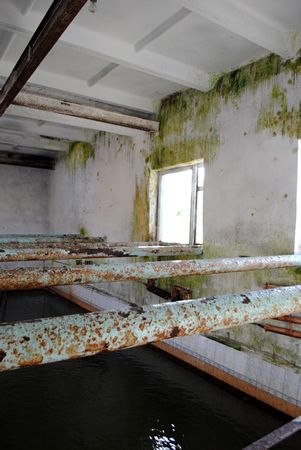
     Cat Lady:
    'The Kaji-Sai hot springs pool'.
  • There's Manjaly-Ata (source, link not working).
  • This link brings one to a photo of Dzhilysu hot spring, Terskey Alatau, Kyrgyzstan, though no other mention.
  • A Russian site link to a hot spring possibly called Chundzha. 
As nature intends
But then there is the soakers paradise of Altyn Arashan, also known as Teplokluenchka, Golden Spa, Ak Suu and/or Karakol. Teplokluenchka is actually Russian for hot springs; since, the village name has been referred to Ak Suu. However in reality there is no village and Ak Suu is used as reference to the sanatorium referred to above.

Altyn Arashan is by far the most photographed (photo of 'heaven') and experiences-shared hot spring in Kyrgyzstan.
'The Altyn Arashan ("Golden Spa") valley leads up from the Ak Suu valley, just South of the village of Teplokluenchka, to a Spartan "hot spring" complex. The road is not an easy one, very steep in places. (source)
More info can be found here. Though experiences elsewhere in Kyrgyzstan seem more attuned to the suited, both the following experience and the photo show that there's more than the eye meets when soaking in Altyn. It's also referred to as old style the kind of style I just might like ...
'Luckily, our worn out and beat selves were welcomed by terrific scenery and a hot spring! It is a sort of old-style natural hot spring with a bathing pool reminiscent of older Japanese spas'.
'We didn't do as the locals did however and run nude from the cabins to the chilly mountain stream about 10 meters away for an icy dip followed by a return to the hot spring. We don't have any pictures of that!'
Photo entitled: 'Natural hot spring bath'. On virtualtourist (by Tipper) with report:
'But healthy people get even healther'.
Nearby is a structure which most say resembles a space pod, others a cave. Hot water is piped in and two persons fit in the pod (source). A photo of such can be seen on the blog Gone to Asia:

Not far away is also a half cave like structure for soaking purposes (see below).


'Hot spring in Altyn Arashan 001'.

By Amyortega05.
[updated October 2013]

Saturday, October 15, 2011

Northern boundary?

The leftovers
With blogs listing details on the hot springs of both Tajikistan and Kyrgyzstan, it's only natural to expect their neighbours, Uzbekistan, Kazakhstan and Turkmenistan, to also be highlighted. Because there aren't that many hot springs this single blog post will cover all three countries.

Soaking in Uzbekistan - no way!
Starting off with Uzbekistan is the most simplest as I have yet to find out whether or not there are hot springs in this country.

Big country, little soaks
To the north of Uzbekistan lies the immense country of Kazakhstan. Here a few hot springs can be found in the mountains bordering Kyrgyzstan and China. However knowing that there are hot springs does not mean that they can be highlighted. Take for instance the hot spring located near Chimkent (Shymkent). Just the one mention:
'hot spring health spas'.
Elsewhere, there is more info on two close to each other located hot springs, Alma Arasan and Zharkent-Arasan.
Alma-Arasan:
'There are 51 groundwater springs, many of which are used for spa therapy purposes. The Alma- Arasan hot spring water is similar in its chemical composition to French mineral waters of the Pyre-nean type (Aix les Bains, etc.)
...
The temperature of major springs constitutes 35-37 degrees centigrade. With regard to water content, temperature and radioactivity the water is similar to Tshaltubo Springs [famous hot spring in Georgia, the country]. The springs have a good influence on people who suffer from rheumatism, metabolic disease, diseases of peripheral system and blood vessels, as well as on the diseases of women and on the people who were poisoned with copper, lead and other metals. Every year Arasan-Kapal Resort accepts around 2000 patients'.
Other info on Alma concern it's establishment in 1886.

On Zharkent which, by the way, was established in 1967:
'The main medicinal factors are: nitric, chloride-sulphate, sodium water (36C) which contains fluorine, organic substances used for bath and shower'.(source)
Kapal (not (?) to be confused with Kapal-Arasan) possesses a mineral spring with a temperature of 25-28C, not quite soakable?

Aktau, lying on the Caspian sea on youtube with this description:
'A small warm bubbling hot spring, a little ways off-the-path from the road between Karagiye Depression (-132 meters below sea level, 3rd lowest spot on Earth) and Aktau city in Mangystau Province, Republic of Kazakhstan'.
Wikitravel mentions the existence of Radon hot springs ("facilities are very primitive") in the Aktau travel guide with nearby mud baths, possibly the same as above?.

An odd experience is revealed by Jennie Vader on a visit to a banya slash hot spring near Turkestan:
'... and I went to a banya in the middle of the steppe about 30 minutes from Turkestan. The banya is a dome-like structure (called the egg) built over a natural, underground hot spring. We all went into this huge egg and then into our own room which consisted of 2 shower heads and an old bathtub. Basically, you seal up your room and the hot water runs constantly, steaming everything up. You shower like usual and sit in the bathtub of really hot water'.

There are also mentions made of the following hot springs in Kazakhstan: Tamshaly, Ayak-Kalkan (hot spring 180 km from Almaty, in the village of Baseit), a so-called Mountain Thermal Water Resort.

A flickr photo reference to a hot spring in their Kazakhstan set. Have my doubts though.

More recently kazworld.info mentions Dobyn:
'Experts say the hot springs at Dobyn village are enriched with minerals and contain small amounts of nitrogen. The waters contain silica and trace elements of radon, providing the thermal springs with unique medical and healing qualities'.
It goes on to mention how the wellness industry in Kazakhstan is shaping up. Twenty three health centres have been established since 2000, with 13 under construction, among them a
Premium Spa Resort (though the website of the company has no info on this possibility). Two-hundred thousand visits were reported in 2011.

Going underground
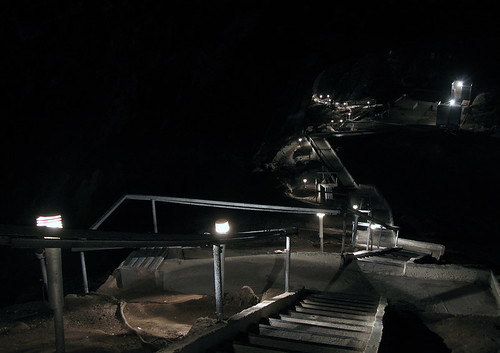
Turkmenistan features an extra ordinary hot spring. Referred to as Kow Ata (Kov Ata, Kovata, Kowata or Bakharden) this a subterranean hot spring. One needs to climb down sets of stairs to get to the thermal waters 60m below ground level.
'The underground lake is formed by a hot spring in a cave 60 m below the ground and stretches over several kilometres. Only the first 70 metres are accessible and sufficiently lit and provide the occasion for a dip in the 36°C water'.
(source).
A great photo can be found on flickr (but not posted). An experience:
'Kowata is an underground hot spring where they took all the trainees swimming a week ago. It is about 45 minutes from the capital and about 5 kilometers from the border with Iran. You descend down about seven flights of slippery steps with wobbly hand rails, wishing you were wearing metal cleats. As you descend the dimly lit corridor, the air grows hotter and more humid, and eventually carries the smell of eggs from the sulfurous waters of the lake. The water is lovely to swim in; about 82 degrees Fahrenheit, it is like being in a bath. The depth of the water wasn’t clear, but nobody’s feet touched the bottom. However, there were many jutting rocks and ledges where you could rest. We spent about two hours swimming before learning that a half-hour was advised, probably for the same reason that excessive time in a hot tub should be avoided. Still, the water is supposed to be medicinal for your skin, and I have not seen any ill effects. When I told my family in Herrick-Gala that I swam, however, they were extremely apologetic because they don’t know how to swim'.
Not always are experiences in such a positive light.
'We drove for a couple of hours out into the middle of nowhere. The engineer led us to a cave and we went inside. Once our eyes adjusted to the dark we saw a large pool of water. There was a single electric lamp on one side of the cave which didn't do much to cut through the gloomy darkness. Bats hung from the ceiling above and the air was thick with steam and the heavy smell of sulphur.
My colleague and I stripped down to our bathing suits and jumped in. The water was bathtub temperature and very murky. I held my breath and let myself sink down as far as I dared but I couldn't touch the bottom.
Strangely the engineer refused to join us but preferred instead to hang out at the cave's entrance and smoke.
The water temperature was pleasant but the sulphurous smell became overbearing after a while and the atmosphere was just plain creepy. My colleague and I climbed out, dried off and put our clothes back on in silence.
We exited the cave and were climbing back into the car when a rickety, rusted-out old bus pulled up and a dozen locals piled out. They were dressed in colorful, ratty garments and were a pretty ragtag bunch.
"Who are they?" I asked our guide.
"Oh them."
And then he told me that this particular hot spring is famous throughout the country. That its warm sulphur waters supposedly have healing properties and that people with otherwise incurable skin diseases were bussed in to bathe here in as a last resort for a cure...
It took weeks before I was convinced that I hadn't contracted leprosy...'.

Kow Ata Underground Lake / Turkmenistan, Bakharden
Photo by flydime:
'The Bakharden Underground lake Kow Ata is an unusual natural site in the biggest cave of the Kopetdag mountains, located about 107 km south-west of Ashgabat. The Turkmen name Kov-Ata means "father of caves". At a first glance, this underground area looks like a magnificent auditorium : the overall length of the cave is 230 m, its height goes up to 20 m, and its width is at some points 57 m (http://www.odyssei.com/travel-tips/4627.html)'.
Wrapping up, in Turkmenistan there is just one mention of another hot spring, Koytendag:
'the, unique hydrogen sulphate hot spring, "Gainar Baba"'.

Friday, June 24, 2011

Soaking with the Mosuo

The Mosuo and bathing
Lijiang is probably one of China's biggest tourist Mecca's but if not for the Ninglang Yi automonous county it would hardly be worth a mention in this blog. However that's not the case.

Located at a distance of no less than 8 hours, Ninglang county, surrounding the Lugu (Luguhu) lake, is a bit isolated and as such has become home to the Mosuo people
(an officially not recognized minority) who might just well be this region's biggest drawcard. The backdrop not being sufficient enough, tourists from all over China come to witness the culture where to be woman is king:
'In an effort to promote Lugu Lake as an interesting tourist spot, the Chinese government advertised the area as "the Woman's Kingdom", a fully matriarchal society, and implied that the women are sexually loose, taking male partners often, and at will. Books with promiscuous covers and amateur paintings with naked and scantily clad women are sold in every shop. Locals are forced to wear "traditional costumes" with the threat of ¥20 per day fines for non-compliance'.
While intrigued by this kind of different culture, one might ask why come all the way here to bear witness to this? Surely a book such as that of by Yang Namche Namu and Christine Mathieu (2) is enough to understand the culture, though it also describes the beauty of the countryside.

But no. Answers to this inexplicable reason to visit Lugu Lake and the surrounding Mosuo heartland are more complex.

At the heart of the argument are distinctions about superiority apparently. Matriarchal is backward, patrimonial is modern. That's how Dru C. Gladney (1) sums up the mainstream view in the book 'Dislocating China: Muslims, Minorities and other Subaltern Subjects', while giving examples of the exoticizing and eroticizing of minorities in modern China (see other entries on Yunnan), which are additional motives for seeking out Mosuo culture.

These motives, I have to admit, are not exclusive to China. See portrayal of Nat. Geo. which have no problems with near naked Ni-Vanuatu for instance, but all white-skinned unclothed persons are neatly blurred. See also my own posting on this subject in Soaking in Southeast Asia: Cliffhanger.


Though much is made of the difference between Mosuo and Chinese culture in Namu and Mathieu's book, notable is the mention of Mosuo enjoying hot springs au-naturel and how this is being prevented by the (Chinese?) authorities (2). More on this development in historical context:
'During the Cultural Revolution, local officials thought this practice [bathing naked] was uncivilized and they added walls to separate men and women. Over time, however, the Mosuo began taking down the walls until the point that they hardly existed. When the area was open for tourism in the 90s, the government forcibly separated male and female bathers. Eventually, the area was reopened for communal bathing after the government realized its value to the local Mosuo people'.
Possibly to exemplify the contrast between the culture's, more has been made of the naked soaking than in reality existed; i.e. a supposed superiority of the Mosuo over Han Chinese due to the former's inability to distinguish between the clothed and unclothed human form without erotizication.

That said, the cultural differences still add to the Lugu lake area attractions:
'In addition the Mosuo of all ages engage in naked bathing at the Waru hot spring, seeing the body as simply a part of the normal pattern of things. For many Chinese, such visits permit a view of fascinating customs found in a beautiful part of the country ...'(3)
Or as in this publication:
'In early 1988, I saw a young man from Sichuan anguishing in the courtyard of the local government; his expensive camera with a telephoto zoom lens had been forfeited when, from behind a towering rock, he photograped the naked bathers in a roofless hot spring in northern Yongning' (4).
Mosuo's soaks
After extensive web search, I still have to proceed beyond the one hot spring, which the above mentioned authors (2) situate near Yongning village. It is often referred to as Wenquan, however Wenquan is just Chinese for hot spring. More commonly it is named after the nearby village of Yongning or Waru (3), I'll stick to the latter. Besides positioning the soak 10 km north of Yongning Tourchina adds:
'Now this place is equipped with proper facilities for people wanting to soak and relax in this comfortable hot spring'.
As opposed to before when ...?


This cached reference describes the (perceived?) past:
'So at any time of the night or day, up to hundreds of naked men and women can be seen bathing together. They play together and have fun. Mosuo people have a very relaxed attitude towards the naked human body and they do not regard nudity as a taboo'.
'A group of Mosuo women and tourists bathing in the famous hot springs of Yongning, Yunnan province, China. August 2007'.

A current firsthand experience by a long-distance rider:
'Had the place all to myself, and soaked for over an hour. The water felt warm, but not hot, smelled heavily of minerals, and actually fizzed like soda pop. ... After the soak I kept riding to see if there was anything up ahead. There was another hot springs – Lao (old) Hot Springs – a few kilometers up the road. Later someone back at Lige said that was the “better” hot springs because the water was hotter, but it sounded pretty crowded'.
So maybe two hot spring sites?

Dane-en-chine has a blog entry in which he describes as much the way there and mentions two hot springs locations near to each other:
'In the hot spring village (Mosuo name is Agua and Chinese name is Wen Chuan) there are 2 bathes. We had a look at both. We don’t like the oldest too much ruined.
The new one where we went has a collective basin share in two parts one for women one for men, just separated by an enormous wooden beam,. It's open air so it is very pleasant.
When we ask to go to the collective bath the owner is surprised and refuses by saying to us "lao bai xin" what wants to say "common people" what in his eyes we are not!
The local people come here to take your bath; they use a lot of soap so the water is too soapy. There are private rooms with bath smaller and cleaner.
We began by the common and finish by the private. No massage just hot bath this water is good for the skin'.
Oddly they include a picture of bathing naked locals with a clothed westerner!

In the Footsteps of Dr. Rock from 2005 adds:
'There is now a "resort" here where pools have been built for tourists. There will probably be other pools built by the time you read this'.
And now for the bad news from 2009:
'Construction of an airport near China's last matriarchal society in the southwestern Yunnan Province has started, authorities said yesterday'.
Innocence ends?

Well, probably one of the very few pictures of men soaking naked in China! Again Yongning hot spring. Look at this link to a photo (sfw) when the soakers still had a view. So decorum meant dividing the pool and put a wall up.

Notes:
(1) Gladney, D.C. (2004) Dislocating China: Muslims, Minorities and other Subattern Subjects. Published by Hirst and Co, London, United Kingdom
(2) Namu, Y.E. & Mathieu, C. (2003) Leaving Mother Lake: A Girlhood at the Edge of the World. U.S.A.
(3) Arlt, W. G. & X. Honggang Tourism Development and Cultural Interpretation in Ghanzi, China. In: Ryan C, & G. Humin (Eds.) (2009) Tourism in China: Destination, Cultures and Communities. Routledge, New York, U.S.A.
(4) Shih, C-k (2010) Quest for Harmony: the Moso Traditions of Sexual Union and Family Life. Stanford University Press, Stanford, U.S.A.