Showing posts with label горячий источник. Show all posts

Saturday, January 26, 2019

Smile

🕉
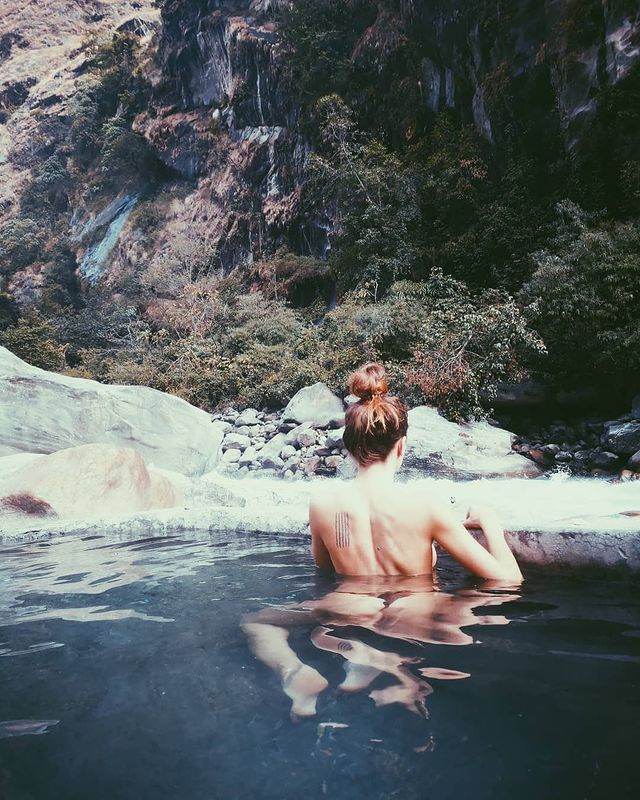
Hot Springs to Freezing River near Lo Manthang.
Hot sun, cold wind, fire and ice, yab yum... this place is everything... with a smile!
#uppermustang #lomanthang #fireandice #rebirth #hotsprings #iceriver
Just a couple of seasonal picca's, mostly from Russia's Kamchatka peninsula. And Nepal (above). And following.


Finally we arrived in Chame 2900m! After long and not easy road we deserve a good relaxation in Hot springs! After 10 minutes we arrived there, one guy lost his conscious because of the very hot water ! He was very lucky that Alex was there and could help him! All other people were totally confused and didn't know what to do! All story is in video!
ellisdelocht
🌼🌼 Some natural hot springs along the way, while walking the Annapurna Circuit. Sense of ultimate freedom and gratitude. 🌼🌼 .
.
.
.
. . .
.
.
.
#nepal #hiking #annapurnacircuit#warmestwaterindays #lifeisgood#luckyluckylucky #inthewoods #travelgram#trekkingnepal #hotsprings #instamood 🌿
Raging
karenk417
Premium shower spot. .
Kheerganga | 181010
.
.
.
.
#kkoinindia#kheerganga#hotsprings#himachalpradesh#architecture#moment#shower#hiking#landscape#scene
Due west of Nepal, it's Kheerganga (Himachal Pradesh, India) while on the northern flanks of the Himalaya and assorted let's enjoy this often featured Kyrgyz soak, located at Altyn Arashan.

A hot spring inside a cave and beside a raging river...what more could you possibly want?
Here 
Изюминка Камчатских походов - это горячие источники. И тем приятнее купание, чем сложнее до них добраться. В центральный кордон Налычевской долины добраться сложно, но можно))) Здесь и насладились мы с @savinsky.life (автор фото) водными процедурами на рассвете в зимний мороз. #kamchatkatoday#kamchatka#камчатка#путешествия#туризм#отдых#travel#tourism
 #горячиеисточники#горячиеключи#термы#hotsprings
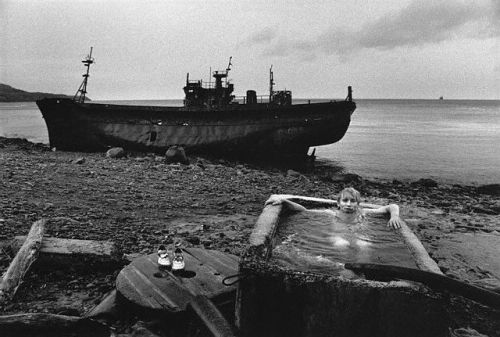
Then rounding this entry off, a couple from Kamchatka, the ultimate soaking in wintery conditions.

Hot springs Kipelye. #hotsprings #snow #Kamchatka #may
 ulyana_41 at Паратунка:
Мм ☺️ повалялись в верхне-паратунских источниках ☺️ кубарем скатились по пухляку со склона 😋 день выдался на ура 😁
#верхнепаратунскиеисточники#источники #зима #циклон #пухляк#отдых


innnay at СНЕЖНАЯ ДОЛИНА Горно-Спортивная База:
И ещё немного о тёплых ваннах в сугробах☺️


Wednesday, February 25, 2015

Expanding

Siberia is definitely a wide expanse of openness, and what with the many hot springs situated in the area around the Baikal lake, one would expect a couple of hundred hot springs to be located in Siberia. At least.
Wrong. After much research there only seem to be a few. Or at least there is so little info available on internet. Or there may be hot springs still waiting to be discovered.

Cold Fame
Superlatives assume Siberia to be very cold. And apparently no place on earth gets colder than Oymyakon. Located 3 days drive from Yakutsk,
'Oymyakon boasts an average winter temperature of -45C, with a one-time world record low of -71.2C
...
Ironically, Oymyakon means “non-freezing water”, situated as it is to a nearby hot spring'. source
Even though this is ironic and might lead one to think that there can be no better way of illustrating the contrast by looking into more 'depth', alas the cold wins from the heat, at least in reporting on internet. Even such absurd news such as
'Nippy cows wear bras in Russia'
get a blog entry.

Possibly dinets.travel.ru refers to Oymyakon (Oimyakon) when focusing on orchids but mentions:
'Some rare and beautiful flowers, normally found only in Southern and Western Siberia, can be seen around hot springs in the uninhabited area between Suntar-Hayata and Verhoyansky Range. In this mountain chain, 3 times as long as Sierra Nevada, there are only two small villages and three mines. Hot springs do not freeze in winter, and I discovered a wintering population of brown dippers (Cinclus pallasi), diving in the water despite the frost'.
Possibly referring to the same, is the mention of Tjoply Kljuch (Tyoply Kljuch), which this Italian blogger refers to as having a 'fonte tiepida' (warm source). LP Thorn Tree also mentions:
'There's a small village called Tjoply Kljuch where there's a hot spring'.
By the way, Tyoply Kljuch is yet again mentioned by Wikipedia as a 'warm spring' on the Sea of Japan coast, north of Vladivostok, south of the Amur, somewhere totally different.

Complicating things even more is this blog entry mentioning that the near by Oymyakon, Tomtor, has a hot spring by wideview.it:
'A stream that never freezes, because of hot springs. The vapour, coming out continuously, freezes instantly over the trees all around, creating very bizzarre shapes'.
Funny
The most western hot springs of Siberia are located near the city of Tyumen. they are also more published and probably seeing a lot more visitors. 

There is a hot spring located just 5 km's from the city, named Verkhniy Bor and it
'... is well developed to accept tourists. Accommodation, meals are readily available. The water is highly mineralized having temperature of 45 degrees Celsius and cures many unhealthy conditions'. source
There are a few soak experiences on internet such as the blogs by englishrussia.com, nashural and this from Sergey Gershtein:
'There are hot natural springs that are said to be funny to visit in winter. It was funny indeed'.
He unfortunately fails to expand why they are funny. 

More photo's can be found on panaramio. 
The hot spring also has it's own website, aptly named vbor.ru.

Tripadvisor refers to this hot spring as Avan (I think) and the Russian reviewers give this hot spring four stars.

Verkhniy Bor, source

Gassy
Further away from Tyumen (27 km) is the hot spring of Sosnoviy Bor (website). Tripadvisor also hands out 4 stars here. 
It can also be referred to as Yalutorovsk.  Virtualtourist once had an extensive entry on the hot spring of what they referred to as Yalutorovsk:
'In some dozen kilometers from Yalutorovsk there is a hot spring. It is just in the forest, so the correct destination I can't say. In any way if you ask residents, they will tell you I suppose. It was funny to sit in the hot water when the snow was everywhere around. If you're in the center of the spring you may light it up because there is gas. It is not dangerous :-)'.
Now why has this link now disappeared?

Finally  some translated information on Tyumen hot springs, making the two hot springs clearer:
'A comfortable hot spring is located 11 kilometers from Tyumen - in the Upper Forest. There is a marble pool in the open air is filled year-round warm water. Pool length of 20 meters, a width of 6 meters and a depth of 1.5 meters is divided into two tracks, the temperature of water in them is different. It is surrounded by pines and ornamental palms, near the falls beautiful artificial waterfall.Near the hot spring are changing rooms and showers. This source is considered to be landscaped, as located near hotels, lodges and cabins for tourists, as well as all the amenities - gazebos, barbecues, and equipped with slides, ski and skate, skating rink, as well as a cafe, billiards, sauna, solarium, Karaoke and much more.Wild hot spring is located 30 kilometers from Tyumen. There are no facilities - it is possible to live in tents or go to the city'.
There is no infrastructure though, so pull up to the pool as close as possible. You’ll have to change clothes in a car and what’s more to run good 30 meters to the water in your bathing suit! That was a challenge with outside temperature -25. What’s more, one of my friends left slippers home and had to run barefoot. Needless to say, he sobered up immediately!
Sosnoviy Bor, source

Watercolours
So I hope I am not confusing everybody. As further west are hot springs near Turinsk by the name of Akvarel. Tripadvisor has also been here and the three reviewers have afforded it just three and a half stars.
Yet again there's a Russian language website through which I learn that the temperature is 35°C, it's 20 km from Turinsk town and renovations took place in 2013. Also this gem of info:
'A little history: In Soviet times, this place was Chekunova Hydropathic-worked doctors took patients. But something went wrong and this looked like a old abandoned building that was restored, rebuilt and opened a new set of watercolors'.
 More info can be had from this English website as well as the following picture:


Photo's from the past show a much more rustic and pleasant looking place. If I am not confused this from nashural concerns the same place?

Southeastwards from Tyumen (100 km) at most probably a town named Zavodoukovsk lies another hot spring, quite rustic. Named Beryozovka, this Russian website has some photo's:


Doesn't look too hot. But apparently hot enough, this hot spring came a a failure of the oil exploration industry. 

Two hundred km's northeast of Tyumen is another possible hot spring, named  Dubrovnaya (?) near the town of Tobolsk (source). It could also be named just Tobolsk ... (source). This is a website with more info.

Elsewhere this Russian website has a list of possible hot springs near Tyumen, unfortunately not all too clear. Probably this is the holy grail for this section. Can someone assist? Because this website mentions 7 hot springs near Tyumen, above are only 5 ...

Wednesday, October 30, 2013

Tying the ribbon round the trees

Wish
To the north of Uzbekistan lies the immense country of Kazakhstan. Here a few hot springs can be found, in the mountains bordering Kyrgyzstan and China. 

However knowing that there are hot springs does not mean that they can be highlighted. 
Take for instance the hot spring located near Chimkent (Shymkent). Just the one mention:
'hot spring health spas'.
That's not much help. Some respite comes from the recent website of edgekz where a page by Alex Lee explains Kazakh hot spring culture. Winter is the season for hot springs. And:
'Springs are sources of healing and spirituality in many cultures, and near Kazakhstan’s hot and cold springs, you can still see ribbons tied to trees, which locals have tied there when they make wishes on the magical waters'.
So there's more.

Comparisons
Alma Arasan is located just south of Alamty. Alma-Arasan:
'There are 51 groundwater springs, many of which are used for spa therapy purposes. The Alma- Arasan hot spring water is similar in its chemical composition to French mineral waters of the Pyre-nean type (Aix les Bains, etc.)
...
The temperature of major springs constitutes 35-37 degrees centigrade. With regard to water content, temperature and radioactivity the water is similar to Tshaltubo Springs [famous hot spring in Georgia, the country]. The springs have a good influence on people who suffer from rheumatism, metabolic disease, diseases of peripheral system and blood vessels, as well as on the diseases of women and on the people who were poisoned with copper, lead and other metals. Every year Arasan-Kapal Resort accepts around 2000 patients'.
I also learned from a now defunct link that Alma was established in 1886. This link also notes the following:
'The resort’s medicinal features include warm springs of lightly mineralized water with silicic acid used for baths'.
Somehow some confusion exists as Alma Arasan can also refer to the public baths in Almaty itself. If you want to know more, take a look at the great entry into the Steppe magazine by Rebecca Beardmore.

On Zharkent Arasan which, by the way, was established in 1967:
'The main medicinal factors are: nitric, chloride-sulphate, sodium water (36C) which contains fluorine, organic substances used for bath and shower'.(source), oh no, another broken link)
Zharkent is located northwest of Almaty, quite a distance away from the former capital. If expecting a nice rural bath do note that Zharkent is another of the over-medicalized baths which seem to treat soaking as a necessary way to treat illness, rather than something which be pleasurable let alone the above mentioned way of a spiritual experience. Here is the link to the bath house / hotel, all in Russian alas. Note that this hot spring has the added benefit of radon ...
Kapal (not (?) to be confused with Kapal-Arasan) possesses (broken link) a mineral spring with a temperature of 25-28C, not quite soakable?

Remojándonos?
Aktau lies on the Caspian sea coast which may possess a salty miracle hot spring as proved on youtube with this description:
'A small warm bubbling hot spring, a little ways off-the-path from the road between Karagiye Depression (-132 meters below sea level, 3rd lowest spot on Earth) and Aktau city in Mangystau Province, Republic of Kazakhstan'.
Wikitravel mentions the existence of Radon hot springs ("facilities are very primitive") in the Aktau travel guide with nearby mud baths, possibly the same as above?

On the Partido y regreso blog there is entry on Aktau hot springs and mud baths. The following picture illustrates the soakability of this hot spring:

Remojándonos [= soaking!] un poco. Está calentito

An avid visitor to the shores of the Caspian takes his wind-cycle to the hot springs and notes that the route along the nuclear power plant is picturesque. Once there: 
'After all of the amazing scenery, I finally got to the hot water spring! Beautiful and well attended spring is extremely hot — 50-60 degrees! It is recommended not to bath more than 15 minutes at a time. Some people take mud bath'.
An odd experience is revealed by Jennie Vader on a visit to a banya slash hot spring near Turkestan:
'... and I went to a banya in the middle of the steppe about 30 minutes from Turkestan. The banya is a dome-like structure (called the egg) built over a natural, underground hot spring. We all went into this huge egg and then into our own room which consisted of 2 shower heads and an old bathtub. Basically, you seal up your room and the hot water runs constantly, steaming everything up. You shower like usual and sit in the bathtub of really hot water'.
Whopping
Then there are the hot springs of Chundzha. Edgekz notes:
'Chundzha is located 243 kilometers east and a four-and-a-half-to five-hour drive from Almaty in the Uighur district of the Almaty region.  The area is home to a whopping 140 mineral springs'. 
It names Mirage, Tumar, Derevushka, Omur Su and Premium spa resorts, all located more or less near Chundzha.
 
'Hot spring pool at Chundzha
The indoor swimming pool at a Soviet resort in Chundzha in the eastern part of the Almaty Region in Kazakhstan'.
The above picture accompanies an article in the Steppe Times by Jonathan Newell. It links to an article which oddly doesn't mention then hot springs themselves.

More recently kazworld.info mentions Dobyn:
'Experts say the hot springs at Dobyn village are enriched with minerals and contain small amounts of nitrogen. The waters contain silica and trace elements of radon, providing the thermal springs with unique medical and healing qualities'.
It goes on to mention how the wellness industry in Kazakhstan is shaping up. Twenty three health centres have been established since 2000, with 13 under construction, among them a Premium Spa Resort (see above). Two-hundred thousand visits were reported in 2011.

There are also mentions made of the following hot springs in Kazakhstan: Tamshaly, Ayak-Kalkan (hot spring 180 km from Almaty, in the village of Baseit), a so-called Mountain Thermal Water Resort.

Edgekz then mentions Rakhmanovsky Klyuchi resort:
'The Rakhmanovsky springs are named for the man who discovered them. Legend has it that Rakhmanov, a local hunter, once wounded a Siberian deer and followed it as it ran into a mountain spring.Rakhmanov discovered that the water was warm and steamy as he continued to track the wounded animal in order to finish it off.But as he approved the stag and aimed for a final shot, he witnessed what he thought was a miracle: The nearly fatally wounded animal lying in the hot mineral waters was suddenly healed, rose up and ran away.Rakhmanov was paralyzed by what he had just seen and couldn’t pull the trigger. Since then, locals have called the healing hot springs after the stunned hunter. To this day, despite their remote location, the Rakhmanovsky springs remain popular and many still believe they offer healing benefits such as reducing pain and improving cardiovascular health. The springs are also thought to help spark regeneration and slow aging.
The major resort in this area is the Rakhmanovsky Klyuchi Resort, which opened in 1964 and can accommodate 80 people'. 
Little other references though.

Finally, a flickr photo reference to a hot spring in their Kazakhstan set. Have my doubts though.

Tuesday, October 18, 2011

As locals do

While discussing hot springs in Kyrgyzstan it's easy to confuse this with political affairs, especially those of the "hot spring" of 2010. Unfortunately the scope of this blog looks at the natural state, hopefully independent of political affiliation. Well, not really, Burma and North Korea are excluded.

Bigger picture
But I still would like to concentrate on hot springs as in geothermality. 


In this blog most of my postings have been highlighting the naturalness of the hot springs or the naturality of the soaking experience itself. 
However in Kyrgyzstan the opposite is also well-known. Soviet times saw grander schemes to develop naturally occurring thermal water into workers paradises, the sanatoriums. Since the collapse of the workers pie-in-the-sky these places have been neglected and in some cases are turning into ruins.

What to think of this (geographic unclear) sanatorium experience?
'I am sitting in the outdoor hot spring pool of the Sanatorium At The End Of The Universe. The tiles are chipped and the water is murky. But, I’ve been assured by my local friend, “don’t worry, the water is changed at least once a week. Anyway, the U.S. military guys came down and did tests. They said the water was fine, but men shouldn’t soak for more than 15 minutes.” What about women, I ask. She shrugs. So I soak a little longer'.
Despite the chipped tiles, this internet reference clearly establishes that the Kyrgyz like soaking. From once what used to be a blog named things the Kyrgyz love:
'Hot Spring Baths – This seems to be a universally healthy thing around the world. What you use it to treat depends on the chemical make-up of each individual spring. The hot springs we went to, Bar Bulak (lit. trans. Fire Spring), had a high sulfur and iron content and according to the sign posted on the wall of the spa it can be used to treat, “Problems of the Skin and the Digestion, Also Useful for Treating Women’s Problems”.
It actually was quite stimulating and our skin was very healthy for the following month. But you have to be careful about which spring you bathe in. Near Kara Kol, one of the more popular springs has Radon in the water'.
Chipping in, a great blog entry by Cult of Hotness has some interesting experiences. Near the Issyk Kul lake:
'My most memorable treatment was HOT MUD. Enter the mud room – tiled from floor to ceiling and slightly dilapidated. Two concrete beds, one elderly shower and a man in Wellington boots holding a hose. My friend was there to translate. A woman was already cocooned on the other bed. As I was the only English speaker for miles around, this also seemed to draw a crowd, so while I stripped, a couple of onlookers gathered. Naked, I lie on a plastic covered ‘bed’ while the man in the boots points what looks like a gas hose at my feet and hot mud spurts out. I forgot about my sunburned feet. I screamed. The mud stopped, the man looked perplexed. I mentally kick myself as now he and the ‘crowd’ think all English speakers are divas. My friend reminds me of my sunburn and admonished me to ‘just bear it’. I do, through gritted teeth. That mud is HOT. I was wrapped cocoon style and left for an eternity before being unwrapped by the man in the boots. I am ordered into the shower, which is tepid as hot water is only available twice a day. I was then hosed from behind by the man in the boots using the hose he used to wash down the beds and the floor. My friend suggested I was receiving special treatment for being ‘foreign’ and ‘a novelty.’ Reading this back to myself, I realize it might sound strange to the reader, but there was truly nothing untoward going on here. Nudity is no big deal in the health spa. The man in boots was really trying to be helpful – and just as well, that mud really sticks to your back!! I have to say, after my round of treatments, my skin felt wonderfully soft and supple. So all in all, a big thumbs up for the hot mud'.
Indeed, according to this document (pdf link) Kyrgyzstan is home to more than 50 thermal springs as well as the environs of the Issyk Kul being a source of
'curative mud'.
So what more specific information is available on the net? 

'sanatorium in kyrgyzstan'
(source: flickr member elisa locci).

For the insane?
Sanatoria are located in
:
  • Jalalabad, also known as Kochkor-Ata:
    'While in Osh I made a daytrip to Jalalabad where they had a thermal hot spring with sanatorium. I say had as most of the buildings where in ruins and the only hot spring water I saw came from a tap where you had to pay for drinking it'.
    'Djalal-Abad is famous for its spas. There is a legend that the water from the Hozret-Ayub-Paigambar spa cured lepers. According to the legend there was a grave, a mosque and the khan's palace near the spa. The Djalal Abad sanatoria, “Kurort”, is based on one of the spas on one of the hills overlooking the town – the waters are salty, but people from a wide area to collect bottles of it. Near the entrance to the Kurort (the health resort) is a cafe with a fine view over the town – the "Ikram-Ajy" Panorama, at a height of 1000 meters , with a complex that consists of a “national crafts hall”, souvenir shop and an entertainment hall –from here you can appreciate how green the city is, as the trees rise above the low-rise building. The spas are also the source for several different brands of mineral water'. (source, link)
  • Ak Suu. There are some photo's of the slowly deteriorating sanatorium as well as other photo's here. Then there is this:
    'For those with too little time to visit Altyn Arashan this is an opportunity to bathe in natural hot springs. The waters are said to have healing properties curing everything from insomnia to rheumatism. Al-Suu's sanatorium 7 km from Karakol is set in a pretty gorge and has numerous relaxing bathhouses. Local people come here at weekends to wallow in the waters, chat and ramble through the gorge. The village of Ak Suu close has plenty of attractive wooden cottages, a Orthodox church and shops where you can stock up on traditional post-bath bread, fish, vodka and beer.It is located on the north slope of Terskey Ala-Too chain in a narrow gorge in Ak-Suu river valley at an altitude of 1950m above sea level in a distance of 16 km from Karakol town. It works all year. The curative spring water wells have been known since the ancient times. A bath and 2 rooms were built in 1896. Since 1957 the sanatorium works as children hospital. The climate of resort is highland. A non-polluted air, ultraviolet rays create appropriate conditions for climate therapy. In the winter the temperature extends to -17C, in the summer the temperature is 20-25C. The general curative factor is mineral water, nitrogen thermal water (till 60C) sulfate-chloride-sodium water with weak mineralization, consists of silicon, acidy fluorine, free sulfur-hydrogen and small quantity of radon.The sanatorium takes in some patients with child cerebal paralysis, consequences og meningitis, myletis, polymyletis, neuritis, cranium-brain traumas, skin ailments supporting-motion system and etc. In the summer time there are 3 pavilions, in the winter -1. The capacity is 250 positions. The term of treatment for mothers with children from 1 to 3 years old is 45 days, children from 4 to 14 years old – 60 days. In the 3 story building there are massage and procedure room sport hall, physiotherapy room, bath department, swimming pool, playing rooms, chambers, kitchen, library, school. The bathes curative exercises mechanic therapy massage and etc. are applied for treatment'.
  • Issyk Ata, also known as Dzuuku or as its translation of warm father (source, link not working)! This combines a sanatorium with the existence of public baths. Immediately the web entries are a lot more positive.
    'Don't know if it is because of the altitude (nearly1800 meters) but I was feeling little strange there in Issyk Ata. This hot spring [another broken link] water spot situated at less than 2 hours from Bishkek was not only smelling the sulfur of its bathes but also something like a soviet perfume. Ok maybe I was sad because not so many chaikhanas up there!'.
    Further experience:
    'It seemed like there was no possibility to get a treatment if you didn’t stay at the SA-NA-TO-RIUM’s own hotel, but just a little bribe later we had both skipped the line and were lying naked on a table covered with black hot mud and wrapped in sheets. Quite a pleasant feeling, as long as you didn’t look up. The moisture in the room had no way of escaping, and a vibrant community of fungi ranging from the familiar green to hairy shades of brown had taken over the ceiling and walls. Left alone by the attendants in my little room, with no escape out of the tightly wrapped sheets and surrounded by a total absence of sound, I got strangely excited'.
    An other visitor says that though what's on offer are somewhat rudimentary facilities, it does have good views. There's a big waterfall nearby.
The pool, photo by Photo from Bishkek. An entry on Issyk Ata.
  • 'Not far up the valley is the Djety Orguz sanatoria built in and the sight of the first meeting between Presidents Akayev and Yelsin in 1991 after the abortive coup in Moscow'. (source)
    This reference also claims that there are more than 50 hot springs in Kyrgyzstan though only lists 4 ...
  • Bar Bulak:
    'Really its not that bad. Its only the iron in the water. The springs are said to be very useful to the health. We can actually see some improvement in the quality of our skin'.
    Possibly this is a reference to the same sanatorium as others under names such as Issyk Kul. The lake of Issyk Kul is quite unique as ice never forms.
    'It is fed by springs including many hot springs and snow melt-off'.
    This according to wikipedia
  • There's a mention of Kadji Sai (Kaji Sai) where pipes bring in mineral water from hot springs. But Cat Lady in Kyrgyzstan comes to the rescue:
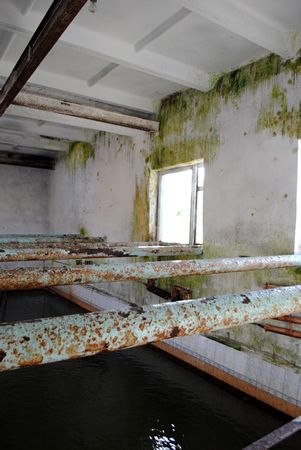
    'Having had a hot springs experience in Kyrgyzstan five years ago, I essentially knew what to expect: hot water from a mysterious thermal source, piped into a dank, moldering, concrete pit. This did not disappoint. The “hot springs” consisted of a dank pool into which the thermally heated waters flowed from an ancient blue pipe. The pool was lined with cracked, broke, and in some places missing tile. The concrete walls were covered in black mold and bright green algae. About six or so feet above the water, thick, rusted pipes were suspended horizontally across the pool for no explicable reason. The water itself, however, despite being a rather frighteningly dark color, was warm and pleasant. It also was a tad salty, which made us all quite buoyant. We spent at least an hour, if not more, swimming'.
     Cat Lady:
    'The Kaji-Sai hot springs pool'.
  • There's Manjaly-Ata (source, link not working).
  • This link brings one to a photo of Dzhilysu hot spring, Terskey Alatau, Kyrgyzstan, though no other mention.
  • A Russian site link to a hot spring possibly called Chundzha. 
As nature intends
But then there is the soakers paradise of Altyn Arashan, also known as Teplokluenchka, Golden Spa, Ak Suu and/or Karakol. Teplokluenchka is actually Russian for hot springs; since, the village name has been referred to Ak Suu. However in reality there is no village and Ak Suu is used as reference to the sanatorium referred to above.

Altyn Arashan is by far the most photographed (photo of 'heaven') and experiences-shared hot spring in Kyrgyzstan.
'The Altyn Arashan ("Golden Spa") valley leads up from the Ak Suu valley, just South of the village of Teplokluenchka, to a Spartan "hot spring" complex. The road is not an easy one, very steep in places. (source)
More info can be found here. Though experiences elsewhere in Kyrgyzstan seem more attuned to the suited, both the following experience and the photo show that there's more than the eye meets when soaking in Altyn. It's also referred to as old style the kind of style I just might like ...
'Luckily, our worn out and beat selves were welcomed by terrific scenery and a hot spring! It is a sort of old-style natural hot spring with a bathing pool reminiscent of older Japanese spas'.
'We didn't do as the locals did however and run nude from the cabins to the chilly mountain stream about 10 meters away for an icy dip followed by a return to the hot spring. We don't have any pictures of that!'
Photo entitled: 'Natural hot spring bath'. On virtualtourist (by Tipper) with report:
'But healthy people get even healther'.
Nearby is a structure which most say resembles a space pod, others a cave. Hot water is piped in and two persons fit in the pod (source). A photo of such can be seen on the blog Gone to Asia:

Not far away is also a half cave like structure for soaking purposes (see below).


'Hot spring in Altyn Arashan 001'.
By Amyortega05.
[updated October 2013]

Saturday, October 15, 2011

Northern boundary?

The leftovers
With blogs listing details on the hot springs of both Tajikistan and Kyrgyzstan, it's only natural to expect their neighbours, Uzbekistan, Kazakhstan and Turkmenistan, to also be highlighted. Because there aren't that many hot springs this single blog post will cover all three countries.

Soaking in Uzbekistan - no way!
Starting off with Uzbekistan is the most simplest as I have yet to find out whether or not there are hot springs in this country.

Big country, little soaks
To the north of Uzbekistan lies the immense country of Kazakhstan. Here a few hot springs can be found in the mountains bordering Kyrgyzstan and China. However knowing that there are hot springs does not mean that they can be highlighted. Take for instance the hot spring located near Chimkent (Shymkent). Just the one mention:
'hot spring health spas'.
Elsewhere, there is more info on two close to each other located hot springs, Alma Arasan and Zharkent-Arasan.
Alma-Arasan:
'There are 51 groundwater springs, many of which are used for spa therapy purposes. The Alma- Arasan hot spring water is similar in its chemical composition to French mineral waters of the Pyre-nean type (Aix les Bains, etc.)
...
The temperature of major springs constitutes 35-37 degrees centigrade. With regard to water content, temperature and radioactivity the water is similar to Tshaltubo Springs [famous hot spring in Georgia, the country]. The springs have a good influence on people who suffer from rheumatism, metabolic disease, diseases of peripheral system and blood vessels, as well as on the diseases of women and on the people who were poisoned with copper, lead and other metals. Every year Arasan-Kapal Resort accepts around 2000 patients'.
Other info on Alma concern it's establishment in 1886.

On Zharkent which, by the way, was established in 1967:
'The main medicinal factors are: nitric, chloride-sulphate, sodium water (36C) which contains fluorine, organic substances used for bath and shower'.(source)
Kapal (not (?) to be confused with Kapal-Arasan) possesses a mineral spring with a temperature of 25-28C, not quite soakable?

Aktau, lying on the Caspian sea on youtube with this description:
'A small warm bubbling hot spring, a little ways off-the-path from the road between Karagiye Depression (-132 meters below sea level, 3rd lowest spot on Earth) and Aktau city in Mangystau Province, Republic of Kazakhstan'.
Wikitravel mentions the existence of Radon hot springs ("facilities are very primitive") in the Aktau travel guide with nearby mud baths, possibly the same as above?.

An odd experience is revealed by Jennie Vader on a visit to a banya slash hot spring near Turkestan:
'... and I went to a banya in the middle of the steppe about 30 minutes from Turkestan. The banya is a dome-like structure (called the egg) built over a natural, underground hot spring. We all went into this huge egg and then into our own room which consisted of 2 shower heads and an old bathtub. Basically, you seal up your room and the hot water runs constantly, steaming everything up. You shower like usual and sit in the bathtub of really hot water'.

There are also mentions made of the following hot springs in Kazakhstan: Tamshaly, Ayak-Kalkan (hot spring 180 km from Almaty, in the village of Baseit), a so-called Mountain Thermal Water Resort.

A flickr photo reference to a hot spring in their Kazakhstan set. Have my doubts though.

More recently kazworld.info mentions Dobyn:
'Experts say the hot springs at Dobyn village are enriched with minerals and contain small amounts of nitrogen. The waters contain silica and trace elements of radon, providing the thermal springs with unique medical and healing qualities'.
It goes on to mention how the wellness industry in Kazakhstan is shaping up. Twenty three health centres have been established since 2000, with 13 under construction, among them a
Premium Spa Resort (though the website of the company has no info on this possibility). Two-hundred thousand visits were reported in 2011.

Going underground
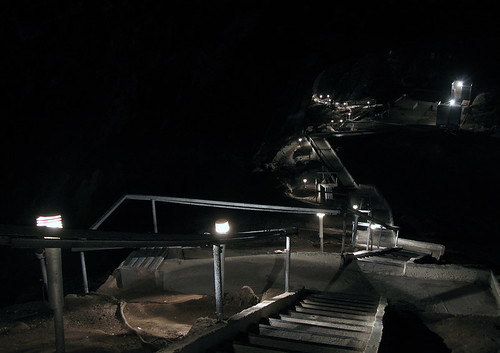
Turkmenistan features an extra ordinary hot spring. Referred to as Kow Ata (Kov Ata, Kovata, Kowata or Bakharden) this a subterranean hot spring. One needs to climb down sets of stairs to get to the thermal waters 60m below ground level.
'The underground lake is formed by a hot spring in a cave 60 m below the ground and stretches over several kilometres. Only the first 70 metres are accessible and sufficiently lit and provide the occasion for a dip in the 36°C water'.
(source).
A great photo can be found on flickr (but not posted). An experience:
'Kowata is an underground hot spring where they took all the trainees swimming a week ago. It is about 45 minutes from the capital and about 5 kilometers from the border with Iran. You descend down about seven flights of slippery steps with wobbly hand rails, wishing you were wearing metal cleats. As you descend the dimly lit corridor, the air grows hotter and more humid, and eventually carries the smell of eggs from the sulfurous waters of the lake. The water is lovely to swim in; about 82 degrees Fahrenheit, it is like being in a bath. The depth of the water wasn’t clear, but nobody’s feet touched the bottom. However, there were many jutting rocks and ledges where you could rest. We spent about two hours swimming before learning that a half-hour was advised, probably for the same reason that excessive time in a hot tub should be avoided. Still, the water is supposed to be medicinal for your skin, and I have not seen any ill effects. When I told my family in Herrick-Gala that I swam, however, they were extremely apologetic because they don’t know how to swim'.
Not always are experiences in such a positive light.
'We drove for a couple of hours out into the middle of nowhere. The engineer led us to a cave and we went inside. Once our eyes adjusted to the dark we saw a large pool of water. There was a single electric lamp on one side of the cave which didn't do much to cut through the gloomy darkness. Bats hung from the ceiling above and the air was thick with steam and the heavy smell of sulphur.
My colleague and I stripped down to our bathing suits and jumped in. The water was bathtub temperature and very murky. I held my breath and let myself sink down as far as I dared but I couldn't touch the bottom.
Strangely the engineer refused to join us but preferred instead to hang out at the cave's entrance and smoke.
The water temperature was pleasant but the sulphurous smell became overbearing after a while and the atmosphere was just plain creepy. My colleague and I climbed out, dried off and put our clothes back on in silence.
We exited the cave and were climbing back into the car when a rickety, rusted-out old bus pulled up and a dozen locals piled out. They were dressed in colorful, ratty garments and were a pretty ragtag bunch.
"Who are they?" I asked our guide.
"Oh them."
And then he told me that this particular hot spring is famous throughout the country. That its warm sulphur waters supposedly have healing properties and that people with otherwise incurable skin diseases were bussed in to bathe here in as a last resort for a cure...
It took weeks before I was convinced that I hadn't contracted leprosy...'.

Kow Ata Underground Lake / Turkmenistan, Bakharden
Photo by flydime:
'The Bakharden Underground lake Kow Ata is an unusual natural site in the biggest cave of the Kopetdag mountains, located about 107 km south-west of Ashgabat. The Turkmen name Kov-Ata means "father of caves". At a first glance, this underground area looks like a magnificent auditorium : the overall length of the cave is 230 m, its height goes up to 20 m, and its width is at some points 57 m (http://www.odyssei.com/travel-tips/4627.html)'.
Wrapping up, in Turkmenistan there is just one mention of another hot spring, Koytendag:
'the, unique hydrogen sulphate hot spring, "Gainar Baba"'.

Wednesday, December 1, 2010

Consuming

'Hot Springs at Iturup Island'. 
By Julie Robinson
Heading south
Following through with the feature on Eastern Russia's soaks, the smaller sections of the puzzle
yet to be pieced together need to be filled in.
 

The Kuril islands are a string of (volcanic) islands which bridge the distance between Kamchatka and Japan's northern Hokkaido island.


Northern Paramushir island, one of the Kuril's biggest islands, is home to hot springs of Verkhneyuryevskiye (source) and there is also the mention of hot springs near Karpinsky volcano and near Ebeko (source). That said there's nothing much than these mentions.

Continuing south, one of the Kuril islands is the uninhabited Ushishir, which according to Wikipedia translates from the Ainu language as hot spring, a nice name for an island.  The island actually consists of two islands connected by a small spit. The southern part is called Yankicha.
Yankicha island features heavily on Kuril island cruises. It's hot spring seems too unique to miss. This site claims:
'Near the lip of the lagoon a srape in the beach fills with thermal waters;no natural hot spring bath can have a more spectacular setting',
a claim they attribute to Micheal Bright [1]. Others add:
'Yankicha is considered by many to be one of the most visually scenic islands in the Kurils. The ancient Ainu people used the thermal area of Yankicha for initiation rites that lasted three days and three nights, in which young men in ceremonial furs were bound together by ropes on wooden platforms over the boiling springs'. 
Photo of the Yankicha soak. Without the furs...
'Maxim, an officer from our navigation team, tries the impromptu hot spring feed bath'.

Others seem more inventive:
'With characteristic Russian make-do-with-what-we-have-ness we managed to construct a makeshift pool with one of our tents! Who’d have thought we’d be getting all touristy-resorty in this desolate place? Was nice to have a warm dip, as if to make up for the earlier cold shower. Karma :)'.
See also the Global Volcanism Programme's entry on Ushishir.

Closeby Rasshua island has 'numerous' hot springs.


Urup island is attributed to have hot springs on the flanks of the volcano Tri Sestry (source). As below:


hitokappu.bg:
'Hot spring. Uninhabited [but ....] Urup, Kuril Island Горячий источник. Необитаемый остров Уруп, Курильские острова'.

The South Kurils
Iturup (sometimes spelt as Etorofu) is the northern most island of the southern Kurils. A no name hot spring is situated 'above' the town of Kuril'sk (source). Or Kurilsk.
On flickr are photo's of the Iwo River (?) hot spring (resort) by ataq411, while FoxySakh has a set of photo's of the island, including a more updated version of the photo below.

A 1992 photo by Shepard Sherbell taken on Iturup with the following caption:
'Man in Hot Spring in the Kuril Islands'.

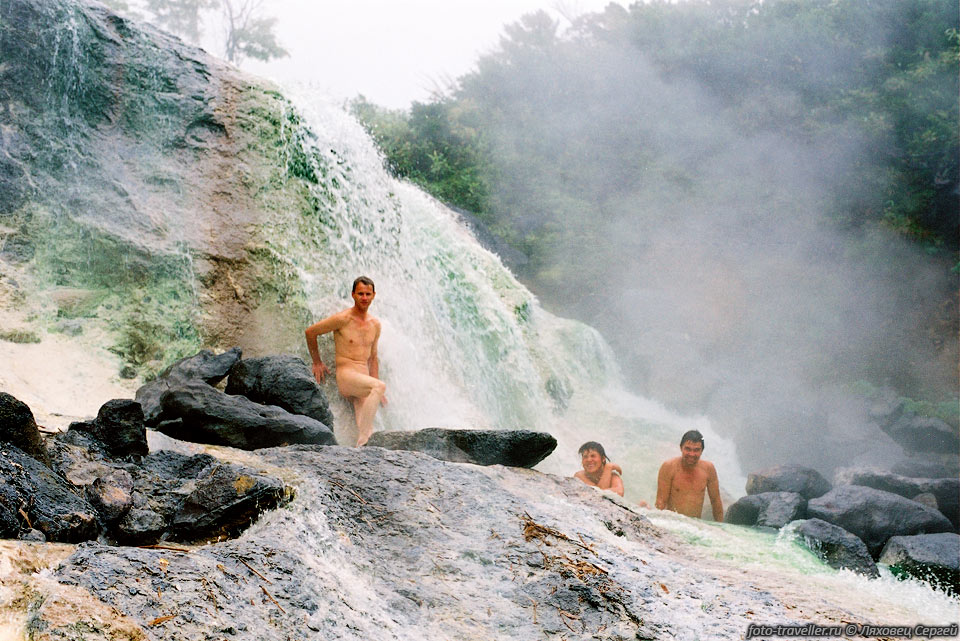
Note also the idyllic hot waterfall in the lead photo to this blog. More photo's can be found here. Looks like a fantastic place to soak.


Interesting
South of Iturup and closest to Japan is the island of Kunashir. Wikipedia:
'Kunashir is formed by four volcanoes which were separate islands but have since joined together by low-lying areas with lakes and hot springs'.
Aaltjeaworldwiseexplorer added on a now defunct blog that
'... some of them natural, others contained in regular pools and a beach filled with hot black rocks, called “Black Beach” which is owned by the military'.
Apparently this references to a ruin of a hot spring, which still affords soaking. Others mention hot beach. Below gives an impression, but not very beach like:

From the original Russian, googles translates this:
'Well, locals, of course, use this feature preaktivneyshe: firstly, almost half of the South Kuril heated by geothermal station, and secondly, wherever possible air baths, swimming baths and Kupalenka. For example - that this is the source of "Sink" on Hot Beach. Charming place with three swimming pools with water 30, 40 and 50 degrees'.
There is this photo of surely a beach hot spring, but don't know whether or not it's at the same location. But on Kunashir.

From damn interesting some biological significance:
'In a hot spring on the Russian volcanic island of Kunashir, there lives a particular type of microbe which consumes poisonous carbon monoxide as nourishment, and exhales hydrogen. The microbe is called C. hydrogenoformans, and researchers at the The Institute for Genomic Research recently finished analyzing its complete genome sequence.
One day, the carbon monoxide waste from other industries may be used to feed vats of these microbes, and the resulting hydrogen could be collected and used to power the fuel cells of tomorrow'.
Дикие природные ванночки на руч. Кислый, берущий начало на фумарольном поле вулкана МенделеевоemojiemojiemojiВода в ручье теплая и на вкус действительно очень кислая #nature#russia#Fumarole#Volcano#kuril#kunashir#природа#курилы
#кунашир#Tourism#туризм 
Across the sea
Finally we cross over the Sea of Okhotsk at it's narrowest to the large island of Sakhalin

The wikitravel entry on Nogliki mentions Goryachie Kluchi:
'Goryachie Kluchi (Горячие Ключи) is a volcanic mountain mountain area, and a village, on a tough dirt road north of town, it has a hot spring to boot.'
This Russian language website has a couple of  photo's of the hot spring and some descriptions which when translated reveals that it's 200 km, 3 hours from the town of Okha. It's a very basic shed on a deeper pond. Surrounding is a swamp with some healing mud.

Or there is this reference:
'Hot springs are waiting for tourists not only in the Kuriles, but also in the north Noglinskom area of Sakhalin'.
 
A 15m high hot waterfall on Sakhalin (or near the Baranski volcano. Oh, ... that's on Iturup!), from a Russsian photo website:
'Горячий водопад высотой 15 метров на 3-й серной речке'.

And that seems to wrap up this blog entry. 

[Updated April 2015]

Notes:
[1] Bright, M. (2005) 1,001 Natural Wonders You Must See Before You Die. Barron's Educational Series, New York, U.S.A.