Showing posts with label therme. Show all posts

Saturday, January 18, 2014

The sacred

Pursuit of tsachu's
The reclusive Kingdom of Bhutan is well-known for it's pursuit of happiness, would this include taking time out for soaking in hot springs?

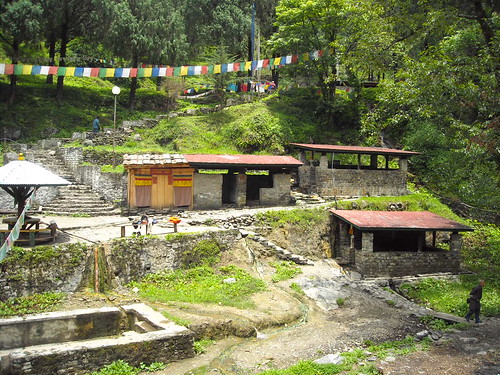
An unknown location of a hot spring, visited by a Japanese blogger who after translation refers this as Do-unman hot spring. But it does seem that the locals have a liking of their soaks ...
Kencho Wangdi in a thoroughly informative article in the Kuensel stated the following:
'Japanese love it [soaking in hot springs], if not for its medicinal value, for its warmth and therapeutic comfort. Visitors believe the thermal springs are great for relieving stress and tension too.
Traditional medicine doctors (Dungtshos) in Thimphu [Bhutan's capital], though, say that it is not good for people with high blood pressure, eye and dizziness disease, and with heart ailments.
Gasa tshachhu’s [tsachu or tshacchu are Bhutanese for hot spring] historical records are sketchy at best as it is for numerous other tshachhus in the country. Dungtsho Yeshey Dorji of the institute of traditional medicine services says that the country’s ancient traditional medicine doctors discovered the medicinal values of the tshachhus and spread the discovery. Because of their curative powers tshachhus were held sacred by the Bhutanese, many believing them to have been touched by divine hands. It is said that Bhutanese warriors wounded in battles sought tshachhus to soak in and applied the warm mud as salve for wounds. Sometimes they traveled for weeks to bathe their wounds in the water. Traditional medicine doctors have long since been prescribing the healing waters for their patients.
Observers also speculate if with modernisation tshachhus would retain their magic for long. In the west hot springs lost out to modern medications which held out the promise for rapid cures of many chronic diseases, which seemed more attractive than several weeks of bathing and other water-related treatments. Physicians were also not all convinced of their medicinal value mainly because no scientific proof existed.
But for elderly Bhutanese like Ap Lhap Tshering, 81, from Lhuentse, a regular visitor to Gasa tshachhu, the magic will never wane. "It's nature's way of healing people."
The looks like a comprehensive answer. Bhutanese must love soaking.
In the article entitled 'The Healing Springs of Bhutan'
ugina adds:
'During the winter months, many people walk to these hot spring spots or "Tsachus" as they are called. People believe that soaking in this water will cure illnesses, such as stomach ailments, headache, skin problems and the list goes on and on'.
The only scientific research I could find on Bhutan's hot springs (P. Wanchuk & Dorji, Y., 2007) includes:
'Tshachu literally means “hot water” and could include the man-made boiled water that is created in artificial conditions. However, as defined in the gSo-ba Rig-pa tradition, tshachu in this context means only that water originating from a “natural source and emanating from natural phenomena which have associated hot properties”. Given its origin, the water contains a combination of coal (rdo-sol), sulphur (mu-zi) and imestone (rdo-sho). Because of the presence of these minerals most of the tshachu have medicinal value. Spiritually, it is believed that tshachu owe their origin to the good wishes and blessings of Buddhas and Boddhisattavas. Hence, almost all tshachu are also held to be gNyes (sacred sites)'.
Which is a lot more than modern day wellness centers can give... It includes information that Bhutan plays host to 10 hot springs, though I'll be able to get references to 9 ....

The significance of hot springs and their opportunity to attract tourists has made the government to present a December 2010 overview on their tourism web site. In all they mention 5 hot springs, this blog posting will do better ...

Lhaden in the hot springs, Gasa by John Wehrheim.
But when talking about the Bhutanese love of hot water one must also mention the existence of the typical Bhutanese custom of hot stone baths. Spring water is diverted into wooden tubs to which are added stones which have been heated over a fire often for hours on end. The result: bliss!

Read more about hot stone baths in this posting.

So where are the soak sites?
Dur
tsachu (Bhumthang) is the highlight of 10-day trek traversing the Bhutanese portions of the Himalaya without it being too strenuous. The trek is actually named after the hot spring.
Despite this though there is little info on the hot springs themselves ..., that is with the exception of Wikitravel:

'A one day trek from road head. The trek is arduous, but stunningly beautiful. Blue sheep, musk deer and Himalayan bear are common in the Duer Hot Spring area'.
A short story on the keeper of Dur hotspring (my ambition) by crankygerman:
'... he will show you with a wry smile how to disrobe and make proper use of them'.
Another hot spring (known as Gasa Tsachu) is likewise known as it is en-route on the more worn out trekking trails of Bhutan. It is (or was) actually the main destination of a 11-day trek.

On yanatravel.com a first hand account to the old site as reported by Phintsho Dorji:
'The hot springs have five ponds. Each is fed from the different springs and each treats a different ailment. Though there are bathrooms and shower rooms and a notice instructing the visitors, ‘Do not enter the pond before taking shower from this bath house’, people enter the ponds without taking bath and that too with their dirty clothes on'.
In 2009 however, it saw a washout occur when a nearby stream managed to undercut the bathing facilities as reported by Kuensel (12 July 2009):
'The healing waters of the country’s most famous hot spring now flow under the Mochu river, which has taken a new course after the May 26 flood that completely washed away the five soaking ponds and the VIP bathhouse built around the spring'.
Reports since though have reported that renovations are underway.
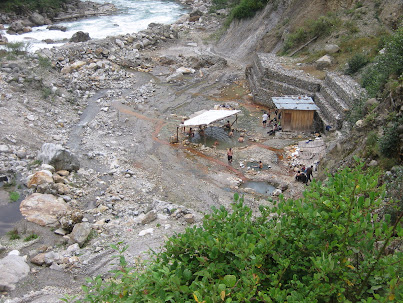
 
'This area used to be green, lush, and developed with many tubs before the flood in 2009. There is now one pool in the hut and an other outside, along with the bathing area to the lower right of the pool'.
Photo by Craig Learned.

An update on Soaking in Southeast Asia refers to a bidding war by Japanese and Italians ..., while in October 2012 the same site mentions that the hot spring is open for business again.
Though there is the reality of the conditions of the Gasa tsachu and development in general as reported by
tripadvisor:

'Gasa Tshachu trek is no more an attraction after the hot spring was washed away by the flood this year. Now there is dirt track just four hours walk from Gasa and two hours from the hot spring site'.
The former refers to the new road which now makes the trek just 2-3 hours away from the roadhead. Bhutan Observer (originally from 29 May 2009, the link now not functioning):
'Passang, 55, a horseman from Zomina, said before the arrival of the road, he used to get Nu 400 for a horse to carry a person and his luggage from the road end at Tashithang to the tshachhu [Gasa hot spring]. But now, he gets only Nu 300 for a horse. He said the coming of the road would directly affect the livelihood of about 100 horsemen'.
The road seems to be on. The Bhutanese reports (24 March 2012) on the road initiative. The locals seem to be intent on the road passing near or through the hot springs area, whereas officials are arguing that they will never get the environmental clearance. In that case the road would by-pass the hot springs by 3-4 km.
Some things never change or do they?
'In the past, visitors relieved themselves in the open and farmers brought domestic animals - pigs, horses and cows to the tshachhu for broken joints and other ailments. Animals are now banned from the tshachhu'.
That positive note from Kencho Wangdi in the Kuensel (14 January 2009).
 
Erik Skydive's picture on Gasa TsaChu as it was.

BBS reports (April 2013) that full development will require another two years:
'The Gasa Dzongdag [local governor] , Sonam Jigme, says works on the guest houses are not complete yet and the dzongkhag will need at least two more years for the entire hot spring site to be completed. there are plans for a medical unit, a lhakhang, and even a parking lot at the site.
The Dzongdag told BBS that confusion over the completion of the site had begun aftersome media reports claimed the hot spring had been completed, encouraging premature visits to the hot spring'.
Prayer
Overall Mr. Wangdi (see above) has a very informative article not only on Gasa but on hot springs in Bhutan in general (see also above fragment in the introduction). He also mentions:
'... Nye [hot spring] in Kurtoe, Chuphu in Punakha and Dunbang in Zhemgang. They are all difficult to reach and entail more than a day’s walk through the rugged terrain'.
The already mentioned Wanchuk & Dorji (2007) have an extensive overview of what they refer to as gNye hot spring noting that it is the most sacred of Bhutan's hot springs. Actually existing out of three distinctive pools, these springs see little soaking folk due to it's remoteness.
'Many of these traditional practices described for the visitors to Kurtoe gNyes tshachu may apply to all the tshachu and their users. First and foremost, on arrival, people pay homage to the Guardian Deity of the tshachu by offering a specific prayer. The Guardian Deity of the gNyes tshachu is called gNod-sbyin-rgod-ma-kha and his homage prayer is as follows:
gNod-sbyin-chen-po-rgod-ma-kha
Ngyur-smrig-gos-gyon-rkang-gling-'bud
Kha-char-bu-yubs-thog-ser-gtong
Yul-bdag-chen-po-khyod-la-bstod'. 
It continues:
'While visiting the Kurtoe gNyes tshachu, people believe that the Guardian Deity gNod-sbyin-rgod-ma-kha disapproves of the following:
1. The presence of clothes of the dead or of those
attending the delivery of babies.
2. Shouting or whistling loudly.
3. Throwing meat or blood in the source of tshachu and
its surrounding areas.
4. Burning meat or animal skin.
5. Defecating or urinating in the tshachu pools.
6. Having sexual intercourse inside the tshachu pools.
7. Bathing in pairs especially couples, and
8. Women and girls bathing when menstruating'.
Not much is known about Dunbang hot spring, though I suspect it refers to Dunmang, see below.

What a waste
Chuphu is much better known as Chubu. Or Chhubu. As stated above, it is located in Punakha, Chubu is often visited.
From recent photo's (by yasu kita) it is evidently a very rustic affair; a small cemented pool with a low corrugated iron roof over it. Already a decenium ago, local government mentioned that
'The Tshachhu, however, lacks proper pond and accommodation facilities'.
Does not look like much has changed since.
Looking further back in time, this
site comes with a plausible reason why the spring is sacred:
'Many great master visited this Landlocked country in different centuries. As well during 8th century, the great Ngingmapa Master Guru Padmasambhava (lotus born) visited Bhutan, subdued the evils and blessed whole corner of the valley where he also introduced Hot spring for the well being of the sentient [= responsive, perceptive] beings. So, with the strong believes, hundreds of people hiked to the particular places where they have hot spring to take bath, especially the victims of different sorts of diseases. And by taking bath in the hot spring, it can heals different kinds of diseases like Tuberculosis, sinus, body-ache etc'.
Sangey Tashey in a very recent blog mentions that due to a new road it's only a 2-3 hour walk.


The above photo comes from this website and contains many a detail about the place as well as daily life during the soaking season. It notes:
'The place is muddy and humid. But it’s seething with heat. It is far-flung and inhospitable. But the place is throbbing with life. Chhubu Tshachhu (hot springs) in Punakha is nature at its most bountiful. Located at 2,930 metres above sea level, Chhubu hot springs are more than two hours’ walk from the road head in Walathang from where visitors hire horses to carry their rations mostly comprising local rice, meat, butter, cheese and eggs. The mountain trail gently snakes through a chir pine forest into the cool, temperate mixed forest.
The hot springs see a chain of people from across Bhutan for more than six months in a year. In the last month of the Bhutanese calendar, the hot springs gushing out of the steep, swampy hillside are inundated with more than 1,000 visitors, says Namgay Wangchuk, 57, the caretaker of the tshachhu. Namgay Wangchuk is popularly known by the title nedag (estate owner) but he says the title is inappropriate because he believes that the ‘real nedag’ or local deities own the tshachhu and not the caretaker.
Namgay says that, during the peak season, more than 100 colourful tents sprout up near the tshachhu transforming the hillside into a vibrant village of strangers. The only guest house cannot accommodate more than 60 people.
...
Chhubu Tshachhu has two ponds separated by a flight of concrete steps. Measuring 43.50 degree Celsius, the first pond is found to cure skin and stomach diseases, tuberculosis and some minor ailments. The second pond, which is 145 average man’s steps below by the bank of the tumbling Tshachhu Phu stream, measures 45.60 degree Celsius.
...
Regular tshachhu visitors say the place surrounding the tshachhu has improved in sanitation but it has become dirtier with waste. Dorji Wangchuk, 56, from Chapcha had been to the tshachhu when he was 15. “At that time, one could hardly find a clean space to walk around,” he recollects. “Every metre of the ground surrounding the tshachhu was filled with human excreta.” After three makeshift latrines were built in 2009, sanitation has improved, but with the number of people visiting the tshachhu increasing by the year, waste management is a big challenge, says caretaker Namgay Wangchuk.
Plastic wrappers and bottles fly around. For lack of a waste disposal site, waste is regularly burnt sending fumes of intoxicating smoke into the clean mountain air. Namgay Wangchuk says burning of waste angers the deities of the place, khachep Draley Gyep and Gomo, who retaliate by causing rains and windstorms.
The tshachhu doesn’t have clean drinking water. Three outdoor taps became defunct barely a few months after they had been built by a contractor in 2009. The leaking tanks and broken pipes were never repaired.
A decent place to camp is on the top of all tshachhu visitors’ wish list.
Apart from a caretaker, who is paid Nu 100 a month by the government, there is neither an organised waste management strategy nor sanitation drive initiated at the tshachhu. A senior monk says, “The bounty of nature must be enjoyed sustainably.”
Hordes
'Koma Tsachu (Punakha) is a vigorous two hour walk from the small community of Mitesgang. There are three bathing pools covered by simple rooves, and a four roomed building with solar lighting where sleeping bags and mats can be laid (there is no charge for staying in the building). Outside, there is ample room to pitch tents and rock overhangs to camp under (source)'.
Then there is an excellent report on a visit to Koma tsachu by Phuntsok Rabten published in the Bhutan Observer (26 April 2008).
'Nestled alongside the creek in this picturesque jungle were the three pools of the hot springs. Amongst the scattering of tents and makeshift camps were two public toilets, three outdoor running taps and a most decent guest house of five rooms and two attached bathrooms, facilitated with solar electricity and water supply. Here, the music of modern amenities played in rhythm with the wild beat of the jungle drums. Koma Tsachu sees revelers and visitors round the year. Spring-time sees the most influx while the student hordes invade the tsachu during holidays. There were about 30 people when we arrived'.
Complacent
Back in 2006 the Kuensel reported on the bridge to Dunmang tsachu (Zhemgang):
'“A new suspension bridge will be constructed next year,” he said. Meanwhile the travellers through the tsachu zam are advised to be careful while passing through this bridge. People as far as from Thimphu and Haa in the west and from Trashigang and Trash Yangtse in the east visit the Dunmang tsachu from November till march. The tsachu’s three ponds with water temperatures measuring between 42 degrees to 52 degrees, is believed to cure diseases like tuberculosis, and sinusitis besides healing aches and wounds. A village elder from Kheng Gongphu said that the temperature of the water had been decreasing over the years. “We used to boil eggs in the tsachu not long ago,” said Ap Sangay, 90. “In the absence of hospitals in the past, the tsachu was very indispensable for us.” Thousands of people visit the tsachu every year'.
More recent info (April 2013) from this BBS report on Dunmang (sometimes referred to as Dungmang or even Duenmang), though notably mentions the lack of facilities.
Sonam describes Dunmang as marvelous. He aslo had the following discussion:
'As I went for a dip late into the night, as if in trance, I was drawn into a conversation by the meandering Mangdechhu [the nearby river!]. Of the many lessons it taught me, she cautioned me that I was already into the 25th year since I was born and that I do not have any concrete achievements to my credit. She also told me that my life was fleeting, just as her flow downstream.
Upon asking about how I could overcome this crisis, she just told me very bluntly that I would rust if I chose to rest and thereby, she put an end to our conversation quite abruptly.
I am assuming, she meant that I need to conquer complacency and work rather very hard!!!'
Seeing is believing  
Gaining in popularity Gelephu tshachu was once less well-known. Kuensel reported in 2003 that renovations were on the horizon.
'It will be the first major renovation since the hot springs were opened to public in 1962'.
Possibly the renovations were in answer to an earlier that year published report in the Bhutan Today. In the article are mentioned inadequate bathing facilities, a decrepit guesthouse and non-existent toilets.
The
BBS even mentions conjunctivitis outbreak at this hot spring:
'... the outbreak occurred after an old couple infected by conjunctivitis soaked in the Tshachu'.
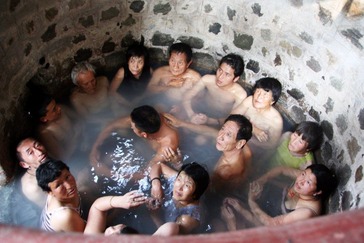
Hot-tubbing Gulephu style ... (source)

However, possibly sine the renovation the hot springs of  Gulephu have seen an upswing in both visitors as well as reports. 
With a characteristic stone lined pool, bathers are now packed as sardines. Reports are made that this is slightly uncomfortable ...
'But in recent times, owing to the lack of separate chambers for men and women, many, who have come to soak in the hot spring, privacy, or the “lack of it”, has become an issue.'
The article continues:
'To ensure this did not lead to depriving genuine users from availing the facility, they would introduce different timings for men and women, who visited the hot spring. Pema Wangdi [Gelephu dungpa = local official] said this would also ease congestion at the site while, at the same time, help to keep the tsachu clean. He said it would prevent dirtying the area, thus avoiding the spread of “skin diseases”, which many visitors complained of, once they visited the bath. The hot spring has five tubs, including the pre-bathing tub. Each can accommodate about 20 to 30 persons at a time'.
Gulephu Hot Spring (Tshachu), Bhutan (source)

Yet, the Kuensel (February 8, 2013) reports that the staggered timings aren't working well. Massive visiting numbers has lead to some soakers not being able to soak, whereas others ended up injured from their soaking experience! See below, photo accompanying article:


Elsewhere
Duethang in Ura, Bumthang is expected to be another better developed hot spring site.

This link goers to a photo with the caption mentioning a hot spring at Woche village.

In all, the above notes 9 distinctive Bhutanese hot springs.

Notes:
P. Wanchuk & Dorji, Y. (2007) Historical Roots, Spiritual Significance and the Health Benefits of mKhempa-lJong gNyes Tshachu (hot spring) in Lhuntshe Journal of Bhutan Studies Vol. 16, Summer 2007, pp 112-128. Thimphu, Bhutan

Thursday, August 29, 2013

Soaking on the steppe

The Mongols and their baths
In the ever expanding list of highlighted countries, being vaguely in the direction of the Himalaya seems to compel this blogs' author to churn out another summation of possible soak sites. In this respect the country referred to as Mongolia is next in line.
So have I determined.

Having a culture which partially stems from the other side of the Himal seems to be a major swaying point to include Mongolia as an entry in this blog, though no doubt images conjured of soakers viewing the rolling steppe limited only by the end of the horizon has a great part to do with aforementioned decision. But will this remain a dream?

Mongolia, we learn, is not a real geothermally active place but nontheless the readable article on harnessing the nation's warmth (Tseesuren, 2001) does list 40 odd hot springs. Though seen mostly from the perspective of possible future power generation it does briefly touch on Mongolian soakers.
'People have used hot springs for bathing and washing clothes since the dawn of civilisation in many parts of the world. In the same way, Mongolia has a considerable experience in health resorts using geothermal water'.
This expression seems to contrast with what seems to be a commonality within Mongolia: the lack of a bathing culture as such. No doubt with the temperature being exceedingly cold most of the year, bathing may not be Mongolians number 1 love. Then again the same temperature must surely make soaking in hot water irresistible to most.


Following is a list of over 40 hot springs which Tseesuren (2001) sums up but to which I've been unable to add any additional info. These little known hot springs are Utaat Minjuur (Domod province (or aimag)), Bol Tal, Chuluut, Tsagaan Sum, Gyalgar, Noyon (all Arkhangai), Tsetsuuh, Zaart, Khojuul, Otgontenger, Ulaan Khaalga (Zavkhan), Euruu (Selenge), Saikhan Khulj (Bulgan), Khamar, Gyatruun, Sharga, Emt (Uvurkhangai), Tsokhiot, Uheg, Örgööt (Bayankhongor), Bulgan (Khovd), Gants mog, Chihert (Bayan Ulgii), Salbart, Urtrag, Tsuvraa and Khunjil (Khuvsgul).

Also note the excellent Bradt Mongolia guide (author Jane Blunden) which has an overview of over 80 hot and cold Mongolian springs (see also appendix).


Zanabazar the zoaker?
While trying to find more on hot springs in Mongolia there's no avoiding Don Croner's
blog on Zanabazar, Mongolia's first Bogd Gegen or religious leader. While living back in the 16th and 17th century, besides relieving spiritual needs, he seems to have been a penchant soaker (see for instance this blogs entry on Qinghai). Happy Mongolia mentions:

'According to tradition, Zanabazar identified up to twenty individual mineral springs here and gave very specific instructions on how they were to be used'.
The same site adds some additional info for the spiritual soaker:
'The best time to use the springs is in the spring or autumn, and and for a full treatment they should be used daily for regimens of twenty-one, twenty-seven, or thirty-one days. Odd-numbered days are considered better. Also, there is one day in each month which is thought to be the most beneficial to use the springs, for example the eighth day of the eighth month, according to the Tibeto-Mongolian lunar calendar'.
I wonder whether more is known about best soaking days. Are they dependent on a lunar calender of sorts?

Zanabazar had a few favourite soaking sites. Don on his travails to retrace Zanabazar steps is often ending at hot springs. The hot spring(s) of Onon (Khentli province) seem a favourite. Don:
'... it was Zanabazar, the First Bogd Gegeen of Mongolia (1635–1723) who reportedly first studied the medicinal properties of the Onon Hot Springs Complex. They are thought to be especially suited for treating lower back problems, which is why Zegvee and I came here. There are nine bathhouses at the Hot Springs, each with water of differing water temperatures. The usual course of treatment is to soak in the cooler hot springs and then proceed to the hotter ones'.
Don does have more info:
'Here are at least fourteen different mineral springs, some of them with boiling-hot water, and several bathhouses. Two of the larger springs, both enclosed by bathhouses, are called Ikh Tsenkher and Baga Tsenkher (“Big Blue” and “Little Blue”), names reportedly given to them by Zanabazar himself, The springs here are famous for treating diseases and afflictions of the lower body: knees (mud packs taken from near the springs are especially good for knee joints), lower back pain, kidney and liver problems, and also rheumatism and sore muscles in general'.
'View of the Hot Springs'
Other info on Onon hot spring:
'The hottest spring of Mongolia is Onon's hot spring with temperature of 70-80°. Its ingredients are chloride, hydro-carbonate, natrium and magnum and it is pellucid liquid that tastes and smells like sulfur-hydroxide.
This spring has been used to cure illnesses such as central and peripheral nerve system diseases, joint diseases, skin diseases, injury and wound.

Setsen khan Sholoi's barn that was built during the 13th century remained till recent time and at that time of khan's only dignitaries used to own the spring and use it in a suitable time of year when it is good for treatment.

Good men who were considered to be heroes of this time used to boil raw frozen meat in this hot spring. At present, people are working to create a comfortable environment at this place and many searches have been made in order to use this hot spring for treatment'.
Another of Zanabazar's haunts was Khujirt (or Khujert, Uvurkhangai aimag).
'Zanabazar was a renowned polymath who applied his energy to the study of a staggering array of subjects. One of his interests was the medicinal properties of hot springs. He is known to have studied the waters of least four hot spring complexes in Mongolia and no doubt he himself took advantage of their curative and restorative powers.
While traveling between the monastery of Baruun KhĂŒree and his workshop at Tövkhon Zanabazar would have had numerous opportunities to stop at the extensive hot springs complex at Khujirt, on the edge of the Orkhon Valley. According to locals it was he who first studied the medicinal properties of these springs. Khujirt, located between what is now the popular tourist attraction of Erdene Zuu and the famous Orkhon Waterfall in the upper Orkhon Valley and easily accessible by road from Ulaan Baatar, is today a major resort with a sanatorium, hotels, and ger camps'.
The above is attributed to the zanabazar.mn site's highlight of Zanabazar's hot spring hide-outs. Don has more on Khujirt.
Otherwise there is this to add on Khujirt hot spring:

'Khujirt is a sanatorium of hot spring (54.5 C) and mud treatment, found in the territory of Khujirt soum of Ovorkhangai Province at 2660 m ASL, 420 km from Ulaanbaatar, 80 km from Arvaikheer and 54 km from Kharkhorin. The hot spring was used by local people starting from many centuries ago. The water has the smell of sulphur, has no color and it is rich in sodium, calcium. Khujirt is one of the first State sanatorium of Mongolia for treatment of nervous, gynecology, kidney, bone, heart and other ailments. The sanatorium has recently opened a special section for foreign tourists. And there is a tourist ger camp not far from the sanatorium. The area is excellent for hiking'. (source: non-functioning)
Finally it was the hot spring of Estiyn (Yestin) which Zanabazar also frequented.
'While overseeing the construction of Saridag Khiyd (see above-below) from 1654 to 1680 Zanabazar would have ample opportunities to visit Estiyn Rashaan (rashaan = mineral springs) twelve miles to the northwest. According to tradition he identified here up to twenty individual mineral springs and determined the medicinal properties of each. Even now some of the springs have small signs in Tibetan indicating what the water is to be used for, including ailments of the heart, teeth, eyes (one for the left eye and one for the right), nerves, nose, ears, innards, lungs, and so on. There are also two log bath houses with bathing pits. Herdsmen from the Tuul and Kherlen valleys still here by horse to take cures and retreats. My horseman when I visited here told me his cousin came here for seven days after a bad fall from a horse and after bathing daily in the bath houses came away cured. Locals also maintain that bathing in the larger of the baths will atone for big sins, while bathing in the smaller one atones for little sin'.
Efficiency
The most well-known hot spring of Mongolia seems to be
Tsenkher. It even has (had?) it's own organisation, Hot Spring Water’s Efficiency Association, though this seems / seemed more dedicated to exploiting greenhouses than encouraging soaking. The sole references date back to 2008.
Besides the organisation there's also mention made of the following:
'Mongolian “Bridge” Group and Japanese “Tsagaan Sogoo” company established the “Tsenkher Jiguur” tourist camp in 1995 pursuing two main goals, the development of tourism based on a hot spa, which is situated in Tsenkher sum of Arkhangai prefecture and the contribution to the local area development ... Please, take off your clothes first, then have a shower and be clean before you bathing in a hot spring! For hygienic purposes it is regulatory to take bath naked in the hot spa.'
That said, there is little proof of nakedness. On internet at least.

Apparently Tsenkher is increasingly commercially exploited. This organisation runs a 'camp':
'“Tsenkher Jiguur” tourist camp is situated in the north of 480 km-s from Ulaanbaatar capital, in the north west of 120 km-s from Khara Khorum tourism destination. The tourist camp is comfortable one, located in the foot of forestry hills with beautiful nature view, neighboring to hot spa. The camp’s capacity is 20 ger rooms, 7 hotel rooms with heating system, which are capable to provide service for 80 persons simultaneously. There Mongolian and European meals are served in Ger restaurant.
The Japanese styled inside and outside hot spa baths are made with original stones and rocks from the nature, so this bath makes people to feel the real natural spa environment and make them to relax and refresh very well. During bathing in outside spa bath travelers can observe glittering stars in the sky in nighttime. There guests have a nice chance to watch national concert with songs and dances, as well as to participate in camp fire works, are able to be provided with service of beauty saloon, massage and sauna.
The springing out of deep earth hot spa contains simple alkaline structure of sodium of sulphuric acid with phtalic and with temperature of 86.5 degrees warmth. Spouting out speed is 10 liters per a second. This spa is very useful for treating any injuries, wound, radicle, fatique and depression, therefore, guests and indigenous people use it with much respect.
In its surrounding area it is absolutely suitable to explore the picturesque nature view, to pick up flowers, to catch butterflies, arrange hiking, horseback trekking tours. Also it is considerably possible for exploring nomads lifestyle, nomadic civilization, riding yaks, catching horse, making horses calm, milking mares and cows, preparing milk products. In wintertime tourists like to have hot spa bath and trek on snow covered hills. Also in spring time tourists can explore Traditional New Year Holiday-White Month and participate in hunting wolves [!]'.
Relax and refresh with dancing with wolves?
Tsenkher hot spring (source).

Not all is so delightful, take this case:
'The "baths" were dirty (and filled with big Mongolian men), the changing rooms were full of flies (see video), ...'.
One (recent) review on tripadvisor which despite the three stars seems less benevolent in description:
'N47°19'8.8" E101°39'16.8" This tourist gercamp has a new modern design hot spring house with separate inside and outside pools for men and women, although apartheid in the outside pools is not enforced. Staff was clearly absent all the time. Towels too. No cleaning was done at all, and the next day the floors were still dirty. Pools were not being kept at the right temperature. Showers and toilets were malfunctioning. All the camp guests use the only showers working, because there aren't any in the ablution block. Without skilled staffing, proper cleaning and adequate maintenance, this new hot spring house will be out of service in a few years'.
Others tend to disagree:
'I’d give Tsenkher hotsprings a 9 out 10'.
'Teel Rashaan (Hot Springs) on the Olziit River. Water is said to be good for digestive problems'. Photo by Don Croner.

On the map
Lesser well known are the following hot springs.
Eustii
(Tuv province):
'Estii rashaan is a hot spring (+34°c) in the valley of the Estii River'.(source)
Khuremt (Uvurkhangai province):
'The Khuremt hot spring has been used since ancient times. Components include bicarbonate and sodium. The maximum temperature of the water reaches 58.8C. There are 10 streams, and the spa water is used for extremities and nervous diseases'. source
Mogoit or Khangain Tsagaan Chuluu (Uvurkhangai province):
'Khangain Tsagaan Chuluu. Is a picturesque white and marble rock on the south east side of the hot spa at Mogoit. It is over 10 meters high taken by someone because of worshipped rock'. (source: link no longer working)
There are also a few photo's on flickr (not interesting enough(?) to repost here). 

Is Mogod the same (Bulgan aimag):
'Elegant Private Stone Bath at the Hot Spring Resort in Mogod, Bulgan Aimag. The facilities, while rustic are very well maintained and the water is fantastic. The only hot spring I've visited in Mongolia that is comparable to a Japanese Onsen. The rooms are simple but comfortable, the gers not quite as nice. Very few foreign tourists, but lots of Mongolian families. The valley setting is lovely. Highly recommended'. Source
Taats (Tsaats?) hot spring has received funding from UNDP's GEF to initiate 'development'. Also located in Uvurkhangai province.

Teel hot spring (see photo above this paragraph) is located in Bayankhongor province.
Shivert (Arkhangai province) seems to be Mongolia's only really developed hot spring. Visit the website of Hasu Shivert resort (devloped doesn't necessarily imply that website is maintained ...) to find the following text:
'Shivert Resort provides state-of-the art wellness center built around natural hot springs. Our staff team is dedicated to answer all your questions and needs during your stay. Newly renovated facility [2009] includes outdoor pools, natural treatment centers, sports facilities, large conference and dining rooms all in the middle of wilderness of Mongolia'.
Despite the development, not much to be found.
Khaluun us (or Tsenkheriin, Zavkhan province):
'...remarkable Hot Spa of Tsenkheriin Khaluun Us , which is now serving as a health spa for tourists, it lies 30 kms south of Tsetserleg town. The water of Tsenkheriin Khaluun Us spring is remarkably hot at +86.5 C and contains hydrogen sulfide'. (source)
P7051502

Photo by smee:
'Mongolia. Hot Spa of Tsenkheriin Khaluun Us - 30 kilometers south of Tsetserleg town. The Shiveet Mankhan tourist camp in the back'.
Bulnai (Khuvsgul province) hot spring resort is described as
'... offering simple cabins around a former Soviet resort'.
A first hand experience:
'I was thinking more of a geyser in the ground - the 'springs' were situated in little wooden huts and were basically just a rectangular hole cut in the wooden floor containing very hot water. The baths came in temperature grades of 38, 43 and 48 degrees centigrade and although you were not permitted to take in soap or shower gel, we spent a good 30 minutes just soaking and trying to expunge the dirt we had accumulated from the previous few days' riding'.
AsiatoEurope2011 in Bulnai (note many springs are hotter):
'Here we are in 28C:'

Bugat hot spring (Bayan Ulgii province) is a hot spring not included in Tseesuren's (2001) list. This web site once added (not working anymore) to the precise coordinates:
'It is a hydro carbonat sulfas natrii hot spring'.
Tsagaan gol (Bayan Ulgii province):
'Locals come to this hot spring to have medical baths and drink the water. There are small wooden houses for hot baths'. source
Commercial property?
The hot spring of Jargalant sum (or Jalga, presumed to be in Khuvsgul province; Jargalan / Khunjil?):
'This hot spring smells and tastes little bit sulfate, transparent, it flows through various stones, like kidney-stones, very thick placed sandy soil. Nearby beautiful high mountains and amazing forest, which has different trees, like pines, ebony, asp, cedar are around the hot spring. Temperature of the hot spring’s water is 45-50C hot'.(source)
More info:
'Jargal Jiguur hot springs, sulphar springs that emerge from the ground (150m) at 70 degrees Celsius. Facilities include outdoor baths (male and female), showers and accommodation'.
It does seem that Jargal Jiguur was the commercial name for Khunjil, the prize winning text of which goes as follows:
'Nestled amid 70 Celsius natural mineral springs, with a knowledgeable, friendly, and professional staff, Jargal Jiguur offers an amazing spa experience. At this premier choice of Jargal Jiguur spas, cascading waters nurture more than skin and body -- they soothe the heart and soul. Visit our recently renovated, Japanese-style spa. Select from a bountiful array of soothing treatments from full body massages to anti-fatigue treatments. Whether you desire a dip in one of our naturally heated mineral spas or a private massage, you ’ll enjoy it in soul-relaxing fashion at our Jargal Jiguur hot springs spa resort'.
Could it be Khunjil?
'Khunjil (mostly known Jargal) is a natural hot spring flows out whole year from the ground at 70 Celsius degree in mountainous North Mongolia. It is located 1580m a.s.l and in 730 km from Ulaanbaatar capital city, over 180 km south-west of Murun town in Khuvsgul province and 5 km south west Jargalant village'.  
The same source adds:
'There is only one tourist camp which is offering for tourists outdoor baths. They transfer the hot water via tubes and built some pools. Curative water and amazing nature featured by wooden mountains make this an excellent place for relax. Night bath is great. Sitting in the pool drinking while seeing stars at the dark sky is one of the favorite activity in here. The open air-baths are recommended'.
Last
Shargaljuut hot spring is a more often visited and more developed hot spring in Bayankhongor aimag. This web site describes Shargaljuut as 'well-known' and 'popular among Mongolians'.


And now we return to the aforementioned vision of soaking in Mongolia. This blogger had a different vision (oh, link not working):
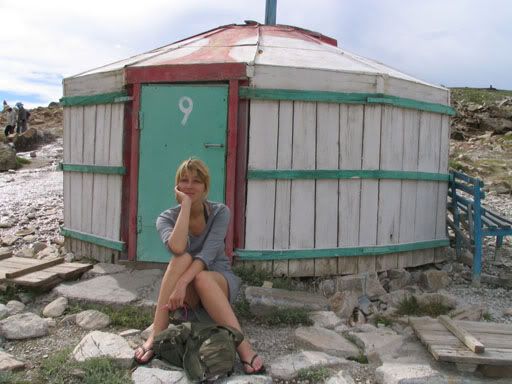
'Upon entering the Shargaljuut springs, it immediately struck us that it was not as developed as we had hoped for. We had dreamt of large pools of water, immaculate service and Russian saunas. None of that. We had to cross some smaller rivers, made it this time, and ended up in a very basic ger camp. The hot springs are symbolic for the Mongol approach. Leaking tubes, old wooden gers, rundown buildings, unclear directions and too many people just hanging about. A hot spring was nothing more than a standard bath in a ger, to be filled with water. However, it must be said the water was fantastic and we felt like new'.
Lazy overachiever has also something to say on Shargaljuut and it is not a thank you to Lonely Planet! But nothing about gers. This website adds a photo which shows both gers as well as a building or two:


The Dutch broadcaster BNN has  a visit to what they attribute as the Tsenkher hot spring, which seems very incorrect as it is quite obviously Shargaljuut. This is the video, the visit starts at 2:20. Floortje Dessing arrives in high spirits but after seeing the docter and the poor state of facilities might have chickened out were she not there to fill her programme ...

 It also has a Facebook site (188 likes)!


'Our private hot spring bath: luxury old school Russian bath tubs hiding inside'.
Shargaljuut, taken in 2005 by Martijnopdemotor.

[Updated August 2013]

Notes:
Tseesuren, B. (2001) Geothermal Resources in Mongolia and Potential Uses. United Nations University. Geothermal Training Programme. Reports 2001, no. 15. ReykjavĂ­k, Iceland

Appendix:
Mongolia's hot springs as according to Blunden (2008). Note that she also lists many other springs which may well be hot. But here are those she does mention specifically:
Övörkhangai aimag: Khujirt, Mogoit, KhĂŒremt, Emt; 
Arkhangai aimag: Shivert; 
Bayankhongor: Shargaljuut, Örgööt, Ükheg; 
Khövsgöl: Bulnai; 
Zavkhan: Otgontenger, Ulaankhaalga, Zart; 
Bulgan: Khulj; 
Selenge: Yestiin Gol, Yöröö; 
Khovd: Nevt, Bulgan; 
Bayan-Ölgii: Gantsmod; 
Khentii: Onongiin Ikh Rashaan; 
Dornod: UtaatminchĂŒĂŒr
 

Tuesday, June 21, 2011

The mundane

Hou Yi's wife
The mountainous province of Yunnan is home to not only a diverse selection of minorities it is also home to many hot springs. In this blog entry I will be focusing on the regions with less hot springs to the South and West of the province's capital, Kunming.

Starting off by going south east, Yuxi prefecture, contains another high number of hot springs.
 
Dayinjie (Hongta district), a 15 minute drive from Yuxi city, is reputed to be the home of many a hot spring. Chris Horton writes:
'The nicest of these is Moon Lake, comprised of a series of 12 pools with different herbs, mineral salts, and liquors to soak away a day'.
Note that there is also accommodation in Dayin(jie) called Moon Lake Hot Spring Hostel (tripadvisor).
'Moon Lake Spa is a traditional Japanese-style hot spring resort, a blend of the most traditional spa culture and the most fashionable casual concept, promote health, recreation and ecological balance, the nature of the clear sky and hot springs leisurely leisure appropriate to bring every visitor, for the love of life and health of people has created an oasis in a bustling city' (source link since original posting in 2011 not working).
Probably the most prosaic description includes this:
'As the saying goes: Chang-e Xiafan only look for home on earth, Hou Yi's wife up on why the palace of heaven - to the Chinese Restaurant Tam!'
? Well, I bet it makes more sense in Chinese (I hope).

Elsewhere in Dayinjie is the hot spring of Yingyuetan (tripadvisor). This should not be confused with the Yingyue hot spring of Chongqing. People's Daily (August 16, 2013) adds:
'The full name of Yingyuetan Hot Spring is Yingyuetan Leisure and Cultural Center. It is located in the Daying Street of Yuxi City. It consists of Yingyuetan Hot Spring, Yingyuetan Water Fitness Center, Gratitude Shopping Street, Yingyue Hot Spring Inn, Sakya Cultural Garden and Yuquan Temple.
While you are in a spring pool, you can hear the sound of fountain, and look at the beautiful moon and shining stars. You will have a wonderful night here'.
And Bailong (hot?) spring (tripadvisor). It's listed under geysers / hot springs, so ...

Anyway this person went to a hot spring near Yuxi (but no name) and mentions:

'Yesterday, most of us decided to visit a local hot spring."Having never been to a hot spring in China, I was excited about relaxing in a mountain pool, getting a massage, and generally spending the afternoon in a stupor.Our "hot spring" was not that sort of place. Instead, we found an odd mix of a public pool and an amusement park. We began the afternoon with "bump bump boats," basically floating bumper cars. These only cost us about $1 USD and fell into the category of awesome, dangerous activities that cannot be found in the US (see my earlier post on the Great Wall slide)'.
Lakeside
The Zaojie (or
Zhaojia) hot springs (Jiangchuan county) see little internet reference though Angsana hotels:
'Zaojie Hot Spring is situated at the foot of Lijia Hill in Jiangchuan County. A unique group of hot springs can be found along the banks of Fuxian Lake and Xingyun Lake, with closely packed spring openings stretching from one point to another in the village. There are springs with double openings and small pools with just a single opening. The strongest flow of water is concentrated at a point with six openings. It is certainly not an exaggeration to say that a spring opening can be found around every corner in the village. The water, which is of a carbonate composition, is clear and refreshing, and ideal for both drinking and bathing. Water temperatures generally range from 20℃ to 30℃. The difference in temperature between the two springs that are furthest apart is as large as 9℃. It is believed that drinking from the pool and bathing in it regularly is an effective way of relieving rheumatism'.
This link continues:
'The Xingyun Lake [also known as Nebula lake] has many hot springs, such as the Luozhipu [or Luosipu] Hot-spring located in Zhaojiawan on the east, and the Haixicun Hot-spring and Shuangjing Hot-spring on the west. From north to south, 5 springs lie in a line. A peculiar thing is that the temperature of these springs is increasing from the north one to the south one, with a total difference of 8 to 9 C. These hot springs are ideal bathing places as well as rest and recuperate resorts along the Xingyun Lake'.
In the same county is also the Fish Spring (tripadvisor) as well as a reference to Shenyu hot spring:
'The village is called Xujiatou Village and it is bestowed with rich hot-spring resources. In the village there is a stone-paved road on both of which houses from late Qing Dynasty are lined. Among the springs scattered in the village there is one called Shenyu Spring'.
This link though explains Shenyu means divine fish and fish live in the spring probably meaning that this is not a hot spring. The link does add:
'In the area, there are also sewage fish and toilet fish, which makes up amazing fish culture'.
In fact yunnanadventure.com adds :
'The water of the Shenyu Spring remains between 28 ℃ to 30 ℃ round the year. Now there are 300 black carps in the spring'.
So a warm spring. No soaking by the way.

Hot and warm
Another purportedly not so hot spring is to be found in Tonghai county, the Warm Water Pond. The same
source also has a reference to the Hot Water Pond of Chengjiang county. Chengjiang also has hot springs in Haikouxiang, the hot water cave of Luchong and the hot water river of Jiucun (source). Though I believe these would be located near the above mentioned Xingyun lake, Mansfield and Walters [1] mention Jiucun village on Fuxian lake as having 'attractive' hot springs.

The aforementioned chinakunming.travel also adds the existence of a hot spring in Meiyun Lao’ao Village (Yimen County).
Wana hot spring is located in Yuanjiang county, apparently development is needed (link not working).

Perrier
Eshan county as far as this blog knows has three hot springs. The lesser known is that of Dalongtan (source). The other lesser known hot spring is Baoquan (source).


More well known is Tianzi (Tianziyuan) hot spring which is a rather large bathing facility with a connected hotel (tripadvisor).
'The spring is rich in geothermal water resources and the temperature is between 39 – 43 ℃ around the year. The water is abundant in calcium, magnesium, zinc, strontium, and oxygen, which is supposed to be good for health and keeping good looks with medical effects' (source).
The eastern most county, Huaning, has the famous hot spring of Xiangbi (or Elephant Trunk Mountain) hot spring which is 8 km from from Huaning county:
'Xiangbi Hot-spring was developed in East Han Dynasty which was about 2,000 years ago. The water temperature remains between 39℃ to 41℃. The water quality is of high level that can be used for bathing as well as drinking. According to a state appraisal, there are 24 microelements in the water that are essential to human body. Three of the elements, namely metasilicate, strontium and lithium, reach the national standard on drinkable natural spring water. The water also has therapy function' (source).
Angsana.com (link now not working) adds quite a bit including this:
'Its beauty has inspired a poem that goes like this: “Great springs of the universe do not be arrogant, as waters in Wenzhao concede to Huaning'.
Ostensibly it compares quality wise to Perrier! The springs have a large indoor pool (source).

Elsewhere in Huaning, is Tobacco hot spring (tripadvisor).

Updated December 2013
 
Notes
[1] Mansfield, S. and M. Walters (2007) China: Yunnan province. Bradt Travel Guides, Bucks, United Kingdom.