Showing posts with label onsen. Show all posts

Sunday, February 16, 2020

Friendship

Gangyap Hot spring Located at 10km from Tashiding. #hotspring #Tatopani #westsikkim
Some interesting finds to share.
Such as above: from the former kingdom of Sikkim. Or below, Dirang from the Indian state of Arunachal Pradesh.


Hotspirngs and warmth of friendship.
Everyone
Located between these two Indian states, is the kingdom of Bhutan, the photo following is of Duengmang:

What a beautiful wonderland 🌱💧..#duenmangtshachu #hotsprings #hiddendestinations #beautifuldestinations #zhemgang #bhutan #traveldiary #travel2020 #travellist #travel #traveldiary #instatravel #travelgram #igtravel #travel #travelphotography #travelphoto #himalayan #musttravel #landscape #trippy #makemytrip #tripver #travelocity getaway #vwtravelshot #yeegetaway
Dopo tanto freddo e tantissimi km fatti.. una doccia calda in mezzo alla natura è la cosa più bella del mondo 🦁Buon anno a tutti🎉🎉🎉😘 #nepal #wild #nature #hotspring #trekking #travel
Over to Nepal, above Jhinu hot spring (and showers), below Chame, as you head up to Manang.


6 hours of trekking in shin-deep snow today to get to Manang. Thinking back to more relaxing times in the hot spring in Chame 😅 @gadventures#explorenepal #nepal #annapurnacircuit #annapurna #chame #optoutside #passionpassport #earthpix #neverstopexploring #exploretheworld #getoutside #igtravel #keepitwild #theoutbound #wanderlust #beautifuldestinations #roamtheplanet #travel # #discoverearth #adventure #trekking #hiking #hotsprings #gadventures
Back to India, but then more to the west.
After Nepal instagrammer Hide_onsen packer hits India's Himal. He starts off with Vashisht hot spring, then Gurudawara, Shiv, Black Shiva and Shittakunda hot springs in Manikaran.
He relates his info more or less as such. On Kasol (Dec. 18, translated):
'Kasoru hot spring in Kasoru ♨️
free
river lies along the field temperature
snow mountain looks spectacular
one tub
spring quality is a free-flowing
sulfur smell pretty to
the hot water acceleration and more than 50 ℃
in Atsuku' soak it is impossible
basically scoop with a bucket
Indians to insanely hot
is over immediately scooped up with a bucket
Sugee
also came two people at 5 o'clock in the early morning
and brighter in large bustle about 10 people
Araitai mosquitoes
dressing room without a
toilet without'

All entries come with good photo's, such as this:

.バシスト温泉① inバシスト♨️Vhasist hot spring無料ヒンドゥー教の寺院内にある温泉Vashishtha Templeでの入浴は神聖で新鮮入浴者の多くは祈りながら入ってた浴槽は1つ 露天風呂泉質は、さらさらとしている硫黄臭がするがツンとはしない湯加減もちょうど良い気温は寒いので45℃程度あるのかな洗体は不可脱衣場なし寺院内で生演奏してたのでBGMもバッチリだが、観光地なので人の出入りはそこそこある#バックパッカー #backpacker #世界一周 #海外旅行 #travel #旅 #trip #旅好きと繋がりたい #traveling #aroundtheworld #tabippo #インド #世界の温泉 #onsen #hotspring #hotsprings #海外の温泉 #温泉 #温泉リゾート #リゾート #リゾート温泉 #温泉バックパッカー #温泉好きな人と繋がりたい #♨️ #露天風呂 #温泉旅行 #温泉好き #天然温泉 #秘湯 #温泉巡り
While rounding off his visit to Himachal Pradesh with Tattapani (translated, Dec. 23):

'Tattapani hot spring in Tattapani ♨️ free here Tattapani is under the influence of the three years before the dam is field temperature that has been put in the river submerged
It was pretty sad now remains, of small over hot water and the hotel spa only bathtub one spring quality is a free-flowing sulfur odor considerably in hot water acceleration and 43 ℃ before and after
scooping a bucket basically'
I believe he mentions that the (natural) hot springs are now submerged.
From the same date, an entry on the above mentioned hotel:
'Tattapani hot spring in Tattapani ♨️ bathing fee 600 yen here Tattapani is under the influence of the three years before the dam is field temperature that has been put in the river submerged remains Currently, only the hot springs of small over hot water and hotel hotels name Sandhya Hot Spring Health Care Tattapani
tub two private bath, co-bath one
spring quality is, there is little slime
sulfur smell is intense
with considerable fine sulfur Izumi
hot spring cure guests also come quite It seems
hot water acceleration is adjustable
Araitai is allowed there dressing room there is toilet'
Regards
So! I finally did it! It feels so good when a 'fear' or an internal obstacle is overcome! 😎 In Japan, I lost the opportunity to enjoy the wonderful hot springs this country offers, this was because you are reqiured to enjoy them completely naked! 😱 I couldn't imagine myself getting into a hot tub lluuuucha!! (naked) with complete strangers and also with not that completely strangers! 😱😱 Even though we are from the same gender... 🙈🙈 So, after this, my 'modesty' became a personal issue to overcome (juuuust for hot springs! 😜). Aaand here I am! These are the Garam Chashma Hot Springs, not only hot, not only naked but also open-air! The bystanders at the back were waiting for tourists to get into the pool! 🧐🧐 Of course, I sent them my regards! 🤪.#tajikistan #travelwoman #freesouls #wanderlust #ewetjourney #thePamirs #passionpassport #letsgosomewhere #traveltheworld #hotsprings #mytinyatlas #theglobewanderer #neverstopexploring #dametraveler #globetrotter #planetdiscovery #roamtheplanet #travelstoke #unlimitedparadise #traveldeeper #exploringtheglobe #tasteintravel #bbctravel #doyoutravel #welivetoexplore #cntraveler #livetravelchannel #travelawesome #viajar #traveladdict
Heading over the water divide, above Tajikistan's Garm Chasma.
Below a rarity on this blog, a soak with no soakers! Kyrgyzstan apparently.

krishofs at Kyzyl-Suu:
👌Hot spring i Kyrgyz••••#kyrgyzstan #denstorekultureisen2019 #uazbuhanka #hotspring #travel #explore #4x4 #offroad #sonya6500 #HofstadNET
I looked up more info on this soak. A very confusing picture. Kyzul Suu is a village:
'Kyzyl-Suu is named for the "Kyzyl-Suu" river that runs through it'.


Visit Karakol adds:
'We offer you a tour to “Juuku” Hot Springs which is located in Chon Kyzyl Suu village 50-60 km west from Karakol. There is also a cave “Kyzyl Unkur” , the remains of Borombai manap’s life, who lived here in the 19th century and the rock "Sim-Sim Open". The hot springs leak in two buildings built in the form of yurt. The Capacity of each pool – 10-15 people. The duration of bathing not more than 30 minutes because of high temperature and radon.
But is the first photo above the size of a yurt? Or does the photo below fit the description better? Also VisitKarakol:


baibol.kg provided me with this info:
The Kyrgyz region is rich in beautiful reservoirs. Among them, mountain rivers and lakes of glacial origin predominate. In addition to them, there are several unique natural thermal springs in the country. They are divided by size, temperature regime and chemical composition of water. But one quality unites them: unconditional benefit for human health. To one of these natural health resorts are the thermal springs of Jyluu-Suu, which are located in the Issyk-Kul region of the country. The deposit of warm springs is located in 55 km from the city of Karakol, at an altitude of 2390 m above sea level. For the convenience of taking baths here was built two swimming pools, separated by a solid wall. They are in a concrete structure, made in the form of a yurt - the national home of nomadic Kyrgyz. Pools are designed for an average of 12 people, the water in them flowing. The temperature of the sources ranges from 32 to 45 degrees Celsius. The deposit refers to chloride-sulphate-sodium, with weakly mineralized water. Staying in Jyluu-Suu helps in the fight against diseases of the musculoskeletal system, skin lesions, various inflammations and diseases of the gastric system. For those who have problems with the respiratory system, it is recommended to visit the saline room located here. The residence time in water is limited at a time, and should not exceed 20 minutes. There are contraindications for people suffering from hypotension, hypertension and heart diseases. A walk through the area will give a lot of new impressions: along the gorge the magnificent Kyzyl-Suu river rolls its majestic waters. Also Kyzyl-Unkur Cave is nearby. The best time to travel to the thermal springs of Jyluu-Suu is the summer-autumn period.
So do we refer to these as Kyzyl-Suu? Or Jyluu-Suu (or alternatively Dzhyly-Suu)?
BBC (Jun. 20, 2013):
'I could have stayed in the Kerege-Tash Valley for a season, but a few days ride and one or two yurt visits later it was time to head south to the long-promised Jyluu-Suu hot springs on an old caravan route that once linked with the Silk Road. The springs are oddly set inside a rustic blue and white hut in the middle of nowhere, looking out onto spectacular valley views. After almost a week in the saddle, the bath came not a moment too soon'.
But Dzhuly-Suu also refers to a place north of the Elbrus (source):
'In the northern part of Mount Elbrus there is a tract of Jil-Su. It is a unique and beautiful place of Kabardino-Balkaria. Gili-Su is translated as «warm water» and is widely known for the healing qualities of mineral water. More than fourteen sources are scattered along the tract in the upper part of the Malki River at an altitude of 2380 meters. Struggling from under the ground hot narzan has unique healing properties, is saturated with mineral and organic substances. And it is translated as «a drink of the hero». He is considered to be the main source of strength for the tribes of the sled that lived in ancient times. The water temperature is quite high, it is plus 22-24 degrees'.
So where are we?

Anyway, elsewhere in Kyrgyzstan, a photo accompanying a Czech report by outdoorito to the hot springs of Altyn-Arashan:


Finishing off with Mongolia:

Tsenkher Hot Spring spa resort. This hot spring is the second hottest spring of Mongolia after Shargaljuut spring. Heat of the water reaches 86 celsius degree. It is an alkaline spring that contains hydrosulfuric acid and silica union and used for medical treatment. Tsenkher Hot Spring is good for treating rheumatism, neuralgia, muscular pain and arthalgia and help improving digestive system, restoring immunity after surgery and recharging yourself. www.classicjourneys-mongolia.com #centralmongolia #hotsprings #Mongolia

Tuesday, November 4, 2014

Update


Just some of the pictures / info I've noticed over the past months concerning just a few of the many, may hot soaks in the Himalaya and further away ...
  • Bhutan 

After the wash out of a few years back this is what the hot springs of Gasa are coming to look like. Sourced from the tumbler of bhutanmajestictravel1:
'The Gasa Tsachu “Hot Spring” very popular for both Nationals and also Tourist to come soak because there are different Bath Tubs for different illness, such as Tuberculosis, Joints, Rashes and so on. Best time is Spring and Winter but my recommendation is late Autumn and late Spring because of lesser visitors. #gasa #hotspring #autumn #spring #winter #tsachu'
Also from Bhutan, this photo from John Berthold as part of a series on the country:

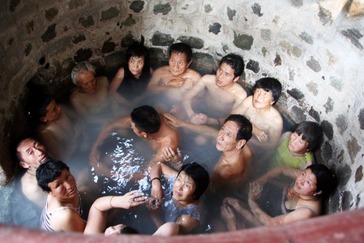
'Bathers enjoy a soak in the Gelephu hot spring in Southern Bhutan next to a small shrine dedicated to Guru Padmasambhava'.
  • China

    Hotspring waterfall spa in Liangshan of Sichuan province, China. #China #waterfall #spa #nature #hotspring #Sichuan #温泉 #凉山 #四川 #backpacking
  • India
Trekking and soaking are heaven sent. Nowhere is this more apparent than in the Himalaya's. Read this trek account from Ujithra Ponniah. An excerpt:
'The trek to Kheerganga begins from Barshani village, which is the last motorable point. It is a 14km uphill trek through the forest.  The forest is alive and buzzing with life and the Parvati River accompanies you through your walk. Having recuperated from our long trek to Kheerganga and enjoyed the dip in the hot spring and rejuvenating sight of the first layer of snow on the surrounding mountains, we trekked further with the hope of reaching Tunda Bhuj, a place adorned with a wide variety of sub-alpine forests'.
What Kheerganga looks like (female side; even so far from reality old habits die hard ...): 

#hotsprings #india #trek 
Kheerganga, Himachal Pradesh, India, source

A hot spring in Madkot, Uttarakhand, India, photo from Picasa accountant Arun Chendukala:

  • Kazakhstan
С добрым утром братва!Вы видите сероводородный источник, который находится в устье р. Горельник.По слухам местных жителей его вода омолаживает и снимает усталость.Температура воды источника около 22°С.#Казахстан #Горы #ГорячийИсточник #Медео #Вхламтур
It says Kazakhstan, so it must be so. But not hot? source

  • Kyrgyzstan
#Горячийисточник #hotsprings #kyrgisztan #socrowded #healthy #salty #hot #swimming #issykkul
source
  • Mongolia 
Tsenkher hot spring, from the blog of ontheroadwithclaire. 
  • Nepal
Hotspring near Nepal - Tibet boarder #nepal #tibet #hotspring #tatopani
source

L'eau doit aussi avoir des vertus quand on la boit car de nombreuses personnes remplissent des bouteilles.
More black and white, this time it is from Chilime Tatopani, Nepal, also near the border with Tibet. More great photo's from Le Voyage de Philmy. 
  • Siberia

Nearly off the Asian continent are the Kuril islands. From this summer are photo's from Eugene Kapersky on flickr:


Iturup hot springs (above) and Urup (below):


Sunday, February 23, 2014

Blind faith in back to nature?

Chongqing 
As well as being provincial capital Chongqing was formerly a part of Sichuan province.

It is said that Chongqing is famous for it's hot springs:
'There are dozens of them located throughout the city. The water temperatures at them are kept at 35-37 degrees Celsius (95-98 degrees Fahrenheit). People have been coming to Chongqing for centuries to visit the local hot springs due to the high mineral content of the waters. It is said that the alkali minerals found in the waters have beneficial medicinal properties, which are said to be effective in curing arthritis, and skin diseases'.
This website mentions that in 2012 Chongqing was awarded the accolade 
‘Global Capital of Hot Springs’,
whatever that means. The award was given by the 65th General Assembly and World Scientific Congress of FEMTEC which I have never heard of. Apparently it might stand of Federation for Hydrotherapy and Climatotherapy

With dozens of them located within the confines of the city we can't expect very natural conditions and that's not the reason I've decided to include these hot springs in this blog. After reading you'll know ...

As well as there being so many located close to the city, the locals also have problems in giving them names and as such we end up with the hot springs of the four wind directions.

Tradition
Info on the North hot spring:
'There are ten springs altogether in the park and the temperature of the water is a constant 35-37 degrees C. The water contains alkali minerals that are considered as having beneficial medicinal properties. The warm water offers an excellent way to relax from the stresses of day to day existence and it also benefits those who suffer from skin problems, arthritis and many other common ailments. Apart from a standard swimming pool there are 75 indoor bathrooms, a newly built triangular indoor swimming pool and a play pool for children'.
Elsewhere we understand that the hot springs here have a tradition of more than 1600 years.

The North hot springs form part of Beibei district. 
Since mid-2013 Banyan Tree have a hot spring resort here:
'Located within the Banyan Tree Spa Chongqing Beibei, there are separate indoor hot spring baths for male and female guests, while the outdoor hot spring pool offers a unique bathing experience'.
There is also another contender in the upmarket area of the northern spring, Brilliant Resort & Spa. Flowery images of the springs are to be found on the website of photographer Micheal Freeman:

 
Elsewhere there is the Haiyu hot spring hotel, tripadvisor giving it four stars.

South & Central
Info on Chongqing's South hot spring.
'The Southern Hot Springs Park has about 110 bathrooms and three swimming pools - outdoor and indoor swimming pools with one for children. The hot springs contain abundant minerals and taking a hot spring bath can rejuvenate body metabolism and cure some diseases, such as those of the skin, arthritis and rheumatism'.


Info on Chongqing Central hot spring is a lot sparser, in fact there's just one mention.

Tongliang is the name given to the western hot spring(s?). The hot springs are
'... located at Xiquan Town, twenty kilometers south of Tongliang county . ... As early as the Yuan Dynasty (1279-1368), the poet Meng Huai wrote a few lines in admiration of the spring'.
Nice pic, but what's the subscript mention?
'@chongqing's XX spring
wiz rachel
by:zong
infact,the water was cold and dirty that day'.
By Ruby's illusion


Back to nature?
Ba'nan
is the name given to
the hot spring otherwise known as the East hot spring.  

Ba'nan district seems hold a different tradition to most hot springs, certainly in China. Since 2008, Ba'nan organizes hot spring festivals, though it's unsure what this actually entails. They must be pretty desperate because that years issue was reported as follows:
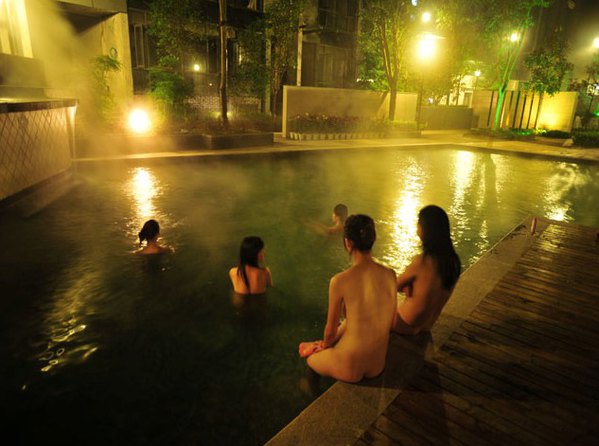
'The 2nd edition of the « Ba'nan Hot Springs Tourism Cultural Festival » near Chongqing has opened on monday. The organizers invited eight pretty models to celebrate the back-to-nature theme by bathing naked...'.
It's unclear whether this was a poor attempt to gain coverage or reflects the reality of soaking here.
However, in the 'Getting Naked: Nudism in China' article, published in 2010, Ba'nan hot spring merits this paragraph:
'... in Sichuan Province, nudism seems to be all the rage. Chongqing Girls Nude Bathing Area sounds more like the title of a dodgy DVD, but it’s actually an area set aside for women in the Ba’nan District’s tranquil East Spring Village. The pool has been in use since the Ming Dynasty, and its water is said to cure blindness. If you fancy a dip, you’ll be pleased to know that it’s open to tourists. Female ones'.
Why only females beats me. Despite this often referred to article, there seems little or none other proof that this practice really exists.

That was until I found this Chinese language website which refers to the Eastern / Ba'nan hot spring and provides photographic proof both of the men and the women's baths:


Stemming from the same period (Nov. 2011), this Chinese language website notes that due to a variety of reasons the hot springs were closed, but locals still took the waters by climbing over the fence. It also suggests more idyllic bathing:


Many more references to al-fresco bathing in Chongqing, f.i. this from the soakingspirit tumblr, which gives an insight into the history of the site, apparently it became famous after curing blindness.

Big plans are underway for this set of springs, though the development report is chaotic.

Elsewhere in Ba'nan district there is the New Orient Hot Spring Hotel which tripadvisor gives a meagre 3 and a half star. And the Sunshine Hot Spring Resort (tripadvisor unrated), while those who favour dong as in Dong Hot Spring Scenic resort may wish to stay there, tripadvisor: 4 stars

Ordinary people
Then there are hot springs in
Tongjing, Yubei district not one of the four wind direction hot springs.
'Tongjing Hot Spring is world famous, hailed as the best hot springs in China'.
Whether this accolade fits the reality or not, plans are under way to re-open these already sprawling facilities in 2014:
'It is expected to become the most beautiful scenic area featuring a hot spring in west China and also the first 5A hot spring tourist attraction in Chongqing.
Unlike some scenic areas, the price is affirmed to be affordable for ordinary people after transformation and will not rise significantly'.
Other hot springs are
The Beidiyiyuan, Jiulongpo District (mention) is often shortened to Beity. Tripadvisor rates this resort as 4,5 stars, though it seems more focus is on the hotel part. Not all is well though?
'hotel is truly 5* nice nice room with special hot spring bath tub included downside to many light switches approx. 14 of them in the room to manage them insane'.
Also located in Jiulongpo district is the  Sun Kingdom Hot Spring Golf Club (source), which is very much a golfing hotel with little or no reference to a hot spring.

Then there is the Tianci Hot Spring resort, more info can be obtained from this website. Tripadvisor give it 4 and a half stars.

Haitangxiaoyue sometimes referred to as Ronghui are said to be Chongqings best urban hot springs. Having 32 pools source Tripadvisor notes 5 stars for this resort complex. Though search for Ronghui and the rating drops!
'This place blows away any spa we’ve been to in the U.S.! It was huge with tons of different types of pools, including wine, green tea, milk, and more. You could easily spend a whole day here, and for two of us it was about $55 U.S.! If we had more time I definitely would have taken advantage of a massage, which was something like 168 rmb ($27 U.S.). Everything was co-ed, so swimsuits were required'.

Saturday, January 18, 2014

The sacred

Pursuit of tsachu's
The reclusive Kingdom of Bhutan is well-known for it's pursuit of happiness, would this include taking time out for soaking in hot springs?

An unknown location of a hot spring, visited by a Japanese blogger who after translation refers this as Do-unman hot spring. But it does seem that the locals have a liking of their soaks ...
Kencho Wangdi in a thoroughly informative article in the Kuensel stated the following:
'Japanese love it [soaking in hot springs], if not for its medicinal value, for its warmth and therapeutic comfort. Visitors believe the thermal springs are great for relieving stress and tension too.
Traditional medicine doctors (Dungtshos) in Thimphu [Bhutan's capital], though, say that it is not good for people with high blood pressure, eye and dizziness disease, and with heart ailments.
Gasa tshachhu’s [tsachu or tshacchu are Bhutanese for hot spring] historical records are sketchy at best as it is for numerous other tshachhus in the country. Dungtsho Yeshey Dorji of the institute of traditional medicine services says that the country’s ancient traditional medicine doctors discovered the medicinal values of the tshachhus and spread the discovery. Because of their curative powers tshachhus were held sacred by the Bhutanese, many believing them to have been touched by divine hands. It is said that Bhutanese warriors wounded in battles sought tshachhus to soak in and applied the warm mud as salve for wounds. Sometimes they traveled for weeks to bathe their wounds in the water. Traditional medicine doctors have long since been prescribing the healing waters for their patients.
Observers also speculate if with modernisation tshachhus would retain their magic for long. In the west hot springs lost out to modern medications which held out the promise for rapid cures of many chronic diseases, which seemed more attractive than several weeks of bathing and other water-related treatments. Physicians were also not all convinced of their medicinal value mainly because no scientific proof existed.
But for elderly Bhutanese like Ap Lhap Tshering, 81, from Lhuentse, a regular visitor to Gasa tshachhu, the magic will never wane. "It's nature's way of healing people."
The looks like a comprehensive answer. Bhutanese must love soaking.
In the article entitled 'The Healing Springs of Bhutan'
ugina adds:
'During the winter months, many people walk to these hot spring spots or "Tsachus" as they are called. People believe that soaking in this water will cure illnesses, such as stomach ailments, headache, skin problems and the list goes on and on'.
The only scientific research I could find on Bhutan's hot springs (P. Wanchuk & Dorji, Y., 2007) includes:
'Tshachu literally means “hot water” and could include the man-made boiled water that is created in artificial conditions. However, as defined in the gSo-ba Rig-pa tradition, tshachu in this context means only that water originating from a “natural source and emanating from natural phenomena which have associated hot properties”. Given its origin, the water contains a combination of coal (rdo-sol), sulphur (mu-zi) and imestone (rdo-sho). Because of the presence of these minerals most of the tshachu have medicinal value. Spiritually, it is believed that tshachu owe their origin to the good wishes and blessings of Buddhas and Boddhisattavas. Hence, almost all tshachu are also held to be gNyes (sacred sites)'.
Which is a lot more than modern day wellness centers can give... It includes information that Bhutan plays host to 10 hot springs, though I'll be able to get references to 9 ....

The significance of hot springs and their opportunity to attract tourists has made the government to present a December 2010 overview on their tourism web site. In all they mention 5 hot springs, this blog posting will do better ...

Lhaden in the hot springs, Gasa by John Wehrheim.
But when talking about the Bhutanese love of hot water one must also mention the existence of the typical Bhutanese custom of hot stone baths. Spring water is diverted into wooden tubs to which are added stones which have been heated over a fire often for hours on end. The result: bliss!

Read more about hot stone baths in this posting.

So where are the soak sites?
Dur
tsachu (Bhumthang) is the highlight of 10-day trek traversing the Bhutanese portions of the Himalaya without it being too strenuous. The trek is actually named after the hot spring.
Despite this though there is little info on the hot springs themselves ..., that is with the exception of Wikitravel:

'A one day trek from road head. The trek is arduous, but stunningly beautiful. Blue sheep, musk deer and Himalayan bear are common in the Duer Hot Spring area'.
A short story on the keeper of Dur hotspring (my ambition) by crankygerman:
'... he will show you with a wry smile how to disrobe and make proper use of them'.
Another hot spring (known as Gasa Tsachu) is likewise known as it is en-route on the more worn out trekking trails of Bhutan. It is (or was) actually the main destination of a 11-day trek.

On yanatravel.com a first hand account to the old site as reported by Phintsho Dorji:
'The hot springs have five ponds. Each is fed from the different springs and each treats a different ailment. Though there are bathrooms and shower rooms and a notice instructing the visitors, ‘Do not enter the pond before taking shower from this bath house’, people enter the ponds without taking bath and that too with their dirty clothes on'.
In 2009 however, it saw a washout occur when a nearby stream managed to undercut the bathing facilities as reported by Kuensel (12 July 2009):
'The healing waters of the country’s most famous hot spring now flow under the Mochu river, which has taken a new course after the May 26 flood that completely washed away the five soaking ponds and the VIP bathhouse built around the spring'.
Reports since though have reported that renovations are underway.
 
'This area used to be green, lush, and developed with many tubs before the flood in 2009. There is now one pool in the hut and an other outside, along with the bathing area to the lower right of the pool'.
Photo by Craig Learned.

An update on Soaking in Southeast Asia refers to a bidding war by Japanese and Italians ..., while in October 2012 the same site mentions that the hot spring is open for business again.
Though there is the reality of the conditions of the Gasa tsachu and development in general as reported by
tripadvisor:

'Gasa Tshachu trek is no more an attraction after the hot spring was washed away by the flood this year. Now there is dirt track just four hours walk from Gasa and two hours from the hot spring site'.
The former refers to the new road which now makes the trek just 2-3 hours away from the roadhead. Bhutan Observer (originally from 29 May 2009, the link now not functioning):
'Passang, 55, a horseman from Zomina, said before the arrival of the road, he used to get Nu 400 for a horse to carry a person and his luggage from the road end at Tashithang to the tshachhu [Gasa hot spring]. But now, he gets only Nu 300 for a horse. He said the coming of the road would directly affect the livelihood of about 100 horsemen'.
The road seems to be on. The Bhutanese reports (24 March 2012) on the road initiative. The locals seem to be intent on the road passing near or through the hot springs area, whereas officials are arguing that they will never get the environmental clearance. In that case the road would by-pass the hot springs by 3-4 km.
Some things never change or do they?
'In the past, visitors relieved themselves in the open and farmers brought domestic animals - pigs, horses and cows to the tshachhu for broken joints and other ailments. Animals are now banned from the tshachhu'.
That positive note from Kencho Wangdi in the Kuensel (14 January 2009).
 
Erik Skydive's picture on Gasa TsaChu as it was.

BBS reports (April 2013) that full development will require another two years:
'The Gasa Dzongdag [local governor] , Sonam Jigme, says works on the guest houses are not complete yet and the dzongkhag will need at least two more years for the entire hot spring site to be completed. there are plans for a medical unit, a lhakhang, and even a parking lot at the site.
The Dzongdag told BBS that confusion over the completion of the site had begun aftersome media reports claimed the hot spring had been completed, encouraging premature visits to the hot spring'.
Prayer
Overall Mr. Wangdi (see above) has a very informative article not only on Gasa but on hot springs in Bhutan in general (see also above fragment in the introduction). He also mentions:
'... Nye [hot spring] in Kurtoe, Chuphu in Punakha and Dunbang in Zhemgang. They are all difficult to reach and entail more than a day’s walk through the rugged terrain'.
The already mentioned Wanchuk & Dorji (2007) have an extensive overview of what they refer to as gNye hot spring noting that it is the most sacred of Bhutan's hot springs. Actually existing out of three distinctive pools, these springs see little soaking folk due to it's remoteness.
'Many of these traditional practices described for the visitors to Kurtoe gNyes tshachu may apply to all the tshachu and their users. First and foremost, on arrival, people pay homage to the Guardian Deity of the tshachu by offering a specific prayer. The Guardian Deity of the gNyes tshachu is called gNod-sbyin-rgod-ma-kha and his homage prayer is as follows:
gNod-sbyin-chen-po-rgod-ma-kha
Ngyur-smrig-gos-gyon-rkang-gling-'bud
Kha-char-bu-yubs-thog-ser-gtong
Yul-bdag-chen-po-khyod-la-bstod'. 
It continues:
'While visiting the Kurtoe gNyes tshachu, people believe that the Guardian Deity gNod-sbyin-rgod-ma-kha disapproves of the following:
1. The presence of clothes of the dead or of those
attending the delivery of babies.
2. Shouting or whistling loudly.
3. Throwing meat or blood in the source of tshachu and
its surrounding areas.
4. Burning meat or animal skin.
5. Defecating or urinating in the tshachu pools.
6. Having sexual intercourse inside the tshachu pools.
7. Bathing in pairs especially couples, and
8. Women and girls bathing when menstruating'.
Not much is known about Dunbang hot spring, though I suspect it refers to Dunmang, see below.

What a waste
Chuphu is much better known as Chubu. Or Chhubu. As stated above, it is located in Punakha, Chubu is often visited.
From recent photo's (by yasu kita) it is evidently a very rustic affair; a small cemented pool with a low corrugated iron roof over it. Already a decenium ago, local government mentioned that
'The Tshachhu, however, lacks proper pond and accommodation facilities'.
Does not look like much has changed since.
Looking further back in time, this
site comes with a plausible reason why the spring is sacred:
'Many great master visited this Landlocked country in different centuries. As well during 8th century, the great Ngingmapa Master Guru Padmasambhava (lotus born) visited Bhutan, subdued the evils and blessed whole corner of the valley where he also introduced Hot spring for the well being of the sentient [= responsive, perceptive] beings. So, with the strong believes, hundreds of people hiked to the particular places where they have hot spring to take bath, especially the victims of different sorts of diseases. And by taking bath in the hot spring, it can heals different kinds of diseases like Tuberculosis, sinus, body-ache etc'.
Sangey Tashey in a very recent blog mentions that due to a new road it's only a 2-3 hour walk.


The above photo comes from this website and contains many a detail about the place as well as daily life during the soaking season. It notes:
'The place is muddy and humid. But it’s seething with heat. It is far-flung and inhospitable. But the place is throbbing with life. Chhubu Tshachhu (hot springs) in Punakha is nature at its most bountiful. Located at 2,930 metres above sea level, Chhubu hot springs are more than two hours’ walk from the road head in Walathang from where visitors hire horses to carry their rations mostly comprising local rice, meat, butter, cheese and eggs. The mountain trail gently snakes through a chir pine forest into the cool, temperate mixed forest.
The hot springs see a chain of people from across Bhutan for more than six months in a year. In the last month of the Bhutanese calendar, the hot springs gushing out of the steep, swampy hillside are inundated with more than 1,000 visitors, says Namgay Wangchuk, 57, the caretaker of the tshachhu. Namgay Wangchuk is popularly known by the title nedag (estate owner) but he says the title is inappropriate because he believes that the ‘real nedag’ or local deities own the tshachhu and not the caretaker.
Namgay says that, during the peak season, more than 100 colourful tents sprout up near the tshachhu transforming the hillside into a vibrant village of strangers. The only guest house cannot accommodate more than 60 people.
...
Chhubu Tshachhu has two ponds separated by a flight of concrete steps. Measuring 43.50 degree Celsius, the first pond is found to cure skin and stomach diseases, tuberculosis and some minor ailments. The second pond, which is 145 average man’s steps below by the bank of the tumbling Tshachhu Phu stream, measures 45.60 degree Celsius.
...
Regular tshachhu visitors say the place surrounding the tshachhu has improved in sanitation but it has become dirtier with waste. Dorji Wangchuk, 56, from Chapcha had been to the tshachhu when he was 15. “At that time, one could hardly find a clean space to walk around,” he recollects. “Every metre of the ground surrounding the tshachhu was filled with human excreta.” After three makeshift latrines were built in 2009, sanitation has improved, but with the number of people visiting the tshachhu increasing by the year, waste management is a big challenge, says caretaker Namgay Wangchuk.
Plastic wrappers and bottles fly around. For lack of a waste disposal site, waste is regularly burnt sending fumes of intoxicating smoke into the clean mountain air. Namgay Wangchuk says burning of waste angers the deities of the place, khachep Draley Gyep and Gomo, who retaliate by causing rains and windstorms.
The tshachhu doesn’t have clean drinking water. Three outdoor taps became defunct barely a few months after they had been built by a contractor in 2009. The leaking tanks and broken pipes were never repaired.
A decent place to camp is on the top of all tshachhu visitors’ wish list.
Apart from a caretaker, who is paid Nu 100 a month by the government, there is neither an organised waste management strategy nor sanitation drive initiated at the tshachhu. A senior monk says, “The bounty of nature must be enjoyed sustainably.”
Hordes
'Koma Tsachu (Punakha) is a vigorous two hour walk from the small community of Mitesgang. There are three bathing pools covered by simple rooves, and a four roomed building with solar lighting where sleeping bags and mats can be laid (there is no charge for staying in the building). Outside, there is ample room to pitch tents and rock overhangs to camp under (source)'.
Then there is an excellent report on a visit to Koma tsachu by Phuntsok Rabten published in the Bhutan Observer (26 April 2008).
'Nestled alongside the creek in this picturesque jungle were the three pools of the hot springs. Amongst the scattering of tents and makeshift camps were two public toilets, three outdoor running taps and a most decent guest house of five rooms and two attached bathrooms, facilitated with solar electricity and water supply. Here, the music of modern amenities played in rhythm with the wild beat of the jungle drums. Koma Tsachu sees revelers and visitors round the year. Spring-time sees the most influx while the student hordes invade the tsachu during holidays. There were about 30 people when we arrived'.
Complacent
Back in 2006 the Kuensel reported on the bridge to Dunmang tsachu (Zhemgang):
'“A new suspension bridge will be constructed next year,” he said. Meanwhile the travellers through the tsachu zam are advised to be careful while passing through this bridge. People as far as from Thimphu and Haa in the west and from Trashigang and Trash Yangtse in the east visit the Dunmang tsachu from November till march. The tsachu’s three ponds with water temperatures measuring between 42 degrees to 52 degrees, is believed to cure diseases like tuberculosis, and sinusitis besides healing aches and wounds. A village elder from Kheng Gongphu said that the temperature of the water had been decreasing over the years. “We used to boil eggs in the tsachu not long ago,” said Ap Sangay, 90. “In the absence of hospitals in the past, the tsachu was very indispensable for us.” Thousands of people visit the tsachu every year'.
More recent info (April 2013) from this BBS report on Dunmang (sometimes referred to as Dungmang or even Duenmang), though notably mentions the lack of facilities.
Sonam describes Dunmang as marvelous. He aslo had the following discussion:
'As I went for a dip late into the night, as if in trance, I was drawn into a conversation by the meandering Mangdechhu [the nearby river!]. Of the many lessons it taught me, she cautioned me that I was already into the 25th year since I was born and that I do not have any concrete achievements to my credit. She also told me that my life was fleeting, just as her flow downstream.
Upon asking about how I could overcome this crisis, she just told me very bluntly that I would rust if I chose to rest and thereby, she put an end to our conversation quite abruptly.
I am assuming, she meant that I need to conquer complacency and work rather very hard!!!'
Seeing is believing  
Gaining in popularity Gelephu tshachu was once less well-known. Kuensel reported in 2003 that renovations were on the horizon.
'It will be the first major renovation since the hot springs were opened to public in 1962'.
Possibly the renovations were in answer to an earlier that year published report in the Bhutan Today. In the article are mentioned inadequate bathing facilities, a decrepit guesthouse and non-existent toilets.
The
BBS even mentions conjunctivitis outbreak at this hot spring:
'... the outbreak occurred after an old couple infected by conjunctivitis soaked in the Tshachu'.
Hot-tubbing Gulephu style ... (source)

However, possibly sine the renovation the hot springs of  Gulephu have seen an upswing in both visitors as well as reports. 
With a characteristic stone lined pool, bathers are now packed as sardines. Reports are made that this is slightly uncomfortable ...
'But in recent times, owing to the lack of separate chambers for men and women, many, who have come to soak in the hot spring, privacy, or the “lack of it”, has become an issue.'
The article continues:
'To ensure this did not lead to depriving genuine users from availing the facility, they would introduce different timings for men and women, who visited the hot spring. Pema Wangdi [Gelephu dungpa = local official] said this would also ease congestion at the site while, at the same time, help to keep the tsachu clean. He said it would prevent dirtying the area, thus avoiding the spread of “skin diseases”, which many visitors complained of, once they visited the bath. The hot spring has five tubs, including the pre-bathing tub. Each can accommodate about 20 to 30 persons at a time'.
Gulephu Hot Spring (Tshachu), Bhutan (source)

Yet, the Kuensel (February 8, 2013) reports that the staggered timings aren't working well. Massive visiting numbers has lead to some soakers not being able to soak, whereas others ended up injured from their soaking experience! See below, photo accompanying article:


Elsewhere
Duethang in Ura, Bumthang is expected to be another better developed hot spring site.

This link goers to a photo with the caption mentioning a hot spring at Woche village.

In all, the above notes 9 distinctive Bhutanese hot springs.

Notes:
P. Wanchuk & Dorji, Y. (2007) Historical Roots, Spiritual Significance and the Health Benefits of mKhempa-lJong gNyes Tshachu (hot spring) in Lhuntshe Journal of Bhutan Studies Vol. 16, Summer 2007, pp 112-128. Thimphu, Bhutan