Showing posts with label thermal springs. Show all posts

Wednesday, February 25, 2015

Expanding

Siberia is definitely a wide expanse of openness, and what with the many hot springs situated in the area around the Baikal lake, one would expect a couple of hundred hot springs to be located in Siberia. At least.
Wrong. After much research there only seem to be a few. Or at least there is so little info available on internet. Or there may be hot springs still waiting to be discovered.

Cold Fame
Superlatives assume Siberia to be very cold. And apparently no place on earth gets colder than Oymyakon. Located 3 days drive from Yakutsk,
'Oymyakon boasts an average winter temperature of -45C, with a one-time world record low of -71.2C
...
Ironically, Oymyakon means “non-freezing water”, situated as it is to a nearby hot spring'. source
Even though this is ironic and might lead one to think that there can be no better way of illustrating the contrast by looking into more 'depth', alas the cold wins from the heat, at least in reporting on internet. Even such absurd news such as
'Nippy cows wear bras in Russia'
get a blog entry.

Possibly dinets.travel.ru refers to Oymyakon (Oimyakon) when focusing on orchids but mentions:
'Some rare and beautiful flowers, normally found only in Southern and Western Siberia, can be seen around hot springs in the uninhabited area between Suntar-Hayata and Verhoyansky Range. In this mountain chain, 3 times as long as Sierra Nevada, there are only two small villages and three mines. Hot springs do not freeze in winter, and I discovered a wintering population of brown dippers (Cinclus pallasi), diving in the water despite the frost'.
Possibly referring to the same, is the mention of Tjoply Kljuch (Tyoply Kljuch), which this Italian blogger refers to as having a 'fonte tiepida' (warm source). LP Thorn Tree also mentions:
'There's a small village called Tjoply Kljuch where there's a hot spring'.
By the way, Tyoply Kljuch is yet again mentioned by Wikipedia as a 'warm spring' on the Sea of Japan coast, north of Vladivostok, south of the Amur, somewhere totally different.

Complicating things even more is this blog entry mentioning that the near by Oymyakon, Tomtor, has a hot spring by wideview.it:
'A stream that never freezes, because of hot springs. The vapour, coming out continuously, freezes instantly over the trees all around, creating very bizzarre shapes'.
Funny
The most western hot springs of Siberia are located near the city of Tyumen. they are also more published and probably seeing a lot more visitors. 

There is a hot spring located just 5 km's from the city, named Verkhniy Bor and it
'... is well developed to accept tourists. Accommodation, meals are readily available. The water is highly mineralized having temperature of 45 degrees Celsius and cures many unhealthy conditions'. source
There are a few soak experiences on internet such as the blogs by englishrussia.com, nashural and this from Sergey Gershtein:
'There are hot natural springs that are said to be funny to visit in winter. It was funny indeed'.
He unfortunately fails to expand why they are funny. 

More photo's can be found on panaramio. 
The hot spring also has it's own website, aptly named vbor.ru.

Tripadvisor refers to this hot spring as Avan (I think) and the Russian reviewers give this hot spring four stars.

Verkhniy Bor, source

Gassy
Further away from Tyumen (27 km) is the hot spring of Sosnoviy Bor (website). Tripadvisor also hands out 4 stars here. 
It can also be referred to as Yalutorovsk.  Virtualtourist once had an extensive entry on the hot spring of what they referred to as Yalutorovsk:
'In some dozen kilometers from Yalutorovsk there is a hot spring. It is just in the forest, so the correct destination I can't say. In any way if you ask residents, they will tell you I suppose. It was funny to sit in the hot water when the snow was everywhere around. If you're in the center of the spring you may light it up because there is gas. It is not dangerous :-)'.
Now why has this link now disappeared?

Finally  some translated information on Tyumen hot springs, making the two hot springs clearer:
'A comfortable hot spring is located 11 kilometers from Tyumen - in the Upper Forest. There is a marble pool in the open air is filled year-round warm water. Pool length of 20 meters, a width of 6 meters and a depth of 1.5 meters is divided into two tracks, the temperature of water in them is different. It is surrounded by pines and ornamental palms, near the falls beautiful artificial waterfall.Near the hot spring are changing rooms and showers. This source is considered to be landscaped, as located near hotels, lodges and cabins for tourists, as well as all the amenities - gazebos, barbecues, and equipped with slides, ski and skate, skating rink, as well as a cafe, billiards, sauna, solarium, Karaoke and much more.Wild hot spring is located 30 kilometers from Tyumen. There are no facilities - it is possible to live in tents or go to the city'.
There is no infrastructure though, so pull up to the pool as close as possible. You’ll have to change clothes in a car and what’s more to run good 30 meters to the water in your bathing suit! That was a challenge with outside temperature -25. What’s more, one of my friends left slippers home and had to run barefoot. Needless to say, he sobered up immediately!
Sosnoviy Bor, source

Watercolours
So I hope I am not confusing everybody. As further west are hot springs near Turinsk by the name of Akvarel. Tripadvisor has also been here and the three reviewers have afforded it just three and a half stars.
Yet again there's a Russian language website through which I learn that the temperature is 35°C, it's 20 km from Turinsk town and renovations took place in 2013. Also this gem of info:
'A little history: In Soviet times, this place was Chekunova Hydropathic-worked doctors took patients. But something went wrong and this looked like a old abandoned building that was restored, rebuilt and opened a new set of watercolors'.
 More info can be had from this English website as well as the following picture:


Photo's from the past show a much more rustic and pleasant looking place. If I am not confused this from nashural concerns the same place?

Southeastwards from Tyumen (100 km) at most probably a town named Zavodoukovsk lies another hot spring, quite rustic. Named Beryozovka, this Russian website has some photo's:


Doesn't look too hot. But apparently hot enough, this hot spring came a a failure of the oil exploration industry. 

Two hundred km's northeast of Tyumen is another possible hot spring, named  Dubrovnaya (?) near the town of Tobolsk (source). It could also be named just Tobolsk ... (source). This is a website with more info.

Elsewhere this Russian website has a list of possible hot springs near Tyumen, unfortunately not all too clear. Probably this is the holy grail for this section. Can someone assist? Because this website mentions 7 hot springs near Tyumen, above are only 5 ...

Wednesday, December 24, 2014

Soaking Gods and Goddessess

A heavily updated entry of the hot soaks of Himachal Pradesh:

Following on the trail of the Indian sub-continent side of the Himalaya we have already featured Arunchal Pradesh state, Bhutan, Sikkim state, Nepal and Kashmir. 
South of Kashmir, but north of the Ganges plain lies Himachal Pradesh. Extremely convenient is the existence of a web site featuring Himachal Pradesh's hot springs, which mentions that the hot springs are popular. Most are located in Kullu district.

Out of Kullu
In Himachal Pradesh (or let's use HP) there are only two hot springs outside of Kullu that I could find; at least on the web. One is that of
Tattapani. Located in Mandi district, this hot spring is just beyond 50 km to the northwest of the state capital of Shimla.
'It is located on the right bank of river Satluj at an altitude of 656 meters. This natural sulphur spring is pure and has curative power for various kings of bodily ailments'.
There's a recently constructed place called Hotel Hot Spring Therme and Spa which seems to be the host of the hot spring. Tripadvisor notes that it has four and a half stars. It has a larger, more public pool and two smaller private pools.
From the hotel website:
'Tattapani is famous for its natural hot sulphur spring gushing out at the temperature of 65 degree Celsius near the the river. From the ancient time the local population well known the miraculous property of this water and come from all over the state to take a dip into the sulphur spring: this provides relief to the people suffering from joint pains, fatigue and stress or any type of skin disease and hence has got a great medicinal quality'.

There must be natural public springs as well. Go2india.in:
'Tattapani is famous for hot spring water coming out by the side of Sutlej River. These hot waters came out from different places on the river bed at Tattapani'.
The hot springs are highly frequented on the festival of Makar Sakranti which heralds the suns movement into the northern hemisphere and is considered an auspicious occasion to take a soak. Some recent dips have seen crowds upwards of 25,000 (source)!
'These hot water springs are situated on the bank of Sutlej river. The river is at 4-5 deg. celsius while the springs are at 60-70 deg. celsius. So you have to mix both waters to enjoy the bath'.
View of Hot water springs-

There is though some doubts as toward the future of Tattapani. The Tribune (Jan. 16, 2013):
'Local hoteliers, pilgrims and residents demand the immediate revival of the legendary hot sulphur springs at a higher side of the 800-MW Kol Dam project to save this tiny hot spring healing baths destination from “imminent manmade disaster”.
The National Thermal Power Corporation (NTPC) has asked the local administration to vacate the bathing sites by February 22 to make way for the filling of the dam for the project. This notification has spelt doom for local small-time vendors and pandas, who make a living from managing the bathing ghats for pilgrims performing rituals of “tula daan” and bathing along the bank of the Sutlej round the year'.
Since this info, the hydro project has been stalled due to technical problems (source), but submersion is the most likely outcome in the near future. The Times of India (Jan. 15, 2014):
'The devotees on Tuesday took ‘last dip’ in the holy waters and hot springs of Tatapani situated on the right bank of Satluj River to mark Makar Sankranti, considered a holy day.
Sources said that unusual rush of pilgrims was seen here on Makar Sankranti probably due to the fear of submergence of this site in dam waters. Around one lakh [100,000] pilgrims took holy dip at natural hot water springs at Tattapani.
...
Both the hot springs bath sites will be submerged in the reservoir of 800-MW Kol dam by the end of this year as the National Thermal Power Corporation (NTPC) authority has started filling up the dam.
“We have started the process to fill the dam reservoir from third week of December last year and it will be filled within 300 days. The water will be stored up to the elevation of 642 meters which will submerge the many areas including the hot springs of Tattapani,” Praveen Bharti, spokesman NTPC project at Kol Dam site said. He claimed that the NTPC authority has relocated the hot water springs at a higher location.
Sources said that NTPC authority has already paid the compensation to the local people here for the land which will be submerged in the reservoir water. Kol dam, the flagship hydro-power project of the NTPC shall be ready to generate power by 2014-15'.
Progress? What if they had tried to develop the geothermal potential?

Anyway, the other hot spring in Mandi district is Jeori, located in Kinnaur district (source).

Jeori, source

A soak to worship
A number of hot springs are located not far from each other in Kullu district, near the town of Manali.

On the bank of the Parvati river, are the hot springs known as
Manikaran which appear along a 1 km long built-up strip. The waters are very hot and besides being used for soaking purposes, they are used to boil meals; a Sikh temple here specializes in producing such meals. The religious significance for the Sikhs and the Manikaran hot springs finds it's origins in that the thermal springs were visited by a Sikh Guru Nanak Dev. This had lead to there being a number of hot pools specifically for Sikh.


'Hot Water Spring at Manikaran'
By Sanjay. Note the cookers along the edge of the spring.

Besides religious significance for the Sikh, Hindu's also see religious significance in the hot springs, according to this legend:
'According to a legend, Manikaran is associated with Lord Shiva and his consort Parvati. Mani Karan means Ear Rings - it is said that once, while taking bath here, Maa Parvati lost her ear rings in the Kund (pond). When she told it to Lord Shiva, he became furious and looked at the water of the kund with great anger and then thousands of ear rings flowed out from the boiling water and since then the water of the spring is boiling'.
Wikipedia has an extensive listing of the religious significances of Manikaran for both religions.
There are many video's of Manikaran, follow the link to just a few on You Tube.

But besides cooking and religion, there are also soaking sites. A recent (July, 2014) experience:
'When we got to the hot springs, I asked if I could dip my foot into the water. He sent us upstairs to house of worship. On the second try, he pointed out the men’s and woman’s bathing sites. The men’s site was out in the open and anyone walking by could look in. I got into the hot spring water and posed for some pictures. When I got out, I asked Kim how her experience was. She told me that she left the women’s area. After getting past the door, all of the women were bathing in the nude. She got out of there without dipping even a toe in the water! I told her I would have traded places with her!!
'Pilgrims bathe in the hot springs of Manikaran next to the roaring Parvati River'.

Further Upstream
Besides being a haven for Israeli tourists (source),
Kasol (which is 1 km further upstream from Manikaran) also has a hot spring. Or hot springs. The temperature is said to be lower than that of Manikaran, affording visitors with a real possibility to soak and not scald.
 

It's quite difficult to pinpoint the hot spring exactly. Following are 3 links to photo's of hot springs in or near Kasol, but all looking differently. FractalEnlightenment.com, Shailpanoramio and Yossi. The former though is a private hot spring attached to the Taji guesthouse, more out of town. Apparently there is more than 1 site; there's even a reference mentioning springs on both sides of the river. Though another states:
'Hot water emerges only at one location at Kasol'.
Taking a bath in one of the hotsprings in Kasol #kasauli #hotspring #himachal #pradesh #india

Whatever, there is this recent (Nov. 2013) description of Kasol:
'Kasol is a backpacker’s paradise. This tiny village is inhabited mostly by tourists from Israel which is why most of the hoardings are in Hebrew and even in restaurants, one would find Israeli menus mostly. Kasol is ideal for a vacation if you want to chill in the lap of nature'.
From this photo I deduce that there also hot tub huts for rent:

 My divine treat, a deluxe hot bath.

Naturally
While researching hot soaks in the Indian administered parts of the Himalaya, one of the only hot springs still remaining in it's true natural surroundings is the hot spring of
Khirganga (Kheer Ganga / Kheerganga). Khirganga is located another 12 km upstream of Kasol and can only be reached on foot.

From Wikipedia:

'... the trail ascends further through thick pine forests to the spiritual site of Khirganga (Kheerganga), a meadow at 2960m where Shiva is said to have meditated for 3000 years. The hot springs at Khirganga are extremely important for Hindu and Sikh pilgrims as well as many others who believe the waters have sacred healing properties'.
The end of the journey means a chance to soak in near natural surroundings with views of majestic Himals. 
But only for men. In India, women can't been seen in whatever state of undress in combibnation with water (unless of course it's a Bollywood blockbuster) so they have to be content with the view of 4 walls. Which is a pity if you see the magnificent surroundings.
The name Khirganga refers to white milk, the substance these waters near in colour, probably due to the sulphur content.


'KhirGanga hot springs'
by ohad_katzin. In front the pool for men,
behind the shed for women (with improvised skylight); out of soaking site the incredulous view. Since though, the roof has fallen into disrepair ...

Experiencing the women's soak ...
Closer to Mainali is the village of Vashisht which (like Manikaran above) has many springs covering a wider area. With access to Mainali guaranteed, Vashisht (or Vashist) has become famous for it's hot springs; it's reputed that daily nearly 3,000 visitors come for a soak, though this description mentions it to be a small peaceful village ..... 
As with Manikaran, this Vashisht hot springs have been listed in India's top ten of hot springs.
In common with nearly everywhere in India, the appearance of hot water springs has lead to the establishment of temples, here named after the spiritual master of Rama, Vashishta.
'Inside the grounds of the Vasistha Temple there are two hot spring pools that are free. They can get a bit dirty'.
A real experience:
'... the hot water springs that flow into an area in the village, from the mountains, boiling water, and the smell of sulphur, where they all do not only their washing of clothes but soap themselves all over the men and boys in their underpants, and wash/bathe... then of course the Public bathing areas of which there are three, like open air mini swimming pools, fed by the hot spring water where every Tom dick and Harry lounge and bathe, right by the old Vashisht Temple of which there are a few here,(temples) there are the free common public baths, which look utterly disgusting and unhygienic, then regular baths and the deluxe baths, looking at them I don't think I personally would want to step foot in any!! Particularly as you can be seen from the cafes and guest houses above getting changed...well maybe not in the private deluxe ones but no thanks all the same!!! The Indian pilgrims come to ceremoniously bathe in the hot spring waters and visit the temples here..... '
Obviously this was blogged by a man.
 

What happens over at the ladies? Lael wrote this on myspace:
'I went into the bath yesterday. There were a couple of Indian women and several little girls. The water was really hot. I have a little thermometer attached to my bag and I took it in the water with me the first time, 112 degrees. I got in and out, my feet feeling more and more cooked each time and playing with the little girls. Indian tourists from other parts of the country came and went, just dipping their feet into the water for blessing. Public places in India are usually filled with men so it was really refreshing to be around all women. I will be headed back there in the evening when the weather cools off a little bit'.
More from the women's side of the springs from Kara and Max:
'Hot springs! Vashisht is blessed with an unlimited supply of scalding hot water, and the townsfolk are appropriately grateful. The source of the springs has a temple built around it where locals come daily to wash and pray. Foreigners are also welcomed into the temple's relaxing sulfuric pools. Inside the temple there are two pools for men and women separated by an ancient stone wall. Kara was pleasantly surprised to see that the strict taboo against nudity dissolved into the steam of the women's bathing area. It was the first time Kara ever saw an Indian woman showing her full skin in the 11 months she has spent in India. Go women of Vashisht! she says. Max was disappointed that the men's pool was in full view of the street above, and so he could not enjoy full relaxation in his birthday suit. Both pools are piping hot and it is a test of endurance to submerge one's full body in the holy water. We always left the hot springs completely rejuvenated and calm. Unfortunately photos are prohibited in the temple...'.
Unfortunately this, however it's not the only such amazing experience.
Ashley in a blog adds to what I believe is also a hot spring visit to Vashisht:
'The female body is sacred in India. They do everything they can to cover their bodies and sometimes will be married for years before even their husbands see them nude. ... As I entered the hot spring I couldn't believe my eyes. There were about a dozen nude women, all shapes, sizes and ages, laughing and slashing about, scrubbing each others backs and just having a grand old time'.
The fascinating blog entry ends with self-reflection:
'Bathing with those women in the hot springs day after day I felt my attitude and self image shifting. Being a young woman growing up in American culture you have societal pressures placed on your body image. I never thought of myself as being insecure about my image but I found myself subconsciously judging others. Not on purpose, but just as a result of our societies labels on beauty. I always wanted children, a lot of them, but I did worry about the toll child baring would take on my body. What I saw in those hot springs was pure, natural, unmanipulated beauty. Everyone of them was perfect and there was not even a glimpse of judgment or shame. It was so inspiring and erased and fear of aging I may have had. Their confidence was beautiful, their smiles were beautiful, the love in their eyes was beautiful, and every curve on their body was absolutely beautiful!'
As is the description.

Besides the public pools,
HP Tourism Development Corp. is said to be running
'turkish style baths'
with more private facilities. Their own web site fails to mention this .... This site mentions that it is due to a dispute between
'... the villagers and the Himachal government regarding payments and the water supply that the villagers believe to be theirs by right. In the meantime, the only place for a hot soak is in the bathing pools of Vashisht’s ancient temple (free) which is far more atmospheric anyway'.
Such is the fame of Vashist, that the Tribune (7 Dec. 2008) even mentions it's a significant place for local Gods and Goddesses:
'Vashisht village is not only known for its hot water springs and the' Vashisht rishi temple, but also for the sanctity of the shrine where the gods and goddesses of Kullu valley visit to take a holy dip'.

Sunday, February 23, 2014

Blind faith in back to nature?

Chongqing 
As well as being provincial capital Chongqing was formerly a part of Sichuan province.

It is said that Chongqing is famous for it's hot springs:
'There are dozens of them located throughout the city. The water temperatures at them are kept at 35-37 degrees Celsius (95-98 degrees Fahrenheit). People have been coming to Chongqing for centuries to visit the local hot springs due to the high mineral content of the waters. It is said that the alkali minerals found in the waters have beneficial medicinal properties, which are said to be effective in curing arthritis, and skin diseases'.
This website mentions that in 2012 Chongqing was awarded the accolade 
‘Global Capital of Hot Springs’,
whatever that means. The award was given by the 65th General Assembly and World Scientific Congress of FEMTEC which I have never heard of. Apparently it might stand of Federation for Hydrotherapy and Climatotherapy

With dozens of them located within the confines of the city we can't expect very natural conditions and that's not the reason I've decided to include these hot springs in this blog. After reading you'll know ...

As well as there being so many located close to the city, the locals also have problems in giving them names and as such we end up with the hot springs of the four wind directions.

Tradition
Info on the North hot spring:
'There are ten springs altogether in the park and the temperature of the water is a constant 35-37 degrees C. The water contains alkali minerals that are considered as having beneficial medicinal properties. The warm water offers an excellent way to relax from the stresses of day to day existence and it also benefits those who suffer from skin problems, arthritis and many other common ailments. Apart from a standard swimming pool there are 75 indoor bathrooms, a newly built triangular indoor swimming pool and a play pool for children'.
Elsewhere we understand that the hot springs here have a tradition of more than 1600 years.

The North hot springs form part of Beibei district. 
Since mid-2013 Banyan Tree have a hot spring resort here:
'Located within the Banyan Tree Spa Chongqing Beibei, there are separate indoor hot spring baths for male and female guests, while the outdoor hot spring pool offers a unique bathing experience'.
There is also another contender in the upmarket area of the northern spring, Brilliant Resort & Spa. Flowery images of the springs are to be found on the website of photographer Micheal Freeman:

 
Elsewhere there is the Haiyu hot spring hotel, tripadvisor giving it four stars.

South & Central
Info on Chongqing's South hot spring.
'The Southern Hot Springs Park has about 110 bathrooms and three swimming pools - outdoor and indoor swimming pools with one for children. The hot springs contain abundant minerals and taking a hot spring bath can rejuvenate body metabolism and cure some diseases, such as those of the skin, arthritis and rheumatism'.


Info on Chongqing Central hot spring is a lot sparser, in fact there's just one mention.

Tongliang is the name given to the western hot spring(s?). The hot springs are
'... located at Xiquan Town, twenty kilometers south of Tongliang county . ... As early as the Yuan Dynasty (1279-1368), the poet Meng Huai wrote a few lines in admiration of the spring'.
Nice pic, but what's the subscript mention?
'@chongqing's XX spring
wiz rachel
by:zong
infact,the water was cold and dirty that day'.
By Ruby's illusion


Back to nature?
Ba'nan
is the name given to
the hot spring otherwise known as the East hot spring.  

Ba'nan district seems hold a different tradition to most hot springs, certainly in China. Since 2008, Ba'nan organizes hot spring festivals, though it's unsure what this actually entails. They must be pretty desperate because that years issue was reported as follows:
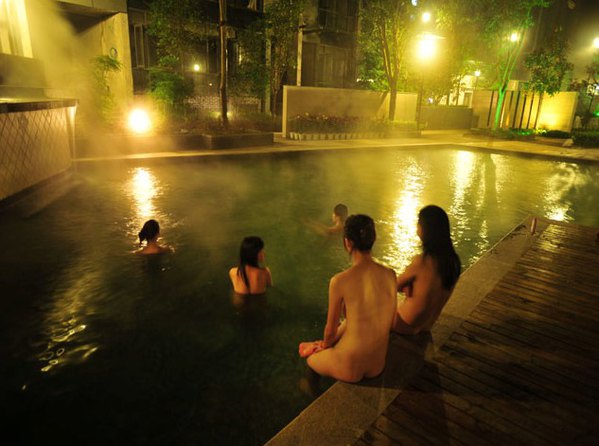
'The 2nd edition of the « Ba'nan Hot Springs Tourism Cultural Festival » near Chongqing has opened on monday. The organizers invited eight pretty models to celebrate the back-to-nature theme by bathing naked...'.
It's unclear whether this was a poor attempt to gain coverage or reflects the reality of soaking here.
However, in the 'Getting Naked: Nudism in China' article, published in 2010, Ba'nan hot spring merits this paragraph:
'... in Sichuan Province, nudism seems to be all the rage. Chongqing Girls Nude Bathing Area sounds more like the title of a dodgy DVD, but it’s actually an area set aside for women in the Ba’nan District’s tranquil East Spring Village. The pool has been in use since the Ming Dynasty, and its water is said to cure blindness. If you fancy a dip, you’ll be pleased to know that it’s open to tourists. Female ones'.
Why only females beats me. Despite this often referred to article, there seems little or none other proof that this practice really exists.

That was until I found this Chinese language website which refers to the Eastern / Ba'nan hot spring and provides photographic proof both of the men and the women's baths:


Stemming from the same period (Nov. 2011), this Chinese language website notes that due to a variety of reasons the hot springs were closed, but locals still took the waters by climbing over the fence. It also suggests more idyllic bathing:


Many more references to al-fresco bathing in Chongqing, f.i. this from the soakingspirit tumblr, which gives an insight into the history of the site, apparently it became famous after curing blindness.

Big plans are underway for this set of springs, though the development report is chaotic.

Elsewhere in Ba'nan district there is the New Orient Hot Spring Hotel which tripadvisor gives a meagre 3 and a half star. And the Sunshine Hot Spring Resort (tripadvisor unrated), while those who favour dong as in Dong Hot Spring Scenic resort may wish to stay there, tripadvisor: 4 stars

Ordinary people
Then there are hot springs in
Tongjing, Yubei district not one of the four wind direction hot springs.
'Tongjing Hot Spring is world famous, hailed as the best hot springs in China'.
Whether this accolade fits the reality or not, plans are under way to re-open these already sprawling facilities in 2014:
'It is expected to become the most beautiful scenic area featuring a hot spring in west China and also the first 5A hot spring tourist attraction in Chongqing.
Unlike some scenic areas, the price is affirmed to be affordable for ordinary people after transformation and will not rise significantly'.
Other hot springs are
The Beidiyiyuan, Jiulongpo District (mention) is often shortened to Beity. Tripadvisor rates this resort as 4,5 stars, though it seems more focus is on the hotel part. Not all is well though?
'hotel is truly 5* nice nice room with special hot spring bath tub included downside to many light switches approx. 14 of them in the room to manage them insane'.
Also located in Jiulongpo district is the  Sun Kingdom Hot Spring Golf Club (source), which is very much a golfing hotel with little or no reference to a hot spring.

Then there is the Tianci Hot Spring resort, more info can be obtained from this website. Tripadvisor give it 4 and a half stars.

Haitangxiaoyue sometimes referred to as Ronghui are said to be Chongqings best urban hot springs. Having 32 pools source Tripadvisor notes 5 stars for this resort complex. Though search for Ronghui and the rating drops!
'This place blows away any spa we’ve been to in the U.S.! It was huge with tons of different types of pools, including wine, green tea, milk, and more. You could easily spend a whole day here, and for two of us it was about $55 U.S.! If we had more time I definitely would have taken advantage of a massage, which was something like 168 rmb ($27 U.S.). Everything was co-ed, so swimsuits were required'.

Thursday, August 29, 2013

Soaking on the steppe

The Mongols and their baths
In the ever expanding list of highlighted countries, being vaguely in the direction of the Himalaya seems to compel this blogs' author to churn out another summation of possible soak sites. In this respect the country referred to as Mongolia is next in line.
So have I determined.

Having a culture which partially stems from the other side of the Himal seems to be a major swaying point to include Mongolia as an entry in this blog, though no doubt images conjured of soakers viewing the rolling steppe limited only by the end of the horizon has a great part to do with aforementioned decision. But will this remain a dream?

Mongolia, we learn, is not a real geothermally active place but nontheless the readable article on harnessing the nation's warmth (Tseesuren, 2001) does list 40 odd hot springs. Though seen mostly from the perspective of possible future power generation it does briefly touch on Mongolian soakers.
'People have used hot springs for bathing and washing clothes since the dawn of civilisation in many parts of the world. In the same way, Mongolia has a considerable experience in health resorts using geothermal water'.
This expression seems to contrast with what seems to be a commonality within Mongolia: the lack of a bathing culture as such. No doubt with the temperature being exceedingly cold most of the year, bathing may not be Mongolians number 1 love. Then again the same temperature must surely make soaking in hot water irresistible to most.


Following is a list of over 40 hot springs which Tseesuren (2001) sums up but to which I've been unable to add any additional info. These little known hot springs are Utaat Minjuur (Domod province (or aimag)), Bol Tal, Chuluut, Tsagaan Sum, Gyalgar, Noyon (all Arkhangai), Tsetsuuh, Zaart, Khojuul, Otgontenger, Ulaan Khaalga (Zavkhan), Euruu (Selenge), Saikhan Khulj (Bulgan), Khamar, Gyatruun, Sharga, Emt (Uvurkhangai), Tsokhiot, Uheg, Örgööt (Bayankhongor), Bulgan (Khovd), Gants mog, Chihert (Bayan Ulgii), Salbart, Urtrag, Tsuvraa and Khunjil (Khuvsgul).

Also note the excellent Bradt Mongolia guide (author Jane Blunden) which has an overview of over 80 hot and cold Mongolian springs (see also appendix).


Zanabazar the zoaker?
While trying to find more on hot springs in Mongolia there's no avoiding Don Croner's
blog on Zanabazar, Mongolia's first Bogd Gegen or religious leader. While living back in the 16th and 17th century, besides relieving spiritual needs, he seems to have been a penchant soaker (see for instance this blogs entry on Qinghai). Happy Mongolia mentions:

'According to tradition, Zanabazar identified up to twenty individual mineral springs here and gave very specific instructions on how they were to be used'.
The same site adds some additional info for the spiritual soaker:
'The best time to use the springs is in the spring or autumn, and and for a full treatment they should be used daily for regimens of twenty-one, twenty-seven, or thirty-one days. Odd-numbered days are considered better. Also, there is one day in each month which is thought to be the most beneficial to use the springs, for example the eighth day of the eighth month, according to the Tibeto-Mongolian lunar calendar'.
I wonder whether more is known about best soaking days. Are they dependent on a lunar calender of sorts?

Zanabazar had a few favourite soaking sites. Don on his travails to retrace Zanabazar steps is often ending at hot springs. The hot spring(s) of Onon (Khentli province) seem a favourite. Don:
'... it was Zanabazar, the First Bogd Gegeen of Mongolia (1635–1723) who reportedly first studied the medicinal properties of the Onon Hot Springs Complex. They are thought to be especially suited for treating lower back problems, which is why Zegvee and I came here. There are nine bathhouses at the Hot Springs, each with water of differing water temperatures. The usual course of treatment is to soak in the cooler hot springs and then proceed to the hotter ones'.
Don does have more info:
'Here are at least fourteen different mineral springs, some of them with boiling-hot water, and several bathhouses. Two of the larger springs, both enclosed by bathhouses, are called Ikh Tsenkher and Baga Tsenkher (“Big Blue” and “Little Blue”), names reportedly given to them by Zanabazar himself, The springs here are famous for treating diseases and afflictions of the lower body: knees (mud packs taken from near the springs are especially good for knee joints), lower back pain, kidney and liver problems, and also rheumatism and sore muscles in general'.
'View of the Hot Springs'
Other info on Onon hot spring:
'The hottest spring of Mongolia is Onon's hot spring with temperature of 70-80°. Its ingredients are chloride, hydro-carbonate, natrium and magnum and it is pellucid liquid that tastes and smells like sulfur-hydroxide.
This spring has been used to cure illnesses such as central and peripheral nerve system diseases, joint diseases, skin diseases, injury and wound.

Setsen khan Sholoi's barn that was built during the 13th century remained till recent time and at that time of khan's only dignitaries used to own the spring and use it in a suitable time of year when it is good for treatment.

Good men who were considered to be heroes of this time used to boil raw frozen meat in this hot spring. At present, people are working to create a comfortable environment at this place and many searches have been made in order to use this hot spring for treatment'.
Another of Zanabazar's haunts was Khujirt (or Khujert, Uvurkhangai aimag).
'Zanabazar was a renowned polymath who applied his energy to the study of a staggering array of subjects. One of his interests was the medicinal properties of hot springs. He is known to have studied the waters of least four hot spring complexes in Mongolia and no doubt he himself took advantage of their curative and restorative powers.
While traveling between the monastery of Baruun Khüree and his workshop at Tövkhon Zanabazar would have had numerous opportunities to stop at the extensive hot springs complex at Khujirt, on the edge of the Orkhon Valley. According to locals it was he who first studied the medicinal properties of these springs. Khujirt, located between what is now the popular tourist attraction of Erdene Zuu and the famous Orkhon Waterfall in the upper Orkhon Valley and easily accessible by road from Ulaan Baatar, is today a major resort with a sanatorium, hotels, and ger camps'.
The above is attributed to the zanabazar.mn site's highlight of Zanabazar's hot spring hide-outs. Don has more on Khujirt.
Otherwise there is this to add on Khujirt hot spring:

'Khujirt is a sanatorium of hot spring (54.5 C) and mud treatment, found in the territory of Khujirt soum of Ovorkhangai Province at 2660 m ASL, 420 km from Ulaanbaatar, 80 km from Arvaikheer and 54 km from Kharkhorin. The hot spring was used by local people starting from many centuries ago. The water has the smell of sulphur, has no color and it is rich in sodium, calcium. Khujirt is one of the first State sanatorium of Mongolia for treatment of nervous, gynecology, kidney, bone, heart and other ailments. The sanatorium has recently opened a special section for foreign tourists. And there is a tourist ger camp not far from the sanatorium. The area is excellent for hiking'. (source: non-functioning)
Finally it was the hot spring of Estiyn (Yestin) which Zanabazar also frequented.
'While overseeing the construction of Saridag Khiyd (see above-below) from 1654 to 1680 Zanabazar would have ample opportunities to visit Estiyn Rashaan (rashaan = mineral springs) twelve miles to the northwest. According to tradition he identified here up to twenty individual mineral springs and determined the medicinal properties of each. Even now some of the springs have small signs in Tibetan indicating what the water is to be used for, including ailments of the heart, teeth, eyes (one for the left eye and one for the right), nerves, nose, ears, innards, lungs, and so on. There are also two log bath houses with bathing pits. Herdsmen from the Tuul and Kherlen valleys still here by horse to take cures and retreats. My horseman when I visited here told me his cousin came here for seven days after a bad fall from a horse and after bathing daily in the bath houses came away cured. Locals also maintain that bathing in the larger of the baths will atone for big sins, while bathing in the smaller one atones for little sin'.
Efficiency
The most well-known hot spring of Mongolia seems to be
Tsenkher. It even has (had?) it's own organisation, Hot Spring Water’s Efficiency Association, though this seems / seemed more dedicated to exploiting greenhouses than encouraging soaking. The sole references date back to 2008.
Besides the organisation there's also mention made of the following:
'Mongolian “Bridge” Group and Japanese “Tsagaan Sogoo” company established the “Tsenkher Jiguur” tourist camp in 1995 pursuing two main goals, the development of tourism based on a hot spa, which is situated in Tsenkher sum of Arkhangai prefecture and the contribution to the local area development ... Please, take off your clothes first, then have a shower and be clean before you bathing in a hot spring! For hygienic purposes it is regulatory to take bath naked in the hot spa.'
That said, there is little proof of nakedness. On internet at least.

Apparently Tsenkher is increasingly commercially exploited. This organisation runs a 'camp':
'“Tsenkher Jiguur” tourist camp is situated in the north of 480 km-s from Ulaanbaatar capital, in the north west of 120 km-s from Khara Khorum tourism destination. The tourist camp is comfortable one, located in the foot of forestry hills with beautiful nature view, neighboring to hot spa. The camp’s capacity is 20 ger rooms, 7 hotel rooms with heating system, which are capable to provide service for 80 persons simultaneously. There Mongolian and European meals are served in Ger restaurant.
The Japanese styled inside and outside hot spa baths are made with original stones and rocks from the nature, so this bath makes people to feel the real natural spa environment and make them to relax and refresh very well. During bathing in outside spa bath travelers can observe glittering stars in the sky in nighttime. There guests have a nice chance to watch national concert with songs and dances, as well as to participate in camp fire works, are able to be provided with service of beauty saloon, massage and sauna.
The springing out of deep earth hot spa contains simple alkaline structure of sodium of sulphuric acid with phtalic and with temperature of 86.5 degrees warmth. Spouting out speed is 10 liters per a second. This spa is very useful for treating any injuries, wound, radicle, fatique and depression, therefore, guests and indigenous people use it with much respect.
In its surrounding area it is absolutely suitable to explore the picturesque nature view, to pick up flowers, to catch butterflies, arrange hiking, horseback trekking tours. Also it is considerably possible for exploring nomads lifestyle, nomadic civilization, riding yaks, catching horse, making horses calm, milking mares and cows, preparing milk products. In wintertime tourists like to have hot spa bath and trek on snow covered hills. Also in spring time tourists can explore Traditional New Year Holiday-White Month and participate in hunting wolves [!]'.
Relax and refresh with dancing with wolves?
Tsenkher hot spring (source).

Not all is so delightful, take this case:
'The "baths" were dirty (and filled with big Mongolian men), the changing rooms were full of flies (see video), ...'.
One (recent) review on tripadvisor which despite the three stars seems less benevolent in description:
'N47°19'8.8" E101°39'16.8" This tourist gercamp has a new modern design hot spring house with separate inside and outside pools for men and women, although apartheid in the outside pools is not enforced. Staff was clearly absent all the time. Towels too. No cleaning was done at all, and the next day the floors were still dirty. Pools were not being kept at the right temperature. Showers and toilets were malfunctioning. All the camp guests use the only showers working, because there aren't any in the ablution block. Without skilled staffing, proper cleaning and adequate maintenance, this new hot spring house will be out of service in a few years'.
Others tend to disagree:
'I’d give Tsenkher hotsprings a 9 out 10'.
'Teel Rashaan (Hot Springs) on the Olziit River. Water is said to be good for digestive problems'. Photo by Don Croner.

On the map
Lesser well known are the following hot springs.
Eustii
(Tuv province):
'Estii rashaan is a hot spring (+34°c) in the valley of the Estii River'.(source)
Khuremt (Uvurkhangai province):
'The Khuremt hot spring has been used since ancient times. Components include bicarbonate and sodium. The maximum temperature of the water reaches 58.8C. There are 10 streams, and the spa water is used for extremities and nervous diseases'. source
Mogoit or Khangain Tsagaan Chuluu (Uvurkhangai province):
'Khangain Tsagaan Chuluu. Is a picturesque white and marble rock on the south east side of the hot spa at Mogoit. It is over 10 meters high taken by someone because of worshipped rock'. (source: link no longer working)
There are also a few photo's on flickr (not interesting enough(?) to repost here). 

Is Mogod the same (Bulgan aimag):
'Elegant Private Stone Bath at the Hot Spring Resort in Mogod, Bulgan Aimag. The facilities, while rustic are very well maintained and the water is fantastic. The only hot spring I've visited in Mongolia that is comparable to a Japanese Onsen. The rooms are simple but comfortable, the gers not quite as nice. Very few foreign tourists, but lots of Mongolian families. The valley setting is lovely. Highly recommended'. Source
Taats (Tsaats?) hot spring has received funding from UNDP's GEF to initiate 'development'. Also located in Uvurkhangai province.

Teel hot spring (see photo above this paragraph) is located in Bayankhongor province.
Shivert (Arkhangai province) seems to be Mongolia's only really developed hot spring. Visit the website of Hasu Shivert resort (devloped doesn't necessarily imply that website is maintained ...) to find the following text:
'Shivert Resort provides state-of-the art wellness center built around natural hot springs. Our staff team is dedicated to answer all your questions and needs during your stay. Newly renovated facility [2009] includes outdoor pools, natural treatment centers, sports facilities, large conference and dining rooms all in the middle of wilderness of Mongolia'.
Despite the development, not much to be found.
Khaluun us (or Tsenkheriin, Zavkhan province):
'...remarkable Hot Spa of Tsenkheriin Khaluun Us , which is now serving as a health spa for tourists, it lies 30 kms south of Tsetserleg town. The water of Tsenkheriin Khaluun Us spring is remarkably hot at +86.5 C and contains hydrogen sulfide'. (source)
P7051502

Photo by smee:
'Mongolia. Hot Spa of Tsenkheriin Khaluun Us - 30 kilometers south of Tsetserleg town. The Shiveet Mankhan tourist camp in the back'.
Bulnai (Khuvsgul province) hot spring resort is described as
'... offering simple cabins around a former Soviet resort'.
A first hand experience:
'I was thinking more of a geyser in the ground - the 'springs' were situated in little wooden huts and were basically just a rectangular hole cut in the wooden floor containing very hot water. The baths came in temperature grades of 38, 43 and 48 degrees centigrade and although you were not permitted to take in soap or shower gel, we spent a good 30 minutes just soaking and trying to expunge the dirt we had accumulated from the previous few days' riding'.
AsiatoEurope2011 in Bulnai (note many springs are hotter):
'Here we are in 28C:'

Bugat hot spring (Bayan Ulgii province) is a hot spring not included in Tseesuren's (2001) list. This web site once added (not working anymore) to the precise coordinates:
'It is a hydro carbonat sulfas natrii hot spring'.
Tsagaan gol (Bayan Ulgii province):
'Locals come to this hot spring to have medical baths and drink the water. There are small wooden houses for hot baths'. source
Commercial property?
The hot spring of Jargalant sum (or Jalga, presumed to be in Khuvsgul province; Jargalan / Khunjil?):
'This hot spring smells and tastes little bit sulfate, transparent, it flows through various stones, like kidney-stones, very thick placed sandy soil. Nearby beautiful high mountains and amazing forest, which has different trees, like pines, ebony, asp, cedar are around the hot spring. Temperature of the hot spring’s water is 45-50C hot'.(source)
More info:
'Jargal Jiguur hot springs, sulphar springs that emerge from the ground (150m) at 70 degrees Celsius. Facilities include outdoor baths (male and female), showers and accommodation'.
It does seem that Jargal Jiguur was the commercial name for Khunjil, the prize winning text of which goes as follows:
'Nestled amid 70 Celsius natural mineral springs, with a knowledgeable, friendly, and professional staff, Jargal Jiguur offers an amazing spa experience. At this premier choice of Jargal Jiguur spas, cascading waters nurture more than skin and body -- they soothe the heart and soul. Visit our recently renovated, Japanese-style spa. Select from a bountiful array of soothing treatments from full body massages to anti-fatigue treatments. Whether you desire a dip in one of our naturally heated mineral spas or a private massage, you ’ll enjoy it in soul-relaxing fashion at our Jargal Jiguur hot springs spa resort'.
Could it be Khunjil?
'Khunjil (mostly known Jargal) is a natural hot spring flows out whole year from the ground at 70 Celsius degree in mountainous North Mongolia. It is located 1580m a.s.l and in 730 km from Ulaanbaatar capital city, over 180 km south-west of Murun town in Khuvsgul province and 5 km south west Jargalant village'.  
The same source adds:
'There is only one tourist camp which is offering for tourists outdoor baths. They transfer the hot water via tubes and built some pools. Curative water and amazing nature featured by wooden mountains make this an excellent place for relax. Night bath is great. Sitting in the pool drinking while seeing stars at the dark sky is one of the favorite activity in here. The open air-baths are recommended'.
Last
Shargaljuut hot spring is a more often visited and more developed hot spring in Bayankhongor aimag. This web site describes Shargaljuut as 'well-known' and 'popular among Mongolians'.


And now we return to the aforementioned vision of soaking in Mongolia. This blogger had a different vision (oh, link not working):
'Upon entering the Shargaljuut springs, it immediately struck us that it was not as developed as we had hoped for. We had dreamt of large pools of water, immaculate service and Russian saunas. None of that. We had to cross some smaller rivers, made it this time, and ended up in a very basic ger camp. The hot springs are symbolic for the Mongol approach. Leaking tubes, old wooden gers, rundown buildings, unclear directions and too many people just hanging about. A hot spring was nothing more than a standard bath in a ger, to be filled with water. However, it must be said the water was fantastic and we felt like new'.
Lazy overachiever has also something to say on Shargaljuut and it is not a thank you to Lonely Planet! But nothing about gers. This website adds a photo which shows both gers as well as a building or two:


The Dutch broadcaster BNN has  a visit to what they attribute as the Tsenkher hot spring, which seems very incorrect as it is quite obviously Shargaljuut. This is the video, the visit starts at 2:20. Floortje Dessing arrives in high spirits but after seeing the docter and the poor state of facilities might have chickened out were she not there to fill her programme ...

 It also has a Facebook site (188 likes)!


'Our private hot spring bath: luxury old school Russian bath tubs hiding inside'.
Shargaljuut, taken in 2005 by Martijnopdemotor.

[Updated August 2013]

Notes:
Tseesuren, B. (2001) Geothermal Resources in Mongolia and Potential Uses. United Nations University. Geothermal Training Programme. Reports 2001, no. 15. Reykjavík, Iceland

Appendix:
Mongolia's hot springs as according to Blunden (2008). Note that she also lists many other springs which may well be hot. But here are those she does mention specifically:
Övörkhangai aimag: Khujirt, Mogoit, Khüremt, Emt; 
Arkhangai aimag: Shivert; 
Bayankhongor: Shargaljuut, Örgööt, Ükheg; 
Khövsgöl: Bulnai; 
Zavkhan: Otgontenger, Ulaankhaalga, Zart; 
Bulgan: Khulj; 
Selenge: Yestiin Gol, Yöröö; 
Khovd: Nevt, Bulgan; 
Bayan-Ölgii: Gantsmod; 
Khentii: Onongiin Ikh Rashaan; 
Dornod: Utaatminchüür