Showing posts with label spa. Show all posts

Saturday, June 14, 2014

Piping hot

Insane
Having blogged on the hot springs of the more mountainous areas of Sichuan, there is still plenty of hot springs to be soaked in without having to take to the mountains. 

This website provides a short overview to the 5 most popular hot springs around Chengdu, Sichuan's provincial capital. In reality it's an overview of the better accommodation boasting their own soaks.

Mention is made of Herijun Hot Springs Hotel which lies within the confines of the city. Tripadvisor has a classic review apparently a guest had a medial collateral ligament ruptured here during a massage! Lexi abroad had a better experience and recounts that the place is divided by gender specific meaning bathing costumes (other than your birthday suit) are disregarded. Part of the experience:
'I didn’t know where to look. I couldn’t look up because then I would probably accidentally stare at all the different shapes of ladies that I was seeing. But I couldn’t look downward the whole time because then I would run into a naked lady. I didn’t think that was something that any of us wanted. I was amazed that none of the ladies were even trying to cover themselves with the washcloth provided. It was an insane mass of everyone walking around nude with the occasional little girl running like crazy with her giggling cohorts.
Nobody dared to stare at me. For the first time in China, stares were pretty much directed away from me. If they stared at me, they only looked at my face because to stare at the rest of me would’ve been breaking the unwritten laws of the hot springs. At first I tried to sneak around without being as naked as possible. Gradually, I realized the futility of this and just walked with the washcloth around my neck.
I spent around 3 hours lolling about in the tubs, the Jacuzzis, the steam room, the sauna, and a mysterious sort of tub with rapids'.
Also within Chengdu city  is the hot spring of Wenjiang (or the Yufu Hot Spring Hotel). It apparently incorporates
'... 50 types of indoor and outdoor hot spring pools'.
This website adds:
'The hot spring water is piped in from 1,800 meters underground, and is rich in minerals helpful in relieving cardiovascular, neural and respiratory illnesses'.
And then there is Taoyuan hot spring hotel.

More traces
Huashuiwan
, Dayi county which is part of Sichuan's capital Chengdu prefecture (and only 85 km from the city center) has a hot spring area which seems quite popular in combination with the nearby skiing area of Xiling. More info on this hot spring can be found here. As an investment project. As winner of the UN Habitat award (link gone). As having 21 hot spring pools, I was lead to believe. 
Tripadvisor in it's Huashuiwan hotel overview mentions 6 hotels with hot spring in their name.

'#hotspring  #huashuiwan  #relax  #hometown  #dayi'
Nearby, Tianfu Hot Spring Hotel in the 'development zone' of Zhougong (near Ya'an) is known as the no. 1 Sichuan hot spring. The hotel is also known as Dream Hot Spring Hotel according to Tripadvisor. However when looking into the overview of hotels in Xingzi county, one counts 6 hotels with hot spring facilities.

The above mentioned Wenjiang hotel should not be confused with Wen Jinjiang Hot Spring Hotel which is located in Chongzhou district's Huaiyuan, nearly 70 km from Chengdu. This webside adds:
'Wenjinjiang hot spring is a garden hotel built in Japanese style. There are over 30 hot spring pools containing various trace elements and minerals'.
Accross the road should be the Xintiandi Hot Spring hotel.
 

Tickling
Further away from Chengdu in northeast direction is the hot spring of
Mianzhou in Mianyang city. It comprises of pools and a hotel, both of which claim to be the biggest indoor hot spring facility in China's southwest. Tripadvisor's rankings are quite good, though little info on the soaks them selves.

Thirty km's from Mianzhou is another hot spring hotel named
Luofushan. Near this hotel is another named Tai Feng Yuan Hot Spring hotel.

Near the so-called West Grand Canyon, south Sichuan, a number of hot springs can be found. Two to three kms away from Yibin is Guandou hot spring. The hot spring is said to be able to accommodate 500 visitors. For a pre-war photo go to verfainverfain's Flickr site. 

One of Yibin's hot springs has gained some notoriety, as soakers turn up with the cheapest swimwear ...! Located in Junlian county. There is an extensive account from 2007 which notes that whereas once the baths were divided in time (men during day, women at night) nowadays bathing is segregated with men being designated the more public site ...:

 'Less than half a meter wall stream, creek side is building the old house, Bamboo Castle, the women in the stream to wash rice vegetables, washboard fetch water for at naked men bathing in the pool without a trace of fear. Pool of men and no scruples, and we walk around, some even standing on the wall, toward the brook brush shampoo.People here are honest with no shilly shame shame, we are hard to come by this fickle social encounters. Prepare a very good one joyous world outside the living picture.Water is very low sulfur content, is said to always wash to treat rheumatism and cirrhosis of the liver, but also skin care. I looked at the old man's skin, it really skin tight flush. I do not know if preconceived sake'.
Translated with google! 

Further away from Yibin (30 km) is the hot spring of Shifu or alternatively known as the hot spring hotel of
West Grand Canyon (or Xibu Daxiagu) (see Tripadvisor). It's discharge is 8000 sq. cum. which ranks top in China. No less than 3000 people can soak here. Note that this may fall into Yunnan ....

Finally, due south of Chengdu is arguably what is regarded as one of China's best hot springs, E'mei. The hotel carrying the name of E'mei has not so bad reviews including this recent review:
'The hot springs on site deserves its own review as an attraction in itself, especially because it has its own entrance fee and is open to the public. The change rooms, showers and lockers are adequate. They even provide you with loaner flip-flops. The pool area consists of a few small warm specialty pools (one containing wine, another with some other concoction) atop a high ground overlooking a very large heated pool below. The source of the hot springs is from as deep as 9,840 ft underground and was formed more than 2,000 years ago. The quantity of heated water is huge with an average temperature of 140°F. This giant pool is divided into 3 sections of varying temperatures (cold, then medium warm, and bloody-hell boiling!)'.

There are actually another three hot springs near E'mei. These are Lingxiu, Hongzhu and Yoga hot springs. 
Yoga hot spring is a resort which offers ... yoga! Probably this doubles up under the name of E'mei Hot Spring Hotel. 
Lingxiu though is more well known (see here f.i.).  There is this description:
'But the hot spring is the main attraction. After you enter the massive lobby, you're given a pair of slippers and directed to your locker in the changing rooms, which are divided by gender. You change into a bathing suit and are promptly given a nice, soft bath robe to lounge around in. Walk out into the public area, and you are in cold-weather paradise with more than 10 indoor and outdoor pools, all steaming hot. Each pool is a different size and shape: Some are like any typical public swimming pool, while others are organically shaped with rocks to perch on. Some have shallow water for kids to play in, and some have whirlpool jets. They even have pools with "doctor fish"—the small fish that eat dead skin. (We tried them. Weird, but worth the experience. Not for the ticklish!)'.
Etta in China: Lingxiu hot spring

Australia's Sydney Morning Herald also notes the Dr. Fish treatment of Hongzhu. As well as offering soaks it also is a 5 star hotel, Tripadvisor reviews. 

Down Sichuan's south
Then near Panzhihua
city close to the border with Yunnan one can visit the hot spring of Hongge. Despite the town having a tradition of industrialization and mining without borders, the nearby Hongge hot spring has been swept up in a development called Holiday Inn Panzhihua, aimed at promoting tourism. The development covers an area of more than four km2 and is
'designed planned according to high standards by the Japanese hot spring experts'.
Not many people are attracted to Panzhihua, though this couple express their satisfaction (in Dutch) concerning the hot spring.
 
Caution? By Wubbo Womb.

Wednesday, January 1, 2014

A secret revealed


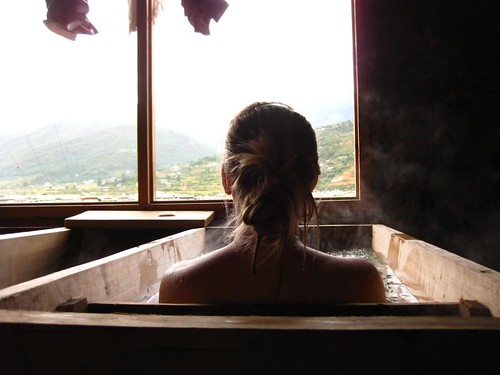
'Cassie in a hot stone bath
Cassie made a bhutanese mans day when he walked in front of the window'.
Photo by The.Adrians.Golf
Divine
There doesn't seem to be anything as a bathing culture in the interior regions of Asia. Or at least so it seems. 

Away from the scrutiny of the public eye and the need for social conditioning to create a distance between rulers (refined taste) and ruled (ignorants), the mountain folk have simply done what seems to be straightforward: clean water equals bathing possibility.

And the higher up the mountains or the more north, the more the need for a hotter bath. With temperatures so low, no one favours a cold bath, nah? 

Do locals adapt their bathing habits? Mostly no, cooler periods simply mean less cleansing ... With the exception of those in the proximity of a hot spring.

But there are exceptions to the lack of natural soaking possibilities.

One of these is the Bhutanese ancient tradition of a hot stone bath. Locally known as a dhotsho (or variations spelled differently, f.i. dotsho), this clearly is a tradition of the Bhutanese themselves and seems not to have many followers elsewhere on the globe. 

Thus quintessential to Bhutan, many a tourist is interested in partaking in this tradition. Or so it becomes more known to the general internet community.

Witness to this has been the increasing numbers of blog reports. digital shangrila describes it as follows:
'so amazing! there are probably some people who don't know what this is, so i will describe it..... a hole is cut in the ground and then the hole is cribbed with timbers. water from the stream is run into the bath which is by the fire, river rocks are put in the fire until they are glowing hot and then they are dropped in the wooden tub full of water until it is boiling hot. the minerals released from the rocks are incredibly healthy and the steam rising of the water is divine!'
A photo which was once on picasa, link seems to have disappeared.
A dhotsho? Left the men are heating the stones, right the women are bathing
.

Ingredients
What makes the dhotsho unique? 

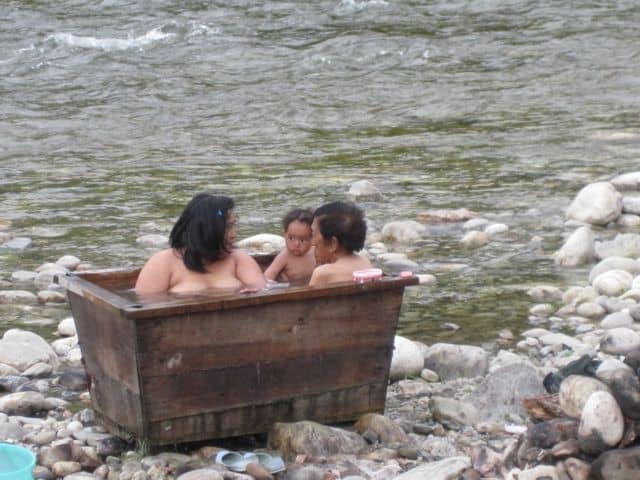
For one, the mostly rustic wooden baths / tubs, not circular as many of us like to think, but rectangular as a regular bath in the western world. 
Ideally, they have at what would be the foot end, a (porous) separation; this is where the hot stones are placed. Mostly meant for lying in, they can also be deeper. Or more rustic without special places for where to put the stones.

The stones are river stones. Large and rounded, these are heated for hours on end over a woodfire until they may well be glowing themselves, before being rinsed (to wash off the soot) and placed in the cold water of the wooden tub. 

Water is mostly free flowing water from a river or nearby stream, but true believers put their faith in spring water, free of any possible pollution (already highly unsuspected in Bhutan. See also the following paragraph on Menchu.

Ideally herbs are added, Artemisia has been mentioned. Plant varieties from the Artemisia family are used throughout traditional Chinese medicine and are well-known for their anti-bacterial qualities. Other mentions are made of secretive herbal add-ons (source):
'Some of the herbs added are a secret known to very few families. The secret is revealed only to their close family members. Some of the families are so secretive that they bring only the root of certain herbs; which most people fail to recognize the actual plant'.
A tub-like bath with herbs floating ... (source).

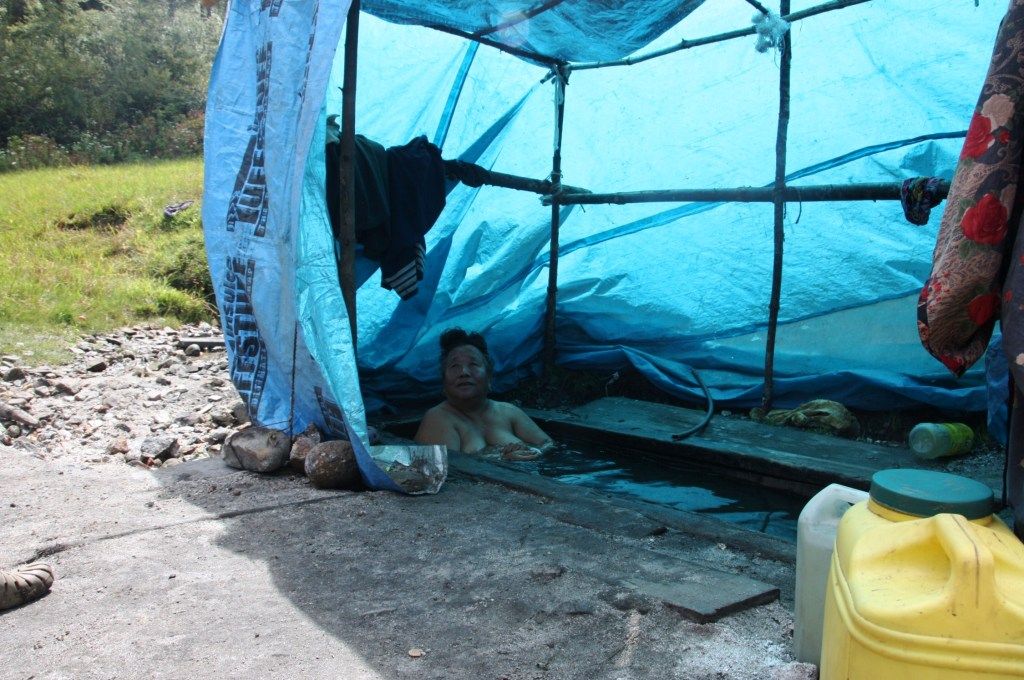
The surroundings. Well, being rustic, a wooden shed seems a luxious version. Mostly soaking is done al-fresco while for foreign guests a tarp may be spun.
With the need for river rocks and water, the hot stone baths are mostly conveniently located near a river(let).


'Muffy enjoying the hot stone bath at basecamp'.
This picture from a more upmarket dhotsho? Sourced from Muffydavis.com. Or alternatively Jeff's LP travel blog.

Decorum is often far from what is on the soakers mind, so locals will jump in au-naturel, no need for bathers. 
Foreign guests tend to follow their own cultural and social baggage. With possibly the fact that when heading to Bhutan, a swimming costume is not on the most essential piece of clothing required to drag over mountain paths.

'Both the trek up and down the mountain and the temple itself offer a truly mystic experience steeped in history, tradition, and sheer wonderment. And a traditional hot stone bath is a great way to soothe aching muscles after the hike – take the plunge and bath nude like some of the locals do'.

Soaking can take in anything between 20 minutes to an hour, depending of course on the comfortability of the bath water (source).

Finally some mention a glass or two of Bhutanese rice whiskey, but that need not be mandatory ...

The more rustic bath (source).

Truth
More background especially scientifically seems lacking, this seems the first concerted effort to collect anything beyond a narrative, but it must be said that most information found relays to wonders of soaking with no sources published or unpublished mentioned.

Probably the most revealing is the lack of a Wikipedia page! That's the lack of info we're faced with.

There is this, from Phuentsho's blog concerning instructions on hot stone baths, though all very straight forward:
'Before the actual bathing, some fire woods are gathered from the nearby forest. Then some stones are also collected. A wooden bathtub is also needed but most spots have readymade wooden bath tubs. This particular spot has a readymade wooden bath tub. Then they pile up stones and woods together and burn them. During this process they make sure to heat the stones to red hot. The bath tub is filled with the Menchu and some Artemisia leaves are also added. They pitch tents to shelter them from the rain, sun and from the cold in the winter. Then the water is heated by dipping red-hot stones. Then two persons soak in the water at a time. After coming out from the hot water they wrap their body in a blanket and lie on a flat surface for some time. A good and nutritious meal is taken'.
This source seems a tad more serious, but makes unsubstantiated claims:
'No scientific research has been done so far, but hot-stone-bath is popularly believed to have certain medicinal benefits. It's a fact that about 80% of skin diseases are curable. Hot-stone-bath is believed to heal many ailments like joint pains, hypertension, stomach disorder, arthritis and many other minor diseases. The addition of aromatic herbs in the water further enhances the healing power of the bath'.
It all seems so easy and spontaneous with little idea of what may or not be correct, as long as the water is hot. but I did run into this info:
'For the Bhutanese, the preparation and enjoyment of the bath is an all day event. Many families consult an astrologer to select an auspicious bathing day so as to give the bath its maximum healing power'. 
Clearly for tourists the consulting an astrologer part is skipped. 

On the other hand it's not unthinkable, consulting an astrologer. Cultural significance of water often extends beyond the day-to-day use, elaborate (and time-consuming) bathing thus becomes a more spiritual significant event, especially during the winter season.
Having lived in Nepal myself, I have been familiar with the winter day of bathing (Maghe Sankranti), while I also am familiar with Tibetan bathing festival (Gamariji, a week long affair, source). Both examples from close culturally related countries, where religion determines bathing habit which takes place depending on lunar events.

Bhutan has it's own bathing festival, Thruebab, the Blessed Rainy Day, which heralds the end of the rainy season, but has no connection to hot stone baths.

The Kuensel (April 17 2013) mentions a unique hot stone bath in the village of Domkhar. Tradition determines that before summer farming can start, villagers must take a bath in an empty rock pool along a local stream. Farmers fill the pool with river water, while the rocks are heated and later placed in the pool where all villagers take turns in bathing, men first, women last, but with darkness to hide in. 
'Apart from pampering their bodies by soaking in the menchu, it was a family feast, where villagers overindulged in meals, alternating with pork, beef, egg, butter and cheese.
The first was meant to heal villagers of any ailment for the coming farming season, and the latter to make one’s body robust for the coming hard labours'.
Despite what I would think is a very normal way of bathing, this website notes:
'Hot-stone-bath is a very popular form of medication practiced in Bhutan. There is no recorded history of its origin. In the olden times it was a luxury enjoyed by the well to do families. A whole day was spent to organize this particular event where the whole family would take part in the hot-stone bathing ceremony.
...
This event was very elaborate. Most well to do families consulted their chief astrologer to look for an auspicious day to organize this event. It's a general belief in Bhutan that any medication done on an auspicious day has more healing power and benefit. A team of able bodied men would make huge fire and heated rocks over it'.
BBS.bt (March 21 2013) has this on the Jaagey menchu of Paro:
'Meanwhile, Aap Passang Namgay said that there are certain dos and don’ts in and around the vicinity of the Menchu. “There is a belief that the people cannot cut trees nearby, neither are they allowed to roast meat and fish. If they do that they will get sick. If they burn incense there will be no problems no matter how long they stay here.”  
Business pick up
Traditions are evolving. Reviving and adapting the bathing traditions are proving to be extra sources of income as baths and bathing houses provide income to local entrepreneurs, relief to local soakers, and an added attraction of Bhutan assisting the country in it's pursuit of happiness!

This recent article in the Kuensel (Dec. 14, 2013) refers to baths being managed not ad hoc for a once a while, but for more commercial reasons. It notes that during a 2 month long religious ritual hot stone baths were run for devotees:
'Called the “menchu”, the initiative was that of three friends, who wanted to “help” devotees, by making available the “medicinal bath”.
Claiming that they have approval from the hospital and Phuentsholing thromde to establish it, one of the owners, Tashi Choda, said they used the Artemisia plant (khempa) with hot water, before immersing hot stones inside the tub.
...
Constructed with bamboo mats covered with tarpaulin, it’s divided into two parts, for male and female, with five wooden tubs each, in which two people can sit.  A was pit dug outside to burn the stones.
“But we’re still picking up the business since most of the devotees are not aware of it,” Tashi said. “Keeping in mind the kind of customer that would visit us, we’ve kept the rate reasonable and charge Nu 150 a day.”
“Most of the customers are old people and adults,” he said.
On an average, more than 15 people visit the spot, usually in the evening, after the wang ends for the day'.
The commercial hot stone baths in operation:


Kuensel has an article (March 23) which describes the town of Mongar and it's new addition: a renovated hot stone bath bathing establishment.
'The Mongar dzongkhag administration has constructed a bathhouse, Chor Chormey, which is two km from Mongar town.  It opened to the public on March 20, coinciding with the International Day of Happiness.
Menchu, literally means medicinal waters, and at the bathhouse people soak in its waters, warmed by stones heated in a fire, which is a traditional way of taking a hot stone bath'.
Yet again an enjoyable read, A year of blue poppies adds to the subject of the increasing popularity of traditional Bhutanese bathing culture:
'In addition to its medicinal benefits, the dotsho also brings families and friends together; the communal culture of soaking in a Bhutanese hot stone bath is much like the experience of the Japanese onsen or the Russian banya. In the past, the primary function of the dotsho was for personal use, however with the influx of tourism to the kingdom over the last decade,  the dotsho have started to provide many local families a means of extra income, catering to outside guests and tourists at a cost'.
Photo:
'Ugyen's family sits inside one of the four bath tubs. Grandfather and grandmother soak themselves and scrub one another inside the bath while the children amuse themselves. The bath is partitioned in a way so that the doh [?] can not enter the main bathing vessel, protecting each body from contact with the scalding stones.'
Another interesting recent article comes from the Tourism Council of Bhutan (April 27, 2013) which highlights the number of foreign tourists seeking solace from the big bad world by taking a retreat to a rustic hot spring; it also mentions that hot stone baths are gathering in popularity as Bhutan slowly (ever so slowly) becomes a boutique country.

While Kuensel (Nov. 20, 2013) wades in with more, mentioning how tourists are savouring the baths. It also notes:
'When the hot stones are dipped in cold water, they crackle and are believed to release minerals, which benefit the body.
...
For tourists it cost between USD 20-40'.
Pricey? 
The above refers to Bumthang, where a home stay programme is run. The same source (but now September 4, 2013) also notes that the success of the programme is in part related to the existence of hot stone baths.

Some experiences
Over on tripadvisor there is a discussion on whether or not it's handy to have a bathing suit when taking a hot stone bath. The answer it seems lies in what each individual feels comfortable with ... 

Feeling comfy? From a Japanese website on hot stone baths.

Sabrina seems to dread the question, more so because she has no way to communicate, as she blogs from a thoroughly entertaining entry on a hot stone bath experience:
'It was sunset and I sat in the bath that was high on a mountain absorbing the beautiful colors of goldish and redish sunrays that stretched through the gaps of that old boomboo door.  Ironically, I was now thrilled that the doors had a hundred holes in it, so the tangy sunset could peak in the hut lighting it a warm amber color. , As the sun faded away, through those little holes I watched the colors of the sky slowly change different shades of baby blue until it finally turned into jet-black.  When the sky fell into darkness, like magic the candles started to slowly glow filling the hut with a dim romantic flicker.  It was so beautiful and I once again found myself falling deeper in love with the Himalayan Mountains of Bhutan'. 
An adapted tourist approach to the hot stone bath (Gal meets Globe) followed by a photo of the experience:
'They heat the rocks for 3 or 4 hours.  There is a side window with a separate area in the tub to place the hot rocks.  It  heats up the water pretty fast.  They put many different herbs in the water and the minerals from the rocks are supposed to help any ailments you might have.  Lighted candles surround the interior for ambience'.
 
'Once inside the tub, they open the doors so we are having our bath in nature'.
As if this is not paradisical there are more upmarket bathing (Uma Paro resort, the rooms here are US$ 400+ ...) experiences, such as this from Tiang's travels:


A Frustrated Gardener has his take on the experience:
'Hot stone baths are the traditional method of getting clean in Bhutan, and simply described are no more than a wooden tub of water heated by very hot rocks. The Bhutanese swear that the mineral filled water is more effective than any massage, and surprisingly I have to agree with them. Native herbs can be added to remedy various ills and are far more environmentally friendly than a slug of Radox. Rather than pay top dollar for the pleasure in a five-star hotel ($100, I ask you?), we were persuaded to let the gentleman farmer, pictured below, prepare us a soothing soak in his back yard for just a few dollars a piece.
...
Despite the very bizarre experience of being starkers in a shed, I felt surprisingly clean and serene at the end of the experience. You should try it, although I wouldn’t recommend carting about superheated rocks with flip-flops on, as shown here. It’s asking for trouble'.
David recounts:
'I quickly peel of my clothes (it is really cold outside and the shack has open windows – plus wind blows through the cracks in between the wood slats) and step into the hot tub.  Ahhh.  I think it needs to be hotter so a couple more stones are added to the “tank”.  In no time, the water is scalding so we add cold water via a small hose that flows from a stream.  Amazingly, I need to keep the cold water running for several minutes – the stones are that hot.  Several herbs are added to the water so it smells nice and minty.  As I mentioned, I’m not a bath person, but this felt great.  I sat there listening to the crackling fire and Bhutanese conversation outside the shack, body submerged, just letting the water, the herbs, and the minerals from the stones work their magic'.
The upmarket experience (Amankora, just a meager US$ 750+ abode) by Mala Barua:
'The hut inside as totally done up in true Aman style with fresh white gowns, towels, iced spring water, candlelight and anything else you might need during your bath. Its pretty paradoxical, but extremely exotic. Now comes the best part. When you get into the bath and you are ready, the therapist opens up the sliding doors of the hut and Voila!!! You have the great vista of the Phobjikha Valley before you while you are enjoying the soak and the sunset!'
Here is a video on a hot stone bath, less elaborate as you can see:


Menchu
Slightly different is another Bhutanese bathing tradition which entails bathing in spring water, known as a menchu. Translated as medicinal water (or possibly mineral water with high mineral content), these are spring waters with curative powers. These are found all over the country and are best appreciated heated with hot stones, so as to make them bearable. So a menchu with a dhotsho ...?

The
Bhutan Times (unfortunately the original source of the article has been lost ...) has an article on menchu's near the capital Thimphu:
'The Menchu Karp smells pungent and is believed to mainly cure tuberculosis, nausea, rheumatism and boost appetite.
“The menchu is so effective that people even tried channeling it down to villages using pipes but failed,” said another visitor, adding that the Menchu Karp is believed to be under the guidance of the local deity, Changmey Phodhup'.
More insight on the significance of menchu's from this description of Aja Chhu:
'There is also a spring water (Menchu) near Aja Chhu believed to have medicinal values. People frequent the place to bathe in the pungent smelling spring for medical purposes. It is believed to have a curative effect on 18 diseases such as tuberculosis, bodyache, ulcer and whooping cough. Located in the same vicinity is another stream called Awa Chhu. Legend has it that the stream that falls from the rocky cliff came into existence after Guru's walking stick was implanted in the rock. The stream falls on a rock basin forming a pool, where it is believed the Guru had taken bath. The pool accommodates nine people and a bath in the pool is believed to purify a person. All visitors sincerely take a dip in the pool which is also believed to be warm in winter and cool in summer'.
Aja Chhu is probably the most sacred of menchu's and Kuensel has a long article on this place.

Fun

The weirdest photo for last, what are these gents doing?


Note:
Besides the aforementioned, hot stone baths are fun!

Thursday, August 29, 2013

Soaking on the steppe

The Mongols and their baths
In the ever expanding list of highlighted countries, being vaguely in the direction of the Himalaya seems to compel this blogs' author to churn out another summation of possible soak sites. In this respect the country referred to as Mongolia is next in line.
So have I determined.

Having a culture which partially stems from the other side of the Himal seems to be a major swaying point to include Mongolia as an entry in this blog, though no doubt images conjured of soakers viewing the rolling steppe limited only by the end of the horizon has a great part to do with aforementioned decision. But will this remain a dream?

Mongolia, we learn, is not a real geothermally active place but nontheless the readable article on harnessing the nation's warmth (Tseesuren, 2001) does list 40 odd hot springs. Though seen mostly from the perspective of possible future power generation it does briefly touch on Mongolian soakers.
'People have used hot springs for bathing and washing clothes since the dawn of civilisation in many parts of the world. In the same way, Mongolia has a considerable experience in health resorts using geothermal water'.
This expression seems to contrast with what seems to be a commonality within Mongolia: the lack of a bathing culture as such. No doubt with the temperature being exceedingly cold most of the year, bathing may not be Mongolians number 1 love. Then again the same temperature must surely make soaking in hot water irresistible to most.


Following is a list of over 40 hot springs which Tseesuren (2001) sums up but to which I've been unable to add any additional info. These little known hot springs are Utaat Minjuur (Domod province (or aimag)), Bol Tal, Chuluut, Tsagaan Sum, Gyalgar, Noyon (all Arkhangai), Tsetsuuh, Zaart, Khojuul, Otgontenger, Ulaan Khaalga (Zavkhan), Euruu (Selenge), Saikhan Khulj (Bulgan), Khamar, Gyatruun, Sharga, Emt (Uvurkhangai), Tsokhiot, Uheg, Örgööt (Bayankhongor), Bulgan (Khovd), Gants mog, Chihert (Bayan Ulgii), Salbart, Urtrag, Tsuvraa and Khunjil (Khuvsgul).

Also note the excellent Bradt Mongolia guide (author Jane Blunden) which has an overview of over 80 hot and cold Mongolian springs (see also appendix).


Zanabazar the zoaker?
While trying to find more on hot springs in Mongolia there's no avoiding Don Croner's
blog on Zanabazar, Mongolia's first Bogd Gegen or religious leader. While living back in the 16th and 17th century, besides relieving spiritual needs, he seems to have been a penchant soaker (see for instance this blogs entry on Qinghai). Happy Mongolia mentions:

'According to tradition, Zanabazar identified up to twenty individual mineral springs here and gave very specific instructions on how they were to be used'.
The same site adds some additional info for the spiritual soaker:
'The best time to use the springs is in the spring or autumn, and and for a full treatment they should be used daily for regimens of twenty-one, twenty-seven, or thirty-one days. Odd-numbered days are considered better. Also, there is one day in each month which is thought to be the most beneficial to use the springs, for example the eighth day of the eighth month, according to the Tibeto-Mongolian lunar calendar'.
I wonder whether more is known about best soaking days. Are they dependent on a lunar calender of sorts?

Zanabazar had a few favourite soaking sites. Don on his travails to retrace Zanabazar steps is often ending at hot springs. The hot spring(s) of Onon (Khentli province) seem a favourite. Don:
'... it was Zanabazar, the First Bogd Gegeen of Mongolia (1635–1723) who reportedly first studied the medicinal properties of the Onon Hot Springs Complex. They are thought to be especially suited for treating lower back problems, which is why Zegvee and I came here. There are nine bathhouses at the Hot Springs, each with water of differing water temperatures. The usual course of treatment is to soak in the cooler hot springs and then proceed to the hotter ones'.
Don does have more info:
'Here are at least fourteen different mineral springs, some of them with boiling-hot water, and several bathhouses. Two of the larger springs, both enclosed by bathhouses, are called Ikh Tsenkher and Baga Tsenkher (“Big Blue” and “Little Blue”), names reportedly given to them by Zanabazar himself, The springs here are famous for treating diseases and afflictions of the lower body: knees (mud packs taken from near the springs are especially good for knee joints), lower back pain, kidney and liver problems, and also rheumatism and sore muscles in general'.
'View of the Hot Springs'
Other info on Onon hot spring:
'The hottest spring of Mongolia is Onon's hot spring with temperature of 70-80°. Its ingredients are chloride, hydro-carbonate, natrium and magnum and it is pellucid liquid that tastes and smells like sulfur-hydroxide.
This spring has been used to cure illnesses such as central and peripheral nerve system diseases, joint diseases, skin diseases, injury and wound.

Setsen khan Sholoi's barn that was built during the 13th century remained till recent time and at that time of khan's only dignitaries used to own the spring and use it in a suitable time of year when it is good for treatment.

Good men who were considered to be heroes of this time used to boil raw frozen meat in this hot spring. At present, people are working to create a comfortable environment at this place and many searches have been made in order to use this hot spring for treatment'.
Another of Zanabazar's haunts was Khujirt (or Khujert, Uvurkhangai aimag).
'Zanabazar was a renowned polymath who applied his energy to the study of a staggering array of subjects. One of his interests was the medicinal properties of hot springs. He is known to have studied the waters of least four hot spring complexes in Mongolia and no doubt he himself took advantage of their curative and restorative powers.
While traveling between the monastery of Baruun Khüree and his workshop at Tövkhon Zanabazar would have had numerous opportunities to stop at the extensive hot springs complex at Khujirt, on the edge of the Orkhon Valley. According to locals it was he who first studied the medicinal properties of these springs. Khujirt, located between what is now the popular tourist attraction of Erdene Zuu and the famous Orkhon Waterfall in the upper Orkhon Valley and easily accessible by road from Ulaan Baatar, is today a major resort with a sanatorium, hotels, and ger camps'.
The above is attributed to the zanabazar.mn site's highlight of Zanabazar's hot spring hide-outs. Don has more on Khujirt.
Otherwise there is this to add on Khujirt hot spring:

'Khujirt is a sanatorium of hot spring (54.5 C) and mud treatment, found in the territory of Khujirt soum of Ovorkhangai Province at 2660 m ASL, 420 km from Ulaanbaatar, 80 km from Arvaikheer and 54 km from Kharkhorin. The hot spring was used by local people starting from many centuries ago. The water has the smell of sulphur, has no color and it is rich in sodium, calcium. Khujirt is one of the first State sanatorium of Mongolia for treatment of nervous, gynecology, kidney, bone, heart and other ailments. The sanatorium has recently opened a special section for foreign tourists. And there is a tourist ger camp not far from the sanatorium. The area is excellent for hiking'. (source: non-functioning)
Finally it was the hot spring of Estiyn (Yestin) which Zanabazar also frequented.
'While overseeing the construction of Saridag Khiyd (see above-below) from 1654 to 1680 Zanabazar would have ample opportunities to visit Estiyn Rashaan (rashaan = mineral springs) twelve miles to the northwest. According to tradition he identified here up to twenty individual mineral springs and determined the medicinal properties of each. Even now some of the springs have small signs in Tibetan indicating what the water is to be used for, including ailments of the heart, teeth, eyes (one for the left eye and one for the right), nerves, nose, ears, innards, lungs, and so on. There are also two log bath houses with bathing pits. Herdsmen from the Tuul and Kherlen valleys still here by horse to take cures and retreats. My horseman when I visited here told me his cousin came here for seven days after a bad fall from a horse and after bathing daily in the bath houses came away cured. Locals also maintain that bathing in the larger of the baths will atone for big sins, while bathing in the smaller one atones for little sin'.
Efficiency
The most well-known hot spring of Mongolia seems to be
Tsenkher. It even has (had?) it's own organisation, Hot Spring Water’s Efficiency Association, though this seems / seemed more dedicated to exploiting greenhouses than encouraging soaking. The sole references date back to 2008.
Besides the organisation there's also mention made of the following:
'Mongolian “Bridge” Group and Japanese “Tsagaan Sogoo” company established the “Tsenkher Jiguur” tourist camp in 1995 pursuing two main goals, the development of tourism based on a hot spa, which is situated in Tsenkher sum of Arkhangai prefecture and the contribution to the local area development ... Please, take off your clothes first, then have a shower and be clean before you bathing in a hot spring! For hygienic purposes it is regulatory to take bath naked in the hot spa.'
That said, there is little proof of nakedness. On internet at least.

Apparently Tsenkher is increasingly commercially exploited. This organisation runs a 'camp':
'“Tsenkher Jiguur” tourist camp is situated in the north of 480 km-s from Ulaanbaatar capital, in the north west of 120 km-s from Khara Khorum tourism destination. The tourist camp is comfortable one, located in the foot of forestry hills with beautiful nature view, neighboring to hot spa. The camp’s capacity is 20 ger rooms, 7 hotel rooms with heating system, which are capable to provide service for 80 persons simultaneously. There Mongolian and European meals are served in Ger restaurant.
The Japanese styled inside and outside hot spa baths are made with original stones and rocks from the nature, so this bath makes people to feel the real natural spa environment and make them to relax and refresh very well. During bathing in outside spa bath travelers can observe glittering stars in the sky in nighttime. There guests have a nice chance to watch national concert with songs and dances, as well as to participate in camp fire works, are able to be provided with service of beauty saloon, massage and sauna.
The springing out of deep earth hot spa contains simple alkaline structure of sodium of sulphuric acid with phtalic and with temperature of 86.5 degrees warmth. Spouting out speed is 10 liters per a second. This spa is very useful for treating any injuries, wound, radicle, fatique and depression, therefore, guests and indigenous people use it with much respect.
In its surrounding area it is absolutely suitable to explore the picturesque nature view, to pick up flowers, to catch butterflies, arrange hiking, horseback trekking tours. Also it is considerably possible for exploring nomads lifestyle, nomadic civilization, riding yaks, catching horse, making horses calm, milking mares and cows, preparing milk products. In wintertime tourists like to have hot spa bath and trek on snow covered hills. Also in spring time tourists can explore Traditional New Year Holiday-White Month and participate in hunting wolves [!]'.
Relax and refresh with dancing with wolves?
Tsenkher hot spring (source).

Not all is so delightful, take this case:
'The "baths" were dirty (and filled with big Mongolian men), the changing rooms were full of flies (see video), ...'.
One (recent) review on tripadvisor which despite the three stars seems less benevolent in description:
'N47°19'8.8" E101°39'16.8" This tourist gercamp has a new modern design hot spring house with separate inside and outside pools for men and women, although apartheid in the outside pools is not enforced. Staff was clearly absent all the time. Towels too. No cleaning was done at all, and the next day the floors were still dirty. Pools were not being kept at the right temperature. Showers and toilets were malfunctioning. All the camp guests use the only showers working, because there aren't any in the ablution block. Without skilled staffing, proper cleaning and adequate maintenance, this new hot spring house will be out of service in a few years'.
Others tend to disagree:
'I’d give Tsenkher hotsprings a 9 out 10'.
'Teel Rashaan (Hot Springs) on the Olziit River. Water is said to be good for digestive problems'. Photo by Don Croner.

On the map
Lesser well known are the following hot springs.
Eustii
(Tuv province):
'Estii rashaan is a hot spring (+34°c) in the valley of the Estii River'.(source)
Khuremt (Uvurkhangai province):
'The Khuremt hot spring has been used since ancient times. Components include bicarbonate and sodium. The maximum temperature of the water reaches 58.8C. There are 10 streams, and the spa water is used for extremities and nervous diseases'. source
Mogoit or Khangain Tsagaan Chuluu (Uvurkhangai province):
'Khangain Tsagaan Chuluu. Is a picturesque white and marble rock on the south east side of the hot spa at Mogoit. It is over 10 meters high taken by someone because of worshipped rock'. (source: link no longer working)
There are also a few photo's on flickr (not interesting enough(?) to repost here). 

Is Mogod the same (Bulgan aimag):
'Elegant Private Stone Bath at the Hot Spring Resort in Mogod, Bulgan Aimag. The facilities, while rustic are very well maintained and the water is fantastic. The only hot spring I've visited in Mongolia that is comparable to a Japanese Onsen. The rooms are simple but comfortable, the gers not quite as nice. Very few foreign tourists, but lots of Mongolian families. The valley setting is lovely. Highly recommended'. Source
Taats (Tsaats?) hot spring has received funding from UNDP's GEF to initiate 'development'. Also located in Uvurkhangai province.

Teel hot spring (see photo above this paragraph) is located in Bayankhongor province.
Shivert (Arkhangai province) seems to be Mongolia's only really developed hot spring. Visit the website of Hasu Shivert resort (devloped doesn't necessarily imply that website is maintained ...) to find the following text:
'Shivert Resort provides state-of-the art wellness center built around natural hot springs. Our staff team is dedicated to answer all your questions and needs during your stay. Newly renovated facility [2009] includes outdoor pools, natural treatment centers, sports facilities, large conference and dining rooms all in the middle of wilderness of Mongolia'.
Despite the development, not much to be found.
Khaluun us (or Tsenkheriin, Zavkhan province):
'...remarkable Hot Spa of Tsenkheriin Khaluun Us , which is now serving as a health spa for tourists, it lies 30 kms south of Tsetserleg town. The water of Tsenkheriin Khaluun Us spring is remarkably hot at +86.5 C and contains hydrogen sulfide'. (source)
P7051502

Photo by smee:
'Mongolia. Hot Spa of Tsenkheriin Khaluun Us - 30 kilometers south of Tsetserleg town. The Shiveet Mankhan tourist camp in the back'.
Bulnai (Khuvsgul province) hot spring resort is described as
'... offering simple cabins around a former Soviet resort'.
A first hand experience:
'I was thinking more of a geyser in the ground - the 'springs' were situated in little wooden huts and were basically just a rectangular hole cut in the wooden floor containing very hot water. The baths came in temperature grades of 38, 43 and 48 degrees centigrade and although you were not permitted to take in soap or shower gel, we spent a good 30 minutes just soaking and trying to expunge the dirt we had accumulated from the previous few days' riding'.
AsiatoEurope2011 in Bulnai (note many springs are hotter):
'Here we are in 28C:'

Bugat hot spring (Bayan Ulgii province) is a hot spring not included in Tseesuren's (2001) list. This web site once added (not working anymore) to the precise coordinates:
'It is a hydro carbonat sulfas natrii hot spring'.
Tsagaan gol (Bayan Ulgii province):
'Locals come to this hot spring to have medical baths and drink the water. There are small wooden houses for hot baths'. source
Commercial property?
The hot spring of Jargalant sum (or Jalga, presumed to be in Khuvsgul province; Jargalan / Khunjil?):
'This hot spring smells and tastes little bit sulfate, transparent, it flows through various stones, like kidney-stones, very thick placed sandy soil. Nearby beautiful high mountains and amazing forest, which has different trees, like pines, ebony, asp, cedar are around the hot spring. Temperature of the hot spring’s water is 45-50C hot'.(source)
More info:
'Jargal Jiguur hot springs, sulphar springs that emerge from the ground (150m) at 70 degrees Celsius. Facilities include outdoor baths (male and female), showers and accommodation'.
It does seem that Jargal Jiguur was the commercial name for Khunjil, the prize winning text of which goes as follows:
'Nestled amid 70 Celsius natural mineral springs, with a knowledgeable, friendly, and professional staff, Jargal Jiguur offers an amazing spa experience. At this premier choice of Jargal Jiguur spas, cascading waters nurture more than skin and body -- they soothe the heart and soul. Visit our recently renovated, Japanese-style spa. Select from a bountiful array of soothing treatments from full body massages to anti-fatigue treatments. Whether you desire a dip in one of our naturally heated mineral spas or a private massage, you ’ll enjoy it in soul-relaxing fashion at our Jargal Jiguur hot springs spa resort'.
Could it be Khunjil?
'Khunjil (mostly known Jargal) is a natural hot spring flows out whole year from the ground at 70 Celsius degree in mountainous North Mongolia. It is located 1580m a.s.l and in 730 km from Ulaanbaatar capital city, over 180 km south-west of Murun town in Khuvsgul province and 5 km south west Jargalant village'.  
The same source adds:
'There is only one tourist camp which is offering for tourists outdoor baths. They transfer the hot water via tubes and built some pools. Curative water and amazing nature featured by wooden mountains make this an excellent place for relax. Night bath is great. Sitting in the pool drinking while seeing stars at the dark sky is one of the favorite activity in here. The open air-baths are recommended'.
Last
Shargaljuut hot spring is a more often visited and more developed hot spring in Bayankhongor aimag. This web site describes Shargaljuut as 'well-known' and 'popular among Mongolians'.


And now we return to the aforementioned vision of soaking in Mongolia. This blogger had a different vision (oh, link not working):
'Upon entering the Shargaljuut springs, it immediately struck us that it was not as developed as we had hoped for. We had dreamt of large pools of water, immaculate service and Russian saunas. None of that. We had to cross some smaller rivers, made it this time, and ended up in a very basic ger camp. The hot springs are symbolic for the Mongol approach. Leaking tubes, old wooden gers, rundown buildings, unclear directions and too many people just hanging about. A hot spring was nothing more than a standard bath in a ger, to be filled with water. However, it must be said the water was fantastic and we felt like new'.
Lazy overachiever has also something to say on Shargaljuut and it is not a thank you to Lonely Planet! But nothing about gers. This website adds a photo which shows both gers as well as a building or two:


The Dutch broadcaster BNN has  a visit to what they attribute as the Tsenkher hot spring, which seems very incorrect as it is quite obviously Shargaljuut. This is the video, the visit starts at 2:20. Floortje Dessing arrives in high spirits but after seeing the docter and the poor state of facilities might have chickened out were she not there to fill her programme ...

 It also has a Facebook site (188 likes)!


'Our private hot spring bath: luxury old school Russian bath tubs hiding inside'.
Shargaljuut, taken in 2005 by Martijnopdemotor.

[Updated August 2013]

Notes:
Tseesuren, B. (2001) Geothermal Resources in Mongolia and Potential Uses. United Nations University. Geothermal Training Programme. Reports 2001, no. 15. Reykjavík, Iceland

Appendix:
Mongolia's hot springs as according to Blunden (2008). Note that she also lists many other springs which may well be hot. But here are those she does mention specifically:
Övörkhangai aimag: Khujirt, Mogoit, Khüremt, Emt; 
Arkhangai aimag: Shivert; 
Bayankhongor: Shargaljuut, Örgööt, Ükheg; 
Khövsgöl: Bulnai; 
Zavkhan: Otgontenger, Ulaankhaalga, Zart; 
Bulgan: Khulj; 
Selenge: Yestiin Gol, Yöröö; 
Khovd: Nevt, Bulgan; 
Bayan-Ölgii: Gantsmod; 
Khentii: Onongiin Ikh Rashaan; 
Dornod: Utaatminchüür