Showing posts with label nude. Show all posts

Tuesday, August 11, 2015

At a high

Top of the world
What follows are those hot springs located in and around Lhasa, Tibet's capital which were originally in another posting, but changes / changes.

Superlatives are used to describe the hot spring of Yangbajing (or alternatively Yangpachen) located in Doilungdeqen county, 87 km north of Lhasa. And arguably one of Tibet's most well-known.
This in part is due to access; the hi-speed railroad to Lhasa passes here and there is a station, enable dieembakation. Even Micheal Pailin made it here, so why not join in?

The Yangbajing springs are massive and are stated  to be the highest altitude springs in the world.
Included as one of the World's Most Amazing Hot Springs, this site is less direct:
'The Yangbajing hot springs field is at an altitude of 4290–4500 m which makes it the highest altitude set of hot springs in China, and possibly the world'.
(Btw, Conumdrum hot springs (CO) are the highest in North America at 3,400m while Boliva's Termas de Polques hot springs are notched at 4,400 (close ...)).

Others have included Yangbajing as one of the 10 Coolest Places to Swim, which seems a bit odd; though the temperature may be cold, the water is hot.
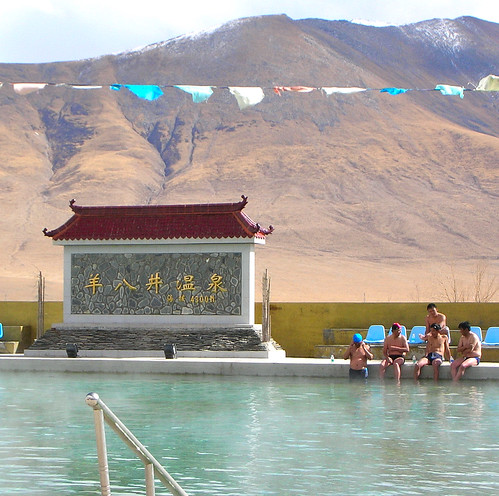

'Hot spring bath at 4600m'.
By Zuzi Griffiths. Though electricity was won since the 1970's, these pools were only filled in 1998 (1).

The Yangbajing hot springs field is extensive. It apparently covers a large area (40 km2, no less, though wikipedia notes 20-30 km2) and besides including the bathing complex (see photo) and geysers, it is also a source for geothermal energy, enough to sustain half of Lhasa so is learnt. I even managed to find an internet entry on Duoji, claimed to be the expert driving the geothermal power project of Yangbajing.

The uniqueness is further demonstrated with this tale of it's existence (from Magic (!) Tibet:
'It was said that long time ago, before the sky and the earth was separated, the whole world was in total darkness. People living at the foot of Mt. Nyainqntanglha were suffering. One day, a golden phoenix flied to the area, determined to create brightness by sacrificing itself. It threw one of its bright eyes onto the ground. A fairy caught the eye, and then a bright lamp arose in the air. Snow capped peaks of Mt. Nyainqntanglha appeared; grassland like huge carpet emerged; happiness came into Tibetan people. However, a greedy man near Yangbajing coveted the lamp. He took a witch man’s idea to sharpen his hatred into an arrow to shoot the lamp. The lamp was broken then, the pieces of the lamp dropped onto the ground, turning into hot springs and burned the man to his end. People said that the hot springs were the fairy’s tears'.
Rabbit writes on clickandrender an expansive piece on Yangbajing including many photo's.

The aforementioned wikipedia reference mentions that the hot springs bathing site goes by the neme of Holy Medical Spring Resort which
'... has both two indoor swimming pools and one outdoor swimming pool'. 
You dog?
The Dezong hot spring (Maizhokunggar county) contrasts greatly with the prior featured hot spring. 
Devoid of development, the setting is rustic and accompanying this is the fact that it's mostly frequented by locals whose disregard for formal attire provides outsiders (surprise, surprise mostly males) with a carte blanche to highlight their possible ultimate dreams.


For instance, this website states the following:
'The hot spring pool is divided into two zones-male pool and female pool. Though a flaw on the wall separating the pool, nobody would peep for lust-people there are quite pure.
...
Man and women bathing together with just a low stone wall between Bubbe bath and medical-worth are another TWO characters of Dezong Hot Spring. Somestimes, local pet dogs are lying by the pool 'appreciating' the naked tourists.'
What a load of info. Tibetan's have no lust? Local dogs do? Or do they really appreciate naked tourists?
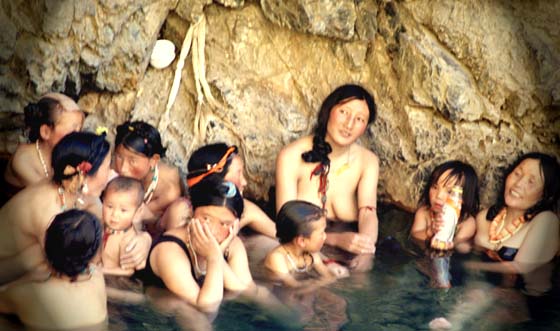
Tibettravel.org's dogs appreciating?

While discussing Dezong (sometimes spelt as Dezhong), China Service Mall asks the following question:
'Is there anywhere else you can bathe in curative, calcite and tussilago-infused waters while gazing upon the most rugged, photogenic landscapes on the planet?'
That seems a weird question, when there are more than 1000 other similar hot springs and the first randomly chosen hot spring featured on this site acclaims to the same!
They continue with the description of the hot spring:
'The Dezong Hot Springs are arranged in simple, rustic fashion, divided into a men's pool, above, and a women's pool, below. 40° C, jade-colored spring waters cascade 20 meters into the resort's pools'.
There was evidence that bathing in Dezong has been taking place for over 1400 years, which must be something of a record.

Mates
One of the more difficult factors when researching hot springs in Tibet is the lack of info foremost and the general confusement concerning the name. Often referred to as Tidrum (or Tirdum, Tridum, Tridom, Dedrom, Drigong) hot spring I believe may well be the same as the above. Pictures though are not conclusive. Experience though in both seems great.


'This is a view from the outside of the hot springs at Tidrum Nunnery'.

'Tidrum Nunnery was home to a hot spring. ...And not just any hot spring. These pools were world class. Gently carbonated, just over 100 degrees Fahrenheit, open to the stars—they don’t get much better than that. Joining eight or ten naked, intoning pilgrims, my attitude about the guest house quickly shifted. What at first seemed like a hardship post was in fact heaven.
My springmates stopped chanting long enough to warn me away from the patch of nettles growing along one edge of the pool. One part of me knew I shouldn’t stay too long, but another part was loving it enough to consider settling in until I simply moved on to my next life and could let my body be taken down the road for a proper sky burial.
After about fifteen minutes I looked up at the lone decoration, a framed photograph of a monk. Someone tried explaining the significance of the picture. Or perhaps he was telling me that my formerly white skin was looking lobster-like. I chose to see the one-way conversation as a sign that it was time to go. My sleep wasn’t half bad'.
Elsewhere Tibetwildyakadventures states:
'Concrete free, these hot springs are truly curative and relaxing. Men and women have separate bathrooms for changing. The best part is the fee. If things haven't changed when you go, it's only 5RMB per person to enjoy the hot springs and the nunnery is free. Some nunneries will offer free accommodations in certain circumstances. Whatever you do, don't get rushed by your driver or guide. This is a place to relax, forget about your watch and soak up the healing waters'.
Hillbilly hollar even introduces us to the aspect of professional soakers:
'Many professional soakers from all over Tibet come and stay for days. A room will cost you $5, and if you can't speak the language than it will be an instant noodle night for you. There is plenty of hot water'.
Where does one apply?

The men's pool at Tidrum by Jill and John. Most probably taken by John:
'To me it was just a lovely hot soak on a cool afternoon'.
More recent info, the Shambhala Serai Tirdom hotel recently opened up and describes itself as a spa / hotel:
'Shambhala Source has 18 rooms overlooking the canyon ravine, hot springs and meditation caves. Six “Tantric space suites” are two-story accommodations with a bathroom featuring a hot spring tub on the first floor with seating, and bedroom with private balcony overlooking the ravine on the second floor. Six other rooms are standard size and also feature a hot spring in the bath. Six more rooms have unsurpassed views over the canyon but no hot spring water directly in the room. All guests may use the open hot spring pool which all rooms overlook'.
A tripadvisor review:
'We stayed 2 nights here. It's a beautiful spot in a river gorge and has mens and womens hot spring pools which are great if your are not too modest. Rooms are marginally clean enough and hot water was no problem. Service was weak and no one speaks English. The restaurant food can generously be described as simple but adequate. Not a great place but probably much better than monastery guesthouse alternatives'.
Aerial View
Shambhala by redcapitalbeijing

Profiteering
Xungbara Qu gets one mention, that as a mini-hot spring in Doilungdeqen county (1).
The mini part lies in the lower temperature possibly. However drinking this water cures stomach aches and skin diseases, bathing stops itches. The same single source mentions that the curative qualities of the water has lead to the establishment of a pharmaceutical plant nearby
'... which are making good profits'.
Extensive search resulted in another find, Qusang hot spring of Doilungdeqen county. Or is it Quisang, Qui sang, Qub sang, Qusan or even Chu sang? Possibly the Qu could also refer to the Xungbara Qu of above. Geoinfo adds:
'Qubsang Qucain is a hot spring(s) and is located in Tibet Autonomous Region, China. The estimate terrain elevation above seal level is 4551 metres. Variant forms of spelling for Qubsang Qucain or in other languages: Qubsang Qucain (bo), Qiusang Qucan (zh), 邱桑曲灿 (zh), Qiusang Qucan, Qubsang Qucain, qiu sang qu can, 邱桑曲灿'.
Whatever, I did find this recent web text elaborating on the bathing habits at Qusang:
'Women were all wrapped in thick padded gowns and waiting outside. They just cared about when they could have a bath and paid little heed to us. When it's the time for women to take the baths, and no male are allowed to come into the hot spring. Males and females bathe in 6-hour turns and a bell notifies them when it's time to switch'.
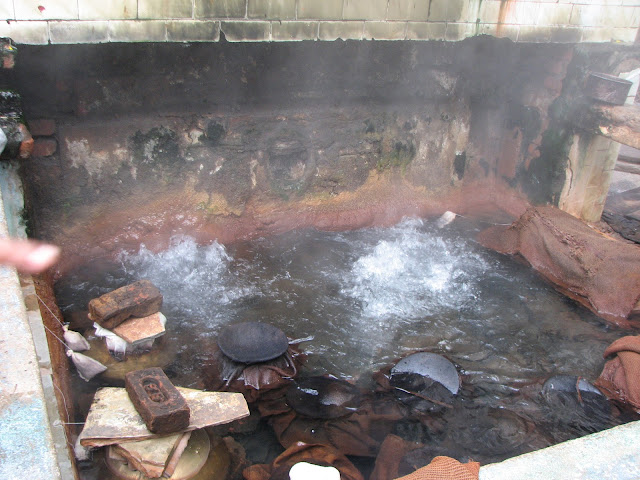
Just one of the three photo's of Qusang hot spring. No subtitle.

The website from which the photo above stems from, has a photo essay entitled
'西藏神奇的裸浴温泉 [Tibet's magic nude bath spa]'
Qusang would be Tibetan for quality water (source) which makes more sense.
Other info includes the fact that this hot spring is only 60 km from Lhasa.

Less info on more springs
Other hot springs in Maizhokunggar county are Paoshang and Riduo. Riduo seems to have certain unknown qualities:
'... is famous for its magic water functions which can improve people's health, beautify skin and adjust blood pressure'
as this website claims. 
But there's more:
'The water temperature at the spring source of Riduo can reach as high as 81C, but in spite of that, there is a harmless little worm living in the water which the locals call "holy worms".
In Rutog village, Maizhokunggar county, one can find the Rutog hot spring!
'[Rutog] is famous for its magic water functions which can improve people's health, beautify skin and adjust blood pressure. Endless visitors and believers come to the hotspring every day for bathing and pilgrim'.
This quote though seems to have partially disappeared from the internet, at least the latter part.
What I did find was that Rutog's springs now are directed to a bottling plant.

Purku hot spring is another hot spring most probably located in Lhasa, the reference at least refers to Nyemo, a county in Lhasa prefecture. This article sums up the hot spring as follows:
'The hot spring is in valley with lofty mountains rising to the sky on both sides. The Yarlung Zangbo River is compressed into a narrow curve at this point. There are many hot springs. On the opposite bank of the river is Tare Village, and there are several hot springs on the cliffs to the west of the village, where villagers have hollowed out several stone pits for people to bathe in winter. Purku Hot Spring is on northern bank of the river with the water temperature of 70 degrees Centigrade, too hot to bathe directly'.
Complete with pictures.
With probably the same hot spring, the book Tibetan Voices: A traditional memoir (Harris, 1996) reference is made of hot springs in Nyemo: 
'In Nyemo there is a very nice river where you could bathe in the winter. Along the banks were some places where you could dig down and the hole would fill up with hot water from an underground spring'.
Thus wraps up this intro to soaking in Tibet and highlighting a few of many of Tibet's hot springs. In the above one must note that the sources used may not always be correct; be it concerning the name of the hot spring or the location.

Notes:
(1) refers to the anonymous publication entitled Travel Guide to Tibet of China, published in 2003 by China International Press.
Harris, B. (1996) Tibetan Voices: A traditional memoir. Eds: H. Wardle , B. Harris, I. Marrs, C.S. Koller. Pomegranate, San Francisco, U.S.A.

Wednesday, December 24, 2014

Soaking Gods and Goddessess

A heavily updated entry of the hot soaks of Himachal Pradesh:

Following on the trail of the Indian sub-continent side of the Himalaya we have already featured Arunchal Pradesh state, Bhutan, Sikkim state, Nepal and Kashmir. 
South of Kashmir, but north of the Ganges plain lies Himachal Pradesh. Extremely convenient is the existence of a web site featuring Himachal Pradesh's hot springs, which mentions that the hot springs are popular. Most are located in Kullu district.

Out of Kullu
In Himachal Pradesh (or let's use HP) there are only two hot springs outside of Kullu that I could find; at least on the web. One is that of
Tattapani. Located in Mandi district, this hot spring is just beyond 50 km to the northwest of the state capital of Shimla.
'It is located on the right bank of river Satluj at an altitude of 656 meters. This natural sulphur spring is pure and has curative power for various kings of bodily ailments'.
There's a recently constructed place called Hotel Hot Spring Therme and Spa which seems to be the host of the hot spring. Tripadvisor notes that it has four and a half stars. It has a larger, more public pool and two smaller private pools.
From the hotel website:
'Tattapani is famous for its natural hot sulphur spring gushing out at the temperature of 65 degree Celsius near the the river. From the ancient time the local population well known the miraculous property of this water and come from all over the state to take a dip into the sulphur spring: this provides relief to the people suffering from joint pains, fatigue and stress or any type of skin disease and hence has got a great medicinal quality'.

There must be natural public springs as well. Go2india.in:
'Tattapani is famous for hot spring water coming out by the side of Sutlej River. These hot waters came out from different places on the river bed at Tattapani'.
The hot springs are highly frequented on the festival of Makar Sakranti which heralds the suns movement into the northern hemisphere and is considered an auspicious occasion to take a soak. Some recent dips have seen crowds upwards of 25,000 (source)!
'These hot water springs are situated on the bank of Sutlej river. The river is at 4-5 deg. celsius while the springs are at 60-70 deg. celsius. So you have to mix both waters to enjoy the bath'.
View of Hot water springs-

There is though some doubts as toward the future of Tattapani. The Tribune (Jan. 16, 2013):
'Local hoteliers, pilgrims and residents demand the immediate revival of the legendary hot sulphur springs at a higher side of the 800-MW Kol Dam project to save this tiny hot spring healing baths destination from “imminent manmade disaster”.
The National Thermal Power Corporation (NTPC) has asked the local administration to vacate the bathing sites by February 22 to make way for the filling of the dam for the project. This notification has spelt doom for local small-time vendors and pandas, who make a living from managing the bathing ghats for pilgrims performing rituals of “tula daan” and bathing along the bank of the Sutlej round the year'.
Since this info, the hydro project has been stalled due to technical problems (source), but submersion is the most likely outcome in the near future. The Times of India (Jan. 15, 2014):
'The devotees on Tuesday took ‘last dip’ in the holy waters and hot springs of Tatapani situated on the right bank of Satluj River to mark Makar Sankranti, considered a holy day.
Sources said that unusual rush of pilgrims was seen here on Makar Sankranti probably due to the fear of submergence of this site in dam waters. Around one lakh [100,000] pilgrims took holy dip at natural hot water springs at Tattapani.
...
Both the hot springs bath sites will be submerged in the reservoir of 800-MW Kol dam by the end of this year as the National Thermal Power Corporation (NTPC) authority has started filling up the dam.
“We have started the process to fill the dam reservoir from third week of December last year and it will be filled within 300 days. The water will be stored up to the elevation of 642 meters which will submerge the many areas including the hot springs of Tattapani,” Praveen Bharti, spokesman NTPC project at Kol Dam site said. He claimed that the NTPC authority has relocated the hot water springs at a higher location.
Sources said that NTPC authority has already paid the compensation to the local people here for the land which will be submerged in the reservoir water. Kol dam, the flagship hydro-power project of the NTPC shall be ready to generate power by 2014-15'.
Progress? What if they had tried to develop the geothermal potential?

Anyway, the other hot spring in Mandi district is Jeori, located in Kinnaur district (source).

Jeori, source

A soak to worship
A number of hot springs are located not far from each other in Kullu district, near the town of Manali.

On the bank of the Parvati river, are the hot springs known as
Manikaran which appear along a 1 km long built-up strip. The waters are very hot and besides being used for soaking purposes, they are used to boil meals; a Sikh temple here specializes in producing such meals. The religious significance for the Sikhs and the Manikaran hot springs finds it's origins in that the thermal springs were visited by a Sikh Guru Nanak Dev. This had lead to there being a number of hot pools specifically for Sikh.


'Hot Water Spring at Manikaran'
By Sanjay. Note the cookers along the edge of the spring.

Besides religious significance for the Sikh, Hindu's also see religious significance in the hot springs, according to this legend:
'According to a legend, Manikaran is associated with Lord Shiva and his consort Parvati. Mani Karan means Ear Rings - it is said that once, while taking bath here, Maa Parvati lost her ear rings in the Kund (pond). When she told it to Lord Shiva, he became furious and looked at the water of the kund with great anger and then thousands of ear rings flowed out from the boiling water and since then the water of the spring is boiling'.
Wikipedia has an extensive listing of the religious significances of Manikaran for both religions.
There are many video's of Manikaran, follow the link to just a few on You Tube.

But besides cooking and religion, there are also soaking sites. A recent (July, 2014) experience:
'When we got to the hot springs, I asked if I could dip my foot into the water. He sent us upstairs to house of worship. On the second try, he pointed out the men’s and woman’s bathing sites. The men’s site was out in the open and anyone walking by could look in. I got into the hot spring water and posed for some pictures. When I got out, I asked Kim how her experience was. She told me that she left the women’s area. After getting past the door, all of the women were bathing in the nude. She got out of there without dipping even a toe in the water! I told her I would have traded places with her!!
'Pilgrims bathe in the hot springs of Manikaran next to the roaring Parvati River'.

Further Upstream
Besides being a haven for Israeli tourists (source),
Kasol (which is 1 km further upstream from Manikaran) also has a hot spring. Or hot springs. The temperature is said to be lower than that of Manikaran, affording visitors with a real possibility to soak and not scald.
 

It's quite difficult to pinpoint the hot spring exactly. Following are 3 links to photo's of hot springs in or near Kasol, but all looking differently. FractalEnlightenment.com, Shailpanoramio and Yossi. The former though is a private hot spring attached to the Taji guesthouse, more out of town. Apparently there is more than 1 site; there's even a reference mentioning springs on both sides of the river. Though another states:
'Hot water emerges only at one location at Kasol'.
Taking a bath in one of the hotsprings in Kasol #kasauli #hotspring #himachal #pradesh #india

Whatever, there is this recent (Nov. 2013) description of Kasol:
'Kasol is a backpacker’s paradise. This tiny village is inhabited mostly by tourists from Israel which is why most of the hoardings are in Hebrew and even in restaurants, one would find Israeli menus mostly. Kasol is ideal for a vacation if you want to chill in the lap of nature'.
From this photo I deduce that there also hot tub huts for rent:

 My divine treat, a deluxe hot bath.

Naturally
While researching hot soaks in the Indian administered parts of the Himalaya, one of the only hot springs still remaining in it's true natural surroundings is the hot spring of
Khirganga (Kheer Ganga / Kheerganga). Khirganga is located another 12 km upstream of Kasol and can only be reached on foot.

From Wikipedia:

'... the trail ascends further through thick pine forests to the spiritual site of Khirganga (Kheerganga), a meadow at 2960m where Shiva is said to have meditated for 3000 years. The hot springs at Khirganga are extremely important for Hindu and Sikh pilgrims as well as many others who believe the waters have sacred healing properties'.
The end of the journey means a chance to soak in near natural surroundings with views of majestic Himals. 
But only for men. In India, women can't been seen in whatever state of undress in combibnation with water (unless of course it's a Bollywood blockbuster) so they have to be content with the view of 4 walls. Which is a pity if you see the magnificent surroundings.
The name Khirganga refers to white milk, the substance these waters near in colour, probably due to the sulphur content.


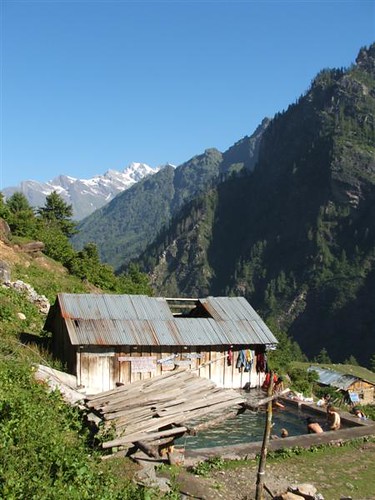
'KhirGanga hot springs'
by ohad_katzin. In front the pool for men,
behind the shed for women (with improvised skylight); out of soaking site the incredulous view. Since though, the roof has fallen into disrepair ...

Experiencing the women's soak ...
Closer to Mainali is the village of Vashisht which (like Manikaran above) has many springs covering a wider area. With access to Mainali guaranteed, Vashisht (or Vashist) has become famous for it's hot springs; it's reputed that daily nearly 3,000 visitors come for a soak, though this description mentions it to be a small peaceful village ..... 
As with Manikaran, this Vashisht hot springs have been listed in India's top ten of hot springs.
In common with nearly everywhere in India, the appearance of hot water springs has lead to the establishment of temples, here named after the spiritual master of Rama, Vashishta.
'Inside the grounds of the Vasistha Temple there are two hot spring pools that are free. They can get a bit dirty'.
A real experience:
'... the hot water springs that flow into an area in the village, from the mountains, boiling water, and the smell of sulphur, where they all do not only their washing of clothes but soap themselves all over the men and boys in their underpants, and wash/bathe... then of course the Public bathing areas of which there are three, like open air mini swimming pools, fed by the hot spring water where every Tom dick and Harry lounge and bathe, right by the old Vashisht Temple of which there are a few here,(temples) there are the free common public baths, which look utterly disgusting and unhygienic, then regular baths and the deluxe baths, looking at them I don't think I personally would want to step foot in any!! Particularly as you can be seen from the cafes and guest houses above getting changed...well maybe not in the private deluxe ones but no thanks all the same!!! The Indian pilgrims come to ceremoniously bathe in the hot spring waters and visit the temples here..... '
Obviously this was blogged by a man.
 

What happens over at the ladies? Lael wrote this on myspace:
'I went into the bath yesterday. There were a couple of Indian women and several little girls. The water was really hot. I have a little thermometer attached to my bag and I took it in the water with me the first time, 112 degrees. I got in and out, my feet feeling more and more cooked each time and playing with the little girls. Indian tourists from other parts of the country came and went, just dipping their feet into the water for blessing. Public places in India are usually filled with men so it was really refreshing to be around all women. I will be headed back there in the evening when the weather cools off a little bit'.
More from the women's side of the springs from Kara and Max:
'Hot springs! Vashisht is blessed with an unlimited supply of scalding hot water, and the townsfolk are appropriately grateful. The source of the springs has a temple built around it where locals come daily to wash and pray. Foreigners are also welcomed into the temple's relaxing sulfuric pools. Inside the temple there are two pools for men and women separated by an ancient stone wall. Kara was pleasantly surprised to see that the strict taboo against nudity dissolved into the steam of the women's bathing area. It was the first time Kara ever saw an Indian woman showing her full skin in the 11 months she has spent in India. Go women of Vashisht! she says. Max was disappointed that the men's pool was in full view of the street above, and so he could not enjoy full relaxation in his birthday suit. Both pools are piping hot and it is a test of endurance to submerge one's full body in the holy water. We always left the hot springs completely rejuvenated and calm. Unfortunately photos are prohibited in the temple...'.
Unfortunately this, however it's not the only such amazing experience.
Ashley in a blog adds to what I believe is also a hot spring visit to Vashisht:
'The female body is sacred in India. They do everything they can to cover their bodies and sometimes will be married for years before even their husbands see them nude. ... As I entered the hot spring I couldn't believe my eyes. There were about a dozen nude women, all shapes, sizes and ages, laughing and slashing about, scrubbing each others backs and just having a grand old time'.
The fascinating blog entry ends with self-reflection:
'Bathing with those women in the hot springs day after day I felt my attitude and self image shifting. Being a young woman growing up in American culture you have societal pressures placed on your body image. I never thought of myself as being insecure about my image but I found myself subconsciously judging others. Not on purpose, but just as a result of our societies labels on beauty. I always wanted children, a lot of them, but I did worry about the toll child baring would take on my body. What I saw in those hot springs was pure, natural, unmanipulated beauty. Everyone of them was perfect and there was not even a glimpse of judgment or shame. It was so inspiring and erased and fear of aging I may have had. Their confidence was beautiful, their smiles were beautiful, the love in their eyes was beautiful, and every curve on their body was absolutely beautiful!'
As is the description.

Besides the public pools,
HP Tourism Development Corp. is said to be running
'turkish style baths'
with more private facilities. Their own web site fails to mention this .... This site mentions that it is due to a dispute between
'... the villagers and the Himachal government regarding payments and the water supply that the villagers believe to be theirs by right. In the meantime, the only place for a hot soak is in the bathing pools of Vashisht’s ancient temple (free) which is far more atmospheric anyway'.
Such is the fame of Vashist, that the Tribune (7 Dec. 2008) even mentions it's a significant place for local Gods and Goddesses:
'Vashisht village is not only known for its hot water springs and the' Vashisht rishi temple, but also for the sanctity of the shrine where the gods and goddesses of Kullu valley visit to take a holy dip'.

Sunday, July 27, 2014

Lisu soaking exposed

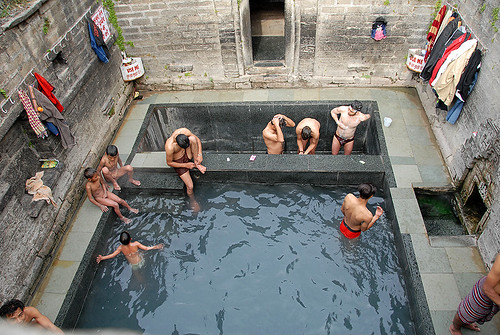
  Source
 
Lisu Bathing
Bordering Burma, the Lisu ehtnic minority live along the banks of the upper Nujiang (Salween) river, in the autonomous prefecture of Nujiang, one of the westernmost administrative divisions of Yunnan, China

Lisu tradition dictates the local custom of holding a bathing festival coinciding with the their new year celebrations. 
This tradition of holding a bathing festival is very much similar to the Tibetan custom (Garma Ri Gi). The tradition transcends the mountain themselves; Hindu's have traditional bathing festivals as well as adhering spiritual connections to water. 
Unique to the Lisu of Nujiang is the involvement of hot springs, which seems sensible considering the time of the year the event is held.


'Every Spring Festival, the Lisu people gather at the Hot Springs by the Nujiang River
By taking baths and washing off dirt with sacred spring water,
people hope for forthcoming auspiciousness'.
Posted by Funansan.

Th Lisu tradition of bathing in hot springs at New Year is called Kuoshi Festival (the New Year festival) determined to be from 20-22 December each year contrasting with Tibet's mid-summer bathing tradition. The practice though does have it's local roots:
'Legend says that the estuary of a huge pool below the cliffs at the foot of the east Gaoligong Mountain was guarded by a pair of little green sparrows. When local people gave parties, year after year, these green sparrows magically provided all the bowls, chopsticks, tables and chairs needed. Then a man failed to return the borrowed articles to the birds and enraged the Dragon King, who ordered that the pool be filled up. The birds turned into girls who bathed in the hot spring near the pool and departed. Consequently, early spring every year, local residents camp near the spring to offer sacrifices to the Dragon King and the magic sparrows, and bathe'.
Others simply see the custom of holding a bathing festival in more practical terms:
'By taking baths and washing off dirt with the sacred spring water, people hope for the forthcoming of auspiciousness'.
Then again the bathing is only a minor part of the festival apparently:
'The most interesting event of the Lisu people's traditional Kuoshi festival is the Hair-Combing Contest held on the first and seventh days of the first lunar month'.
The bathing festival seems to coincide with the Lisu New Year, but might just follow the Kuoshi festival; the Bathing Festival is
'... usually held in the first month of the lunar year'.
Which one could also describe as very early spring .... 

How to soak Lisu Style
Though soaking is part of the Lisu cultural tradition, this source puts the whole soaking process in more evocative terms:
'When the time comes, people from near counties and regions, wearing rich dresses and bringing food, luggage and even cooking stuff, keep pouring in. Tents cover the place, which is quiet in normal times. People all crowd together, singing and smiling happily, and the scene is full of bustle and excitement. The "Spring Bathing Festival", which used to be a day to take bath and cure diseases, now becomes a festival of revelry for people to spend holidays and dance and sing. Especially for youths at their life's full flowering, they gather together in dozens or even hundreds to compete songs, poems and look for lovers. It lasts all through the night and they never feel bored with it'.
No, soaking is not boring here.

However, when searching the web for hot springs in the Nujiang Autonomous Prefecture nearly all focus on the bathing during the festival, as if no soaking takes place at other times. 
And unfortunately most of the reporting on the festival involves sensationalizing the methods of bathing. 
For instance eChinacities includes Nujiang valley hot springs in China's Top 5 Best Nude Bathing Areas despite the fact that the Lisu bathe only semi-naturally ....
It even means that simply the sight of seeing soakers soak can be the ultimate destination. From Yunnantour.net:
'Every year, during the Spring Festival period, Lisu minority people will have bath together in hot springs along both sides of Nu River (the Salween). And held many activities such as poem contest, singing and dancing, etc, to celebrate the coming of spring season. This trip is specially good for photographing'.
For proof purposes the site no longer exists alas. 

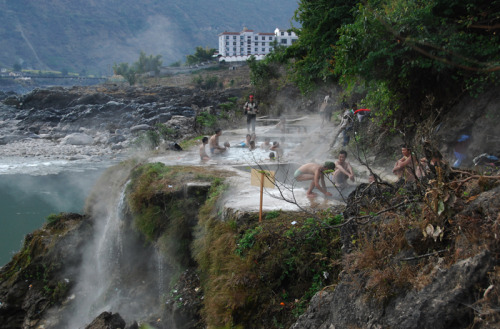
Source, caption translated by google:
'Captain guide whispered, pointing to the river: there is beauty in the hot springs! Aha! This really been kept under Liu arrived, I saw the green leaves masking, several topless women are soaked in smoke curl Zaochi, the Liu quietly approaching, when they found me immediately picked up a towel to cover the naked upper body let me exceedingly disappointed!'
And how is the experience seeing soaking locals?
'I left the competition place at noon and walked to visit their "zaotanghui" (public baths) gathering. Some women were taking baths in the hot springs, laughing and playing. Even when tourists focused their cameras on them, they did not behave in an offended manner. What a simple and happy nationality'.
So much for the modern man ... 
Another visitor mentions that the bathing festival is highlighted by eight camera bearing tourists and adds this:
'It is said, used to be with the bath naked men and women, and now more and more "civilized", "naked" too little, men and women are "incompatible", and is generally sub-pools and baths'.


Future
Anyway, modernity also plays a major part in the future of some of these soaks. The Sydney Morning Herald no less, also takes a soak with the locals:
'Men and women alike stripped to their underpants, Wa Ba's family and friends sat soaking in hot pools fed by a geothermal spring gushing from a mossy crevice under the gnarled roots of a banyan tree on the bank of the Nu River.
As his wife tended a kettle over a wood fire and young women drank cups of hot water straight from the spring, Wa offered round a bottle of his homemade rice wine, a clear brew strong enough to give a noticeable buzz from just a capful.
"Usually we take a bath here on the eve of the new year, so we're a bit late this year," said Wa, who lives in Dapicha, a village half an hour's walk away. "If you bathe here when the year is new, it protects you from illness" '.
Reported in 2005, it then goes on to mention that:
'But the hot pool enjoyed by Wa's group, the land of Pi's community, and perhaps even the tenure of his Lisu people in the Nu Valley, are threatened.
Just downstream from the hot spring, about five kilometres up from the town of Liuku, marker pegs stenciled "Liuku Power Station" are rammed into the earth beside a tunnel into the hillside. When built later this decade, the dam's reservoir will submerge the hot spring and many small farms and villages lining the river'.
Though the loss of the soaks is certainly a disadvantage, the projects (once completed) will certainly massively impact the local inhabitants and change their ways of life with no way back.
The consequences will also be felt in countries downstream, for instance now (in 2014) the Mekong is drying up along Thailand and in Lao, consequences attributed (by the press) to dams on this river, while decreasing waters are leaving Vietnam's Mekong delta more prone to become more saline, thus affecting agricultural negatively.
That said, dams have many environmental advantages over alternatives but being highly intrusive is not one of them.

The opposition, though not entirely successful, has been able to stall the construction according to the Times (21 May 2009). Opponents are organised in the Save the Nujiang as well as Salween Watch
The former reports that recently (March 2014) that construction is scheduled to start.

'Ritual bathing in hot springs is a part of the Lisu New Years tradition. These public springs will be deluged if the dam projects are completed. During Spring Festival camps are built near the pools which makes for a festival atmosphere'.

The soaks of Nujiang
Despite the considerable wealth of information on how the locals soak, hardly any information is available on where they soak and definitely no personal experiences are described on the net in English. Swell.

Some places that are mentioned as having soak sites are Chawalong, which is located in the north of Nujiang prefecture. The photo available on flickr doesn't endear itself to potential soakers though ....

Elsewhere mention is made of hot springs, 10 km north of Liuku city (Lushui county), the prefectures administrative center. These are Laomudeng (possibly), Bazhaodeng, Baihualing, Denggen and Mazhanghe (source).

Then this visitor mentions a distance of 30 km from Liuku and after google translate the following conspires:

 
'Fellow men left after another, but the ladies unwilling. Japan recalled bare bulbs, everyone wants to feel that part of the wonderful review in China at this time to revisit. At this point nothing can stop them, bidet into the embrace of the idea of ​​natural strong impact on them, and off it! Water it! Let those men waiting on top of it! Several women from the big city to abandon the secular, but also learn the local Lisu villagers, naked and jumped into the pool to that Pitt among the skin smooth and soft shine of turquoise water is more tender and beautiful in the clear water of the figure will undoubtedly expose'.
So to sum it up: there seems to be a lot of possibilities but does anybody know where?