Showing posts with label Lhasa. Show all posts

Sunday, September 6, 2015

Drama

Friends
To start off this photo post, let's see what recent pictures were published from the former Soviet republic. To start with current day Russia and the many hot springs surrounding the Baikal lake, Siberia. This being Zaibaikal:

 
#hotsprings #lakebaikal #russia #siberia #friends #howmanypeoplefitinonetub #rudelbumsinrussland #nature #baikalsee
dámské
In the mountains of Kyrgyzstan, this peculiar hot spring, a must-see of every off the trodden path tourist, source.
KAZAKHSTAN, BAIKONUR : People cool off in a hydrosulfuric spring at the bank of the Syr Darya river in Kazakhstan’s city of Baikonur, near the well-known Russian leased cosmodrome, on August 29, 2015. The temperature in the city reached 29 degrees celsius. AFP PHOTO / KIRILL KUDRYAVTSEV
Source

Car wash
Heading more to the south, Mongolia and Tibet:

Mongolia!!! Paradise 
source

 Many of the nearby hills were covered in prayer flags, as are almost all the hills in this part of the world. Nearby is the Northern Sichaun-Tibet Highway. Along the highway is Darjay Gompa, an important monastery that seemed like all the other monasteries to me. The dirt roads had Tibetan horsemen, roaming groups of village children (“I love you America!”) and monks on motorcycles. 
There is a small hot-spring with lukewarm water on the other side of a river from Talam Khang. There are always ten or more people there, taking baths and chatting and a nearby shop sells alcohol. Ana was hesitant to get into the water in the almost entirely naked man-infested pool. There was trash all around the edges – though almost all Tibetan people live off the land, they could hardly be seen as environmental stewards, the addiction to producing garbage has afflicted them, too. They drive their motorbikes and cars everywhere. It isn’t strange to see them herding yaks on motorbike, honking and whipping at them in the mountain grasslands, their campsites strewn with empty bottles and instant noodle packaging.
At night I went for a beer at the warm springs and was sitting on a rock with the Germans. A man drove his jeep right into the pool and started washing the mud off of it just a couple feet from us.
 objevily jsme horké prameny!
Somewhere on the Tibetan plateau, source. 

The Dezhong hot spring, Lhasa, Tibet, source. 

Wild and free
Then on to the Himal proper: later Nepal. 
From India comes this photo entry from ramblingwiththerickshaws, a thoroughly enjoyable and different experience of India.

 I never thought smelling like sulfur would become such a memorable and special experiment and although I am fully clothed the rest of the time here in India, going wild and free will always have a special meaning meaning for me, especially in the Himalayas.
This hot tub is acceptable. #nepal #chame #yodo #yolo #yolohomo #rkon #rkoi #hottubbin #hottub #hotsprings #annapurnacircuit #annapurna #annapurnasanctuary @eyes_without_a_face_369 - 
Source
Monsoon season is already here in the Philippines, despite the summer heat. Don't know why, but it made me think of this place. After a tiring and hot second day on the Tamang Heritage Trail, we finally made it to the village of Tatopani. And this was our reward - a relaxing and steamy bath in the village's hot spring with a view of the Himalayas. At night it rained and hailed. But it was quite warm inside the dining hall. A bad Nepali (or maybe it was Indian) drama tv show being watched by the village children made us laugh and entertained us throughout the night. I miss trekking in Nepal. // Tatopani, Tamang Heritage Trail, Nepal

Tuesday, August 11, 2015

At a high

Top of the world
What follows are those hot springs located in and around Lhasa, Tibet's capital which were originally in another posting, but changes / changes.

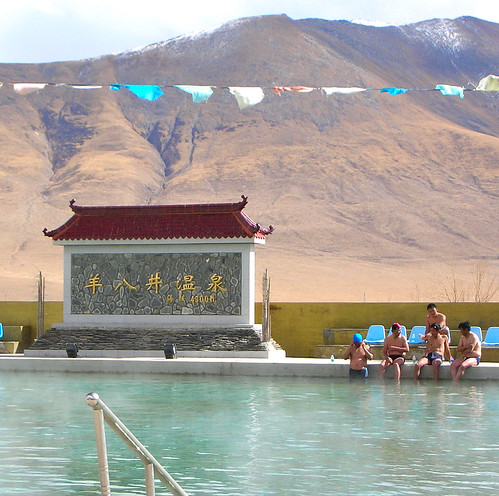
Superlatives are used to describe the hot spring of Yangbajing (or alternatively Yangpachen) located in Doilungdeqen county, 87 km north of Lhasa. And arguably one of Tibet's most well-known.
This in part is due to access; the hi-speed railroad to Lhasa passes here and there is a station, enable dieembakation. Even Micheal Pailin made it here, so why not join in?

The Yangbajing springs are massive and are stated  to be the highest altitude springs in the world.
Included as one of the World's Most Amazing Hot Springs, this site is less direct:
'The Yangbajing hot springs field is at an altitude of 4290–4500 m which makes it the highest altitude set of hot springs in China, and possibly the world'.
(Btw, Conumdrum hot springs (CO) are the highest in North America at 3,400m while Boliva's Termas de Polques hot springs are notched at 4,400 (close ...)).

Others have included Yangbajing as one of the 10 Coolest Places to Swim, which seems a bit odd; though the temperature may be cold, the water is hot.


'Hot spring bath at 4600m'.
By Zuzi Griffiths. Though electricity was won since the 1970's, these pools were only filled in 1998 (1).

The Yangbajing hot springs field is extensive. It apparently covers a large area (40 km2, no less, though wikipedia notes 20-30 km2) and besides including the bathing complex (see photo) and geysers, it is also a source for geothermal energy, enough to sustain half of Lhasa so is learnt. I even managed to find an internet entry on Duoji, claimed to be the expert driving the geothermal power project of Yangbajing.

The uniqueness is further demonstrated with this tale of it's existence (from Magic (!) Tibet:
'It was said that long time ago, before the sky and the earth was separated, the whole world was in total darkness. People living at the foot of Mt. Nyainqntanglha were suffering. One day, a golden phoenix flied to the area, determined to create brightness by sacrificing itself. It threw one of its bright eyes onto the ground. A fairy caught the eye, and then a bright lamp arose in the air. Snow capped peaks of Mt. Nyainqntanglha appeared; grassland like huge carpet emerged; happiness came into Tibetan people. However, a greedy man near Yangbajing coveted the lamp. He took a witch man’s idea to sharpen his hatred into an arrow to shoot the lamp. The lamp was broken then, the pieces of the lamp dropped onto the ground, turning into hot springs and burned the man to his end. People said that the hot springs were the fairy’s tears'.
Rabbit writes on clickandrender an expansive piece on Yangbajing including many photo's.

The aforementioned wikipedia reference mentions that the hot springs bathing site goes by the neme of Holy Medical Spring Resort which
'... has both two indoor swimming pools and one outdoor swimming pool'. 
You dog?
The Dezong hot spring (Maizhokunggar county) contrasts greatly with the prior featured hot spring. 
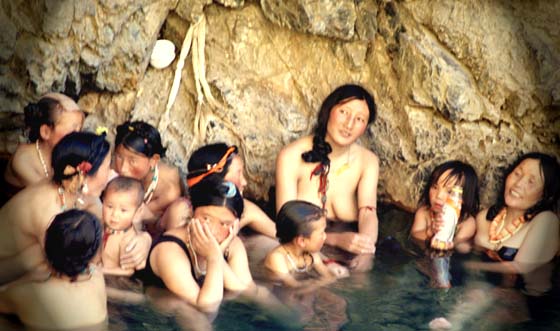
Devoid of development, the setting is rustic and accompanying this is the fact that it's mostly frequented by locals whose disregard for formal attire provides outsiders (surprise, surprise mostly males) with a carte blanche to highlight their possible ultimate dreams.


For instance, this website states the following:
'The hot spring pool is divided into two zones-male pool and female pool. Though a flaw on the wall separating the pool, nobody would peep for lust-people there are quite pure.
...
Man and women bathing together with just a low stone wall between Bubbe bath and medical-worth are another TWO characters of Dezong Hot Spring. Somestimes, local pet dogs are lying by the pool 'appreciating' the naked tourists.'
What a load of info. Tibetan's have no lust? Local dogs do? Or do they really appreciate naked tourists?

Tibettravel.org's dogs appreciating?

While discussing Dezong (sometimes spelt as Dezhong), China Service Mall asks the following question:
'Is there anywhere else you can bathe in curative, calcite and tussilago-infused waters while gazing upon the most rugged, photogenic landscapes on the planet?'
That seems a weird question, when there are more than 1000 other similar hot springs and the first randomly chosen hot spring featured on this site acclaims to the same!
They continue with the description of the hot spring:
'The Dezong Hot Springs are arranged in simple, rustic fashion, divided into a men's pool, above, and a women's pool, below. 40° C, jade-colored spring waters cascade 20 meters into the resort's pools'.
There was evidence that bathing in Dezong has been taking place for over 1400 years, which must be something of a record.

Mates
One of the more difficult factors when researching hot springs in Tibet is the lack of info foremost and the general confusement concerning the name. Often referred to as Tidrum (or Tirdum, Tridum, Tridom, Dedrom, Drigong) hot spring I believe may well be the same as the above. Pictures though are not conclusive. Experience though in both seems great.


'This is a view from the outside of the hot springs at Tidrum Nunnery'.

'Tidrum Nunnery was home to a hot spring. ...And not just any hot spring. These pools were world class. Gently carbonated, just over 100 degrees Fahrenheit, open to the stars—they don’t get much better than that. Joining eight or ten naked, intoning pilgrims, my attitude about the guest house quickly shifted. What at first seemed like a hardship post was in fact heaven.
My springmates stopped chanting long enough to warn me away from the patch of nettles growing along one edge of the pool. One part of me knew I shouldn’t stay too long, but another part was loving it enough to consider settling in until I simply moved on to my next life and could let my body be taken down the road for a proper sky burial.
After about fifteen minutes I looked up at the lone decoration, a framed photograph of a monk. Someone tried explaining the significance of the picture. Or perhaps he was telling me that my formerly white skin was looking lobster-like. I chose to see the one-way conversation as a sign that it was time to go. My sleep wasn’t half bad'.
Elsewhere Tibetwildyakadventures states:
'Concrete free, these hot springs are truly curative and relaxing. Men and women have separate bathrooms for changing. The best part is the fee. If things haven't changed when you go, it's only 5RMB per person to enjoy the hot springs and the nunnery is free. Some nunneries will offer free accommodations in certain circumstances. Whatever you do, don't get rushed by your driver or guide. This is a place to relax, forget about your watch and soak up the healing waters'.
Hillbilly hollar even introduces us to the aspect of professional soakers:
'Many professional soakers from all over Tibet come and stay for days. A room will cost you $5, and if you can't speak the language than it will be an instant noodle night for you. There is plenty of hot water'.
Where does one apply?

The men's pool at Tidrum by Jill and John. Most probably taken by John:
'To me it was just a lovely hot soak on a cool afternoon'.
More recent info, the Shambhala Serai Tirdom hotel recently opened up and describes itself as a spa / hotel:
'Shambhala Source has 18 rooms overlooking the canyon ravine, hot springs and meditation caves. Six “Tantric space suites” are two-story accommodations with a bathroom featuring a hot spring tub on the first floor with seating, and bedroom with private balcony overlooking the ravine on the second floor. Six other rooms are standard size and also feature a hot spring in the bath. Six more rooms have unsurpassed views over the canyon but no hot spring water directly in the room. All guests may use the open hot spring pool which all rooms overlook'.
A tripadvisor review:
'We stayed 2 nights here. It's a beautiful spot in a river gorge and has mens and womens hot spring pools which are great if your are not too modest. Rooms are marginally clean enough and hot water was no problem. Service was weak and no one speaks English. The restaurant food can generously be described as simple but adequate. Not a great place but probably much better than monastery guesthouse alternatives'.
Aerial View
Shambhala by redcapitalbeijing

Profiteering
Xungbara Qu gets one mention, that as a mini-hot spring in Doilungdeqen county (1).
The mini part lies in the lower temperature possibly. However drinking this water cures stomach aches and skin diseases, bathing stops itches. The same single source mentions that the curative qualities of the water has lead to the establishment of a pharmaceutical plant nearby
'... which are making good profits'.
Extensive search resulted in another find, Qusang hot spring of Doilungdeqen county. Or is it Quisang, Qui sang, Qub sang, Qusan or even Chu sang? Possibly the Qu could also refer to the Xungbara Qu of above. Geoinfo adds:
'Qubsang Qucain is a hot spring(s) and is located in Tibet Autonomous Region, China. The estimate terrain elevation above seal level is 4551 metres. Variant forms of spelling for Qubsang Qucain or in other languages: Qubsang Qucain (bo), Qiusang Qucan (zh), 邱桑曲灿 (zh), Qiusang Qucan, Qubsang Qucain, qiu sang qu can, 邱桑曲灿'.
Whatever, I did find this recent web text elaborating on the bathing habits at Qusang:
'Women were all wrapped in thick padded gowns and waiting outside. They just cared about when they could have a bath and paid little heed to us. When it's the time for women to take the baths, and no male are allowed to come into the hot spring. Males and females bathe in 6-hour turns and a bell notifies them when it's time to switch'.
Just one of the three photo's of Qusang hot spring. No subtitle.

The website from which the photo above stems from, has a photo essay entitled
'西藏神奇的裸浴温泉 [Tibet's magic nude bath spa]'
Qusang would be Tibetan for quality water (source) which makes more sense.
Other info includes the fact that this hot spring is only 60 km from Lhasa.

Less info on more springs
Other hot springs in Maizhokunggar county are Paoshang and Riduo. Riduo seems to have certain unknown qualities:
'... is famous for its magic water functions which can improve people's health, beautify skin and adjust blood pressure'
as this website claims. 
But there's more:
'The water temperature at the spring source of Riduo can reach as high as 81C, but in spite of that, there is a harmless little worm living in the water which the locals call "holy worms".
In Rutog village, Maizhokunggar county, one can find the Rutog hot spring!
'[Rutog] is famous for its magic water functions which can improve people's health, beautify skin and adjust blood pressure. Endless visitors and believers come to the hotspring every day for bathing and pilgrim'.
This quote though seems to have partially disappeared from the internet, at least the latter part.
What I did find was that Rutog's springs now are directed to a bottling plant.

Purku hot spring is another hot spring most probably located in Lhasa, the reference at least refers to Nyemo, a county in Lhasa prefecture. This article sums up the hot spring as follows:
'The hot spring is in valley with lofty mountains rising to the sky on both sides. The Yarlung Zangbo River is compressed into a narrow curve at this point. There are many hot springs. On the opposite bank of the river is Tare Village, and there are several hot springs on the cliffs to the west of the village, where villagers have hollowed out several stone pits for people to bathe in winter. Purku Hot Spring is on northern bank of the river with the water temperature of 70 degrees Centigrade, too hot to bathe directly'.
Complete with pictures.
With probably the same hot spring, the book Tibetan Voices: A traditional memoir (Harris, 1996) reference is made of hot springs in Nyemo: 
'In Nyemo there is a very nice river where you could bathe in the winter. Along the banks were some places where you could dig down and the hole would fill up with hot water from an underground spring'.
Thus wraps up this intro to soaking in Tibet and highlighting a few of many of Tibet's hot springs. In the above one must note that the sources used may not always be correct; be it concerning the name of the hot spring or the location.

Notes:
(1) refers to the anonymous publication entitled Travel Guide to Tibet of China, published in 2003 by China International Press.
Harris, B. (1996) Tibetan Voices: A traditional memoir. Eds: H. Wardle , B. Harris, I. Marrs, C.S. Koller. Pomegranate, San Francisco, U.S.A.

Monday, April 30, 2012

Getting high. Introducing Tibet


Tirdum hot spring, by Ying

Tibet's soaks
The area known as Tibet Autonomous Region (TAR) is a vast area covering the huge mountainous plains north of the Himalaya divide.

As one would expect, both the immenseness as well as the mountainous terrain give a huge potential for thermal activity. Mushroom expert Daniel Winkler mentions more than 1000 possible hot springs!
The Travel Guide to Tibet of China (see note 1) mentions
'... geologists have found over 630 geothermal spots'.
All noted, pinpointing the exact soaks is not an easy task. Tourism is limited, the local population mostly dispersed. That means that finding those thousand springs on the internet is most probably not going to be achieved.

Sites containing Tibet soak sites lists are near non-existent.
Probably the only website other than this site with notes on Tibetan hot springs is that by the aforementioned danielwinkler.com, though these are mostly references to soaks in the Ganzi Tibet, a prefecture of Sichuan province, not Tibet proper.

Elsewhere, the significance of Tibetan hot springs is highlighted as there are two mentions in China's Top 10 Most Popular Hot Spring Resorts, the same list as others refer to as China's Most Romantic hot springs, even though one of the two listed permits gender separate only bathing. Very romantic!

What is clear is that the aforementioned dearth of accessible info seems to contrast both with local penchant for soaking as well as increased popularity of soaking in China.
My impression from accessing hundreds of websites on the subject of Tibetan soaks, is that the Chinese favour an organized hot spring whereas the local population simply savour the opportunity and benefits a local (if somewhat rustic) soak may provide.

Somewhere in Tibet. By Songpinghan:
'Buddha monks taking a bath in hot spring water'. (not working)
Bliss
Bathing experiences are on a whole quite diverse. Fox on the Run sums up his quest for a soak as follows:
'I have to admit I got a bit confused by the whole hot spring issue in Tibet. For me, the term hot spring conjures up images of bubbling pools, either natural or of the "cement pond" type, where you can lie back and let the hot water work on your aching muscles, preferably while you sip on a cocktail. We encountered several hot springs during this trip, none of which even came close to my mental image. For the most part they were like little streams coming out of the ground, sometimes creating puddles and usually just building interesting mineral formations. They were definitely not big enough to comfortably climb into. In some locations, industrious locals would build bath houses where the hot water was piped into stalls either through shower heads or directly into tubs. In these places you could at least get clean, but there was no lounging around with friends in your bathing suits enjoying a drink and a soak'.
That typified Tibetan soak however is not as typical.

These intrepid travellers savour the soak reluctantly, but though they may not be so positive, the experience is so much purer. Or so it seems:
'Finally we found what looked like a women’s pool. A bunch of ladies were just leaving, including one girl who spoke Hindi and had just returned from Bylekuppe, a massive Tibetan settlement near my home town in India! Conscious of offending local women but tempted by the water, I nervously stripped down to my undergarments and waded in. This water was just right (am beginning to sound like Goldilocks now!) Soon two nuns arrived on the scene. They told me that they had walked for two hours over the hills just to soak. They started to strip. I had never realized how many layers of clothing nuns wore…it went on and on…and then suddenly they were naked. I was traumatized…it was like seeing the Shankaracharya or Mother Teresa nude!
Then a bunch of ladies arrived with their pink cheeked snotty nosed offspring. The women wore some elaborate braids with turquoise and ribbons. Some had thick woolen capes and had obviously not bathed for quite a while. They all stripped down to basics too. Now Cat and I were overdressed! The mothers dunked their squalling kids in the water and scrubbed them mercilessly. It was increasingly merry. The nuns taught me the names of different polite body parts in Tibetan (I got over my blushes pretty quickly) and all the ladies were giggling and pointing at us. Occasionally some mother would blow her baby’s nose and a wad of snot would float by. The boys from the men’s section were really curious about the naked ladies and were trying to peek over the wall. I was worried about how the nuns would react to this, but they were blissfully unconcerned! We sat there in happy harmony until our skins started to wrinkle'.
This experience by Banjara concerns the hot springs of Tridum / Tidum, which elsewhere I discovered to be considered as:
'... one of the cleanest natural hot spring in Tibet'!
On an entirely different note, many Tibetan hot springs existing at high altitude have resulted in there being distinct micro-climates with bacteria, plant and wildlife not seen elsewhere (1).


To make the soak listings more accessible I've kept to listings of hot springs by prefecture.

More or less.

Notes:
(1) refers to the anonymous publication entitled Travel Guide to Tibet of China, published in 2003 by China International Press.

Wednesday, February 3, 2010

Under the Everest

Xigazê or Shigatse [Xigazê] is a prefecture southwest of Lhasa. Seeing it is en route to Everest there are a number of accounts of hot springs.

Yatung and around

Two hot springs linked heavily (though often with exactly the same phrasing) are Xiqin (Xieqing?) and Yatung (Yadong, though also referred to as 'famous Kambu Qucain hot spring', Kangbu or Kangbo) hot springs. Read with me:
'Xiqin Hot Spring (4010 elevations) is located at Chusha Town in Lhatse (Lhazê) County, 10 km from the county and 0.5 km from the No. 318 national highway. It is said lots of illness can be cured by taking a shower in the hot spring.
Yatung Hot Spring is located at Kangpu Township, Yatung County. It is a healing center with physical therapy, entertainment, health care and accommodation. There are 13 mouths hot spring here with different water temperatures, which has quick curative effect on different kinds of illness including rheumatism, skin disease and fracture'.
The Tibet China: Travel Guide (1) adds:
'People all say that the springs in this area have magical medical effects. The 14 [!] here are different in temperature, mineral resources and effects. Legends say that bathing in these springs can relieve one from bone fracture, stomachache, rheumatism, skin disease and many other illnesses'.

Then this recent blog mentions only 12 different springs. It also mentions the existence of a new thermae.

The hot spring named Xieqing (could it be an alt for Xiqin?) is apparently getting ready for Tibetan New Year according to this recent (Jan 10, 2010) short
news clipping:

'As locals in Xigaze become rich, they choose many different ways to celebrate the traditional Tibetan new year and soaking in hot spring is one of their best choices'.
Soaking rich?
Possibly also referring to Xiqin but spelt as Xiuquian blogging cyclist (or is it cycling blogger?) Brad Davies shares this soaking experience:
'The complex, stuck in the middle of nowhere, was absolutely bizarre. The pool which served as the hot spring had about four inches of water in it despite being two metres deep. After eating I returned to the pool to find it full of Chinese army guys – naked – soaping each other while karaoke music echoed through the complex'.
Again most probably referring to the same hot spring (though not named) was visited by fellow blogging cyclists James and Marg:
'it was amazing to see a 16 by 4 meter pool, concrete painted walls some where to change and there were 8 or so locals there in the water. There was also a sauna, paradise. Cold and howling wind outside, inside aahhh! Had a swim and cleanup, the temp was 28 degrees and hot water issued slowly from a valve. The water is changed weekly, done yesterday. Don’t put your head under. 15Y for us and 5Y for locals'.
Elsewhere in Yatung valley you may also 'find' Liangpu hot spring.

Slimy or not?
A few days later Marg and James visit Tsamda (or Tingri) hot spring:

'Lots of Tibetans and a gent from Sichuan Province were rather bemused by our appearance, hairy, unshaven. Such issues of course do not burden them. Adjacent to the rooms was a hot pool indoors. Very warm within the closed poolroom. This pleasing ambience was let down by the adjacent toilet whose odour permeated the spar. The toilets were open to any one and there were passers by enjoyed our tanned bodies, not. The ladies present did not venture into the open central pool. It sat in a courtyard surrounded by the various rooms and seemed to be a men’s club only. Many stood around watching us looking like content walruses wallowing in the water'.
LP Tibet describes it as a
'slimy communal pool',
which is backed up by this first hand account from
Travelbabs:
'In the afternoon we headed over to some hot springs also by horsecart. This time the poor horsey had to lug the four of us to the hot springs! Once there we nearly fainted at the sight of the communal 'hot spring'- the slimiest most disgusting pool I've ever seen with all kinds of things floating in it. But we decided to treat ourselves to the private pool which was nice, and had the Brazilian music blaring through the Dutchies' travel speakers making our own little pool party!'
Finally Colin Bolton reveals the truth:
'Now the pool itself looked hot, but also slightly scummy.
...
we were a little surprise to see a lady carry some vegetables to the small feeder tank and start to wash and peel them in there. With various leaves and peelings floating past
...
A Chinese group turned up with the intention of having a quick dip and we noticed the vegetable chopping soon stopped and someone washed the scum off the surface pronto - I guess we weren't important enough. As we went to get something to eat more locals started turning up, and not being too shy, were soon naked and splashing around in the pool ...'
Aha, not important enough.

There is also a very recent eperience  by how to visit tibet:
'The odourless, iron-rich springs are about 12km west of Tingri, and are piped directly into the pools of the Tsamda Snow Leopard Hot Spring Hotel (dm Y40, d Y200-280). Most travellers are not very impressed with the public pools, but you can rent a private room with bath for Y50 for a couple hours if the place is not busy. The private bath is a bit rough, too, and stained red in places from the iron in the water, but it’s just the thing for cleaning yourself off after a day or two at Everest Base Camp.
The hotel makes for a better stop than Tingri. There’s a common room on the 2nd floor with outstanding views, and some pleasant easy walks around the nearby hills. And the hot-spring water, despite the basic setup, is actually very good quality and the perfect temperature for  soaking in'.
Source: Colleen 381.
'Tingri - hot spring'.
Lofty heights
Back in Lhatse county contains the hot spring of Mangpu. On the info.tibet site an extensive report is published on soaking here:
'According to the local people, and their well-known doctors, since ancient times people have visited this place. They believe that the hot spring was formed naturally, and call it the "Integration of Water and Fire." As the name infers, one can cure diseases through therapeutic methods of soaking in, bathing in, and even drinking the hot water. It is believed by local people that many diseases can be cured by the hot spring including; gastric diseases, gallbladder diseases, rheumatism, arthritis, eye problems, high blood pressure and dermatitis just to list a few.
...
The temperature in Mangpu hot spring is a little high. Accordingly, it is inappropriate to stay too long in the water. Following local customs, people should not put on their clothes immediately after bathing but rather cover themselves in a rug or quilt and lay down for about 15 minutes. By doing so people will sweat greatly, resulting in all kinds of germs or poisons from either inside the body or skin are expelled through the capillary vessels, by which one becomes healthy.
...
Old Kelsong, our guide, told us of an ancient ballad which spoke of "the Lotus Buddha meditating here with fairies and the Buddha of Longevity informed all that this was a sacred place, which people should visit to get rid of their diseases in the hot spring"'.
En passant the report mentions the height of 4800m making it higher than the claim of the world's highest soak (Yangbajing, see Lhasa chapter) as well as mentioning the existence of the hot spring of Nyidong.

Another possible Shigatse hot spring is Rongbuk according to Benoit Perrault. It possibly beats even Mangpu, 5000m height!


[Updated January 2015] 
Notes:
(1) refers to the anonymous publication entitled Travel Guide to Tibet of China, published in 2003 by China International Press.

Saturday, January 30, 2010

Getting high. Introducing Tibet

Tibet's soaks
The area known as Tibet Autonomous Region (TAR) is a vast area covering the huge mountainous plains north of the Himalaya divide. As one would expect both the immenseness as well as the mountainous terrain give a huge potential for thermal activity.
Daniel Winkler mentions more than 1000 possible hot springs! The Travel Guide to Tibet of China (see note 1) mentions
'geologists have found over 630 geothermal spots'.

That noted, pinpointing the exact soaks is not an easy task. Tourism is limited, the local population mostly dispersed. That means that finding those thousand springs on the internet is most probably not going to be achieved.

Sites containing Tibet soak sites lists are near non-existent. Only the hot spring in China listing of the Beijing 2008 site as well as Tibetan Hot Springs by danielwinkler.com contain some links, though in the former these are mostly references to soaks in the Ganzi Tibet prefecture of Sichuan province, not Tibet proper. The latter counts no more than 3 listings. So massive steps can be expected.

Elsewhere, the significance of Tibetan hot springs is highlighted as there are two mentions in China's Top 10 Hot Spring Resorts, the same list as others refer to as China's Most Romantic hot springs, even though one of the two listed permits gender separate only bathing!

What is clear is that the aforementioned dearth of accessible info seems to contrast both with local penchant for soaking as well as increased popularity of soaking in China.
My impression from accessing hundreds of websites on the subject of Tibetan soaks, is that the Chinese favour an organized hot spring whereas the local population simply savour the opportunity and benefits a local, if somewhat rustic soak may provide.

Somewhere in Tibet. By Songpinghan:
'Buddha monks taking a bath in hot spring water'.
Bathing experiences are on a whole quite diverse. Fox on the Run sums up his quest for a soak as follows:
'I have to admit I got a bit confused by the whole hot spring issue in Tibet. For me, the term hot spring conjures up images of bubbling pools, either natural or of the "cement pond" type, where you can lie back and let the hot water work on your aching muscles, preferably while you sip on a cocktail. We encountered several hot springs during this trip, none of which even came close to my mental image. For the most part they were like little streams coming out of the ground, sometimes creating puddles and usually just building interesting mineral formations. They were definitely not big enough to comfortably climb into. In some locations, industrious locals would build bath houses where the hot water was piped into stalls either through shower heads or directly into tubs. In these places you could at least get clean, but there was no lounging around with friends in your bathing suits enjoying a drink and a soak'.
That typified Tibetan soak however is not as typical.
These intrepid travellers savour the soak reluctantly, but though they may not be so positive, the experience is so much purer. Or so it seems:
'Finally we found what looked like a women’s pool. A bunch of ladies were just leaving, including one girl who spoke Hindi and had just returned from Bylekuppe, a massive Tibetan settlement near my home town in India! Conscious of offending local women but tempted by the water, I nervously stripped down to my undergarments and waded in. This water was just right (am beginning to sound like Goldilocks now!) Soon two nuns arrived on the scene. They told me that they had walked for two hours over the hills just to soak. They started to strip. I had never realized how many layers of clothing nuns wore…it went on and on…and then suddenly they were naked. I was traumatized…it was like seeing the Shankaracharya or Mother Teresa nude!
Then a bunch of ladies arrived with their pink cheeked snotty nosed offspring. The women wore some elaborate braids with turquoise and ribbons. Some had thick woolen capes and had obviously not bathed for quite a while. They all stripped down to basics too. Now Cat and I were overdressed! The mothers dunked their squalling kids in the water and scrubbed them mercilessly. It was increasingly merry. The nuns taught me the names of different polite body parts in Tibetan (I got over my blushes pretty quickly) and all the ladies were giggling and pointing at us. Occasionally some mother would blow her baby’s nose and a wad of snot would float by. The boys from the men’s section were really curious about the naked ladies and were trying to peek over the wall. I was worried about how the nuns would react to this, but they were blissfully unconcerned! We sat there in happy harmony until our skins started to wrinkle'.
This experience by Banjara concerns the hot springs of Tridum / Tidum, Shigatse (or Xigatse) prefecture which elsewhere I discovered to be considered as:
'one of the cleanest natural hot spring in Tibet'!
Noteworthy, many hot springs existing at high altitude have resulted in there being distinct micro-climates with plant and wildlife not seen elsewhere (1).

Lhasa Prefecture: at a high

To make the soak listings more accessible I've kept to listings of hot springs by prefecture. What follows are those located in and around Lhasa, Tibet's capital.

Superlatives are what are used to describe the hot spring of Yangbajing (or alternatively Yangpachen) located in Doilungdeqn county, 87 km north of Lhasa. Access is great, even the new railroad to Lhasa passes here and there is a station. Even Micheal Pailin made it here, so why not join in?

The Yangbajing springs are massive and are stated to be the highest altitude springs in the world. Included as one of the World's Most Amazing Hot Springs, this site is less direct:
'The Yangbajing hot springs field is at an altitude of 4290–4500 m which makes it the highest altitude set of hot springs in China, and possibly the world'.
Others have included Yangbajing as one of the 10 Coolest Places to Swim, which seems a bit odd; though the temperature may be cold, the water is hot.


'Hot spring bath at 4600m'.
By Zuzi Griffiths. Though electricity was won since 1970's these pools were only filled in 1998 (1).

The Yangbajing hot springs field is extensive. It apparently covers a large area (40 km2, no less) and besides including the bathing complex (see photo) and geysers, it is also a source for geothermal energy, enough to sustain half of Lhasa so continues the Beijing 2008 site.

The uniqueness is further demonstrated with this tale of it's existence (from Magic (!) Tibet:
'It was said that long time ago, before the sky and the earth was separated, the whole world was in total darkness. People living at the foot of Mt. Nyainqntanglha were suffering. One day, a golden phoenix flied to the area, determined to create brightness by sacrificing itself. It threw one of its bright eyes onto the ground. A fairy caught the eye, and then a bright lamp arose in the air. Snow capped peaks of Mt. Nyainqntanglha appeared; grassland like huge carpet emerged; happiness came into Tibetan people. However, a greedy man near Yangbajing coveted the lamp. He took a witch man’s idea to sharpen his hatred into an arrow to shoot the lamp. The lamp was broken then, the pieces of the lamp dropped onto the ground, turning into hot springs and burned the man to his end. People said that the hot springs were the fairy’s tears'.
Rabbit writes on clickandrender an expansive piece on Yangbajing including many photo's.
You dog?
The Dezong hot spring (Maizhokunggar county) contrasts greatly with the prior featured hot spring. Devoid of development, the setting is rustic and accompanying this is the fact that it's mostly frequented by locals whose disregard for formal attire provides outsiders (surprise, surprise mostly males) with a carte blanche to highlight their possible ultimate dreams.
Tibettravel.org states the following:
'The hot spring pool is divided into two zones-male pool and female pool. Though a flaw on the wall separating the pool, nobody would peep for lust-people there are quite pure.
...
Man and women bathing together with just a low stone wall between Bubbe bath and medical-worth are another TWO characters of Dezong Hot Spring. Somestimes, local pet dogs are lying by the pool 'appreciating' the naked tourists.'
What a load of info. Tibetan's have no lust. Local dogs do. Or do they really appreciate naked tourists?

Tibettravel.org's dogs appreciating?

While discussing Dezong, China Service Mall asks the following question:
'Is there anywhere else you can bathe in curative, calcite and tussilago-infused waters while gazing upon the most rugged, photogenic landscapes on the planet?'
That seems a weird question, when there are more than 1000 other similar hot springs and the first randomly chosen hot spring featured on this site acclaims to the same!
They continue with the description of the hot spring:
'The Dezong Hot Springs are arranged in simple, rustic fashion, divided into a men's pool, above, and a women's pool, below. 40° C, jade-colored spring waters cascade 20 meters into the resort's pools'.
The Beijing 2008 site mentions that bathing in Dezong has been taking place for over 1400 years, which must be something of a record.

Dezhong alt?
One of the more difficult factors when researching hot springs in Tibet is the lack of info foremost and the general confusement concerning the name. Often referred to as Tidrum (or Tirdum, Tridum, Tridom) hot spring I believe may well be the same. Pictures though are not conclusive. Experience though in both seems great.


'This is a view from the outside of the hot springs at Tidrum Nunnery'.
By Dire Wolf

Hipbelt:
'Tidrum Nunnery was home to a hot spring. ...And not just any hot spring. These pools were world class. Gently carbonated, just over 100 degrees Fahrenheit, open to the stars—they don’t get much better than that. Joining eight or ten naked, intoning pilgrims, my attitude about the guest house quickly shifted. What at first seemed like a hardship post was in fact heaven.
My springmates stopped chanting long enough to warn me away from the patch of nettles growing along one edge of the pool. One part of me knew I shouldn’t stay too long, but another part was loving it enough to consider settling in until I simply moved on to my next life and could let my body be taken down the road for a proper sky burial.
After about fifteen minutes I looked up at the lone decoration, a framed photograph of a monk. Someone tried explaining the significance of the picture. Or perhaps he was telling me that my formerly white skin was looking lobster-like. I chose to see the one-way conversation as a sign that it was time to go. My sleep wasn’t half bad'.
Elsewhere Tibetwildyakadventures states:
'Concrete free, these hot springs are truly curative and relaxing. Men and women have separate bathrooms for changing. The best part is the fee. If things haven't changed when you go, it's only 5RMB per person to enjoy the hot springs and the nunnery is free. Some nunneries will offer free accommodations in certain circumstances. Whatever you do, don't get rushed by your driver or guide. This is a place to relax, forget about your watch and soak up the healing waters'.
Hillbilly hollar even introduces us to the aspect of 'professional soakers':
'Many professional soakers from all over Tibet come and stay for days. A room will cost you $5, and if you can't speak the language than it will be an instant noodle night for you. There is plenty of hot water'.
Where does one apply?


The men's pool at Tidrum by Jill and John. Most probably taken by John.
'To me it was just a lovely hot soak on a cool afternoon'.

Less info on more springs
Other hot springs in Maizhokunggar county are Paoshang and Riduo. Riduo seems to have certain unknown qualities:
'is famous for its magic water functions which can improve people's health, beautify skin and adjust blood pressure'
as Chinatibetnews claims.

In Rutog village, Maizhokunggar county, one can find the
Rutog hot spring!
'[Rutog] is famous for its magic water functions which can improve people's health, beautify skin and adjust blood pressure. Endless visitors and believers come to the hotspring every day for bathing and pilgrim'.
Xungbara Qu is mentioned as a mini-hot spring in Doilungdeqen county(1). The mini part lies in the lower temperature possibly. However drinking this water cures stomach aches and skin diseases, bathing stops itches. The same single source mentions that the curative qualities of the water has lead to the establishment of a pharmaceutical plant nearby
'which are making good profits'.
Finally, extensive search resulted in another find, Qusang hot spring of Doilungdeqen county. Or is it Quisang? This recent (April 2010) web text elaborates:
'Women were all wrapped in thick padded gowns and waiting outside. They just cared about when they could have a bath and paid little heed to us. When it's the time for women to take the baths, and no male are allowed to come into the hot spring. Males and females bathe in 6-hour turns and a bell notifies them when it's time to switch'.
Just one of the three photo's of Quisang hot spring. No subtitle.

Purku hot spring is another hot spring most probably located in Lhasa, the reference at least refers to Nyemo, a county in Lhasa prefecture. The article on tibetmagazine sums up the hot spring as follows:
'The hot spring is in valley with lofty mountains rising to the sky on both sides. The Yarlung Zangbo River is compressed into a narrow curve at this point. There are many hot springs. On the opposite bank of the river is Tare Village, and there are several hot springs on the cliffs to the west of the village, where villagers have hollowed out several stone pits for people to bathe in winter. Purku Hot Spring is on northern bank of the river with the water temperature of 70 degrees Centigrade, too hot to bathe directly'.
Complete with pictures.
In the above one must note that the sources used may not always be correct; be it concerning the name of the hot spring or the location.

Notes:
(1) refers to the anonymous publication entitled Travel Guide to Tibet of China, published in 2003 by China International Press.

Healing hot springs dezhong