Showing posts with label bathing festival. Show all posts

Thursday, February 19, 2015

On expedition

Nagqu
One of the biggest (bigger than California!) yet least traveled prefecture's of Tibet is that of Nagqu (alternatively Nagchu). This is all the more illustrated by using for instance flickr. The search term Nagqu only gets 83 hits, less than 1% of the number of hits Shigatse would get (figures from 2010)! Instagram gives 28 for Nagqu, 1428 for Shigatse ...!


Anyway, that probably means that researching the depth of information on hot springs in Nagqu will not be very rewarding. And complicating:  some websites placing Yangbajing hot spring in this prefecture (Yangbajing alone counts for 10.000 or so links). So when raking through the potential links for say Nagqu, it's quite difficult to find genuine Nagqu hot springs.

But still if one seeks, one finds. Dor Ji [1] mentions Gulug boiling fountain of Nagqu county. Another link to this hot spring is an article entitled, 'Chronology of the Gulu hot spring Cesium deposit in Nagqu, Tibet and it geographical significance'[2].Dor Ji also mentions a warm spring located in Nagqu town:
'The thermal water has temperature of 40-61C. A small scale geothermal power plant was also constructed here in the 1990s.
...
In addition, the Nagqu Geothermal Power Plant installed a 1 MW binary unit in 1993 but production was terminated due to serious scaling problems'.
The article also has a map with lots of red dots showing Tibet's more than 600 estimated hot springs! [Tibettravel.org puts an estimate of 1000+!]

A website promoting tourism in Nagqu (if allowed to come) once used to mention more than 200 soaking sites alone in Nagqu!

The following picture is taken from a Chinese language website. After translation it conspires that this is the first non-natural pool in Nagqu prefecture, it may well be called Lhomar and it's located 30 km's from Nagqu city.


Ancient art and soaking
Rongma
hot springs, Nyima county find themselves often on tour programmes as there are also murals worth visiting:

'The picture on the stone can also change with the change of the season and time'.
There was once an expedition (?) to 'north Tibet" which expanded our knowledge on these springs:
'There are three layers in the hot springs. We stood on a piece of flat sand land, the first layer. Nearby there is a wading pool of nearly 200 square meters, with numberless spouting spring mouths. At the right of the pool, stalactites have accumulated over thousands of years, and one or two spring mouths can often be found in the middle or beside them. Some mouths have water spouting out, and some have no water but only a sound. At the right corner of the pool there is an earth hole, and the superfluous water of the pool overflows to an underground passage by this way and runs to the small river below.
There are some small spring mouths on the second layer. It is small compared with the spring pool aforementioned. In fact, each spring mouth on the second layer is able to spout enough water to make a pool. These spring mouths are obviously older than the spring pool. The stalactites there are solid and tall, in different shapes, some like a marmot watching the moon with its babies, some like playing monkeys and some like mother giving milk to babies.
The third layer is beside the small river. Tall stalactites have formed exquisite rockwork after being sculpted by superlative craftsmanship over many years. Lucid river water sometimes runs into a cave and flows on to another. There are two spring mouths in the river water at the cave mouth. The spring water spouting out creates an excellent sight with the tall stalactites.
Between the second and the third layer, there are two slopes, frozen now. With sunlight spreading on the ice surface, the colors change. The shape of each spring mouth is different; some only have one spring mouth, overflowing intermittently; the water is lucid and bright, but the sediment at the bottom is of different colors: green, pink, light yellow and milky white.
Rongma hot springs are still in a pure natural state. Except for two stone pagodas and sutra flags beside the upper wading pool, there is no man-made mark. According to local people, nobody goes there except locals washing clothes'.
Rongma hot spring photo by Single Singer

One must note that Rongma hot spring is quite unique:
'The Rongma Hot Spring is a collection of naturally warm springs that span over hundreds of kilometers'.
Exposing skin
Also in Nyima county is the hot springs of Wenbo; the excellent aforementioned expedition of north Tibet describes:

'The altitude of the hot spring is 4,516 meters, a little lower than Rongma hot springs, but the climate is much worse. The spring mouth is halfway up the hill. There are only 100 meters from our parking place to the spring mouth, but we spent 20 minutes getting there. We actually panted three times for every step.
There is only one spring mouth, as large as a bowl, overflowing water. Local people dug out two hollows below, one large and one small surrounded by gravel. The larger one has a tall and glossy wall with a small hole for the overflow, available for three people to bathe at once; it is especially for men. The smaller one is especially for women and the wall is less than half a meter. Standing in the men's pool, one can see everything in the women's pool where not only the cold wind cannot be prevented but also privacy is nil.
I could not resist the inducement of that green pool, and began to take off three cold-resistant military overcoats. Once the skin was exposed to the cold wind, it was so cold that I felt the bones hurting, which is unimaginable for people who have never been to northern Tibet in winter. When stepping into the pool, it was so comfortable that I felt each pore was breathing.
The shining sun is just overhead, and the ultraviolet radiation shines on the skin by reflection from the water surface like a lot of small needles. I tried to hide my body under the water and hide my head in the shadow of the wall and began to relax with eyes closed. The northern wind howled outside the wall; the scene inside the wall is exuberant, stalactites covered by green lichen, and the spring water rushing into the pool, making the sound of "large and small pearls falling on a jade plate".
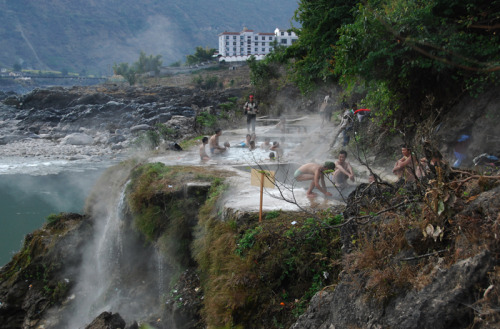
Gongzha told me that during the Bathing Festival every year all people living for hundreds of miles around come here to bathe. The bathing rules are very strict. For example, the first bathing duration is 10 minutes, the second 15 minutes, and the third 20 minutes, and so on until you reach the longest duration you can bear. And then, one should reduce the time by five minutes one after another until returning to the beginning.
During the Bathing Festival every year, as there are so many people, an old Tibetan doctor will arrange the time depending on individual person's situation, such as 15 minutes or half an hour, and everybody will step into the pool by turns. It is said that by bathing for a week during the Bathing Festival one will not catch a cold in a year.
Hissing
As if this was not enough, the expedition to Nagqu as described in Tibetmagazine
features the hot springs of Lhaya, however it's unclear where exactly they are other than on the border between Shigatse and Nagqu:

'Lhaya Hot Spring is in the river valley beside the road. From far away we saw mist curling up in the valley and heard the "hiss" of the spurting spring spreading far into the valley.
There are two springs in the center of the river, with one discharging directly into the river, the spring water creating a circle of some one square meter like an umbrella on the river surface; the other one is what people call a 'multicolored spring'. In center of the river, stands a round stalactite some 100 cm higher than the river surface that emits different color from the sun's rays. The spring water spurts out from the middle of the stone, as high as about one meter, and is very beautiful. Many fish without any scales swim around the spring. ... The spring is in the center of the river and access is impossible, which is a pity'.
According to wikipedia the village of Dongqiao (Amdo county) is noted for it's hot spring of Jipu. But that's all what the internet will reveal on this subject.

Notes:
[1] Dor Ji (2008) Geothermal Resources and Utilization in Tibet and the Himalayas. Presented at the Workshop for Decision Makers on Direct Heating Use of Geothermal Resources in Asia, organized by UNU-GTP, TBLRREM and TBGMED, in Tianjin, China, 11-18 May, 2008.
[2] Zhao Yuanyi , Zhao Xitao , Ma Zhibang & Deng Jian [unknown] Chronology of the Gulu Hot Spring Cesium Deposit in Nagqu, Tibet and It Geological Significance. Institute of Mineral Resources, CAGS, Beijing, China

Sunday, July 27, 2014

Lisu soaking exposed

  Source
 
Lisu Bathing
Bordering Burma, the Lisu ehtnic minority live along the banks of the upper Nujiang (Salween) river, in the autonomous prefecture of Nujiang, one of the westernmost administrative divisions of Yunnan, China

Lisu tradition dictates the local custom of holding a bathing festival coinciding with the their new year celebrations. 
This tradition of holding a bathing festival is very much similar to the Tibetan custom (Garma Ri Gi). The tradition transcends the mountain themselves; Hindu's have traditional bathing festivals as well as adhering spiritual connections to water. 
Unique to the Lisu of Nujiang is the involvement of hot springs, which seems sensible considering the time of the year the event is held.


'Every Spring Festival, the Lisu people gather at the Hot Springs by the Nujiang River
By taking baths and washing off dirt with sacred spring water,
people hope for forthcoming auspiciousness'.
Posted by Funansan.

Th Lisu tradition of bathing in hot springs at New Year is called Kuoshi Festival (the New Year festival) determined to be from 20-22 December each year contrasting with Tibet's mid-summer bathing tradition. The practice though does have it's local roots:
'Legend says that the estuary of a huge pool below the cliffs at the foot of the east Gaoligong Mountain was guarded by a pair of little green sparrows. When local people gave parties, year after year, these green sparrows magically provided all the bowls, chopsticks, tables and chairs needed. Then a man failed to return the borrowed articles to the birds and enraged the Dragon King, who ordered that the pool be filled up. The birds turned into girls who bathed in the hot spring near the pool and departed. Consequently, early spring every year, local residents camp near the spring to offer sacrifices to the Dragon King and the magic sparrows, and bathe'.
Others simply see the custom of holding a bathing festival in more practical terms:
'By taking baths and washing off dirt with the sacred spring water, people hope for the forthcoming of auspiciousness'.
Then again the bathing is only a minor part of the festival apparently:
'The most interesting event of the Lisu people's traditional Kuoshi festival is the Hair-Combing Contest held on the first and seventh days of the first lunar month'.
The bathing festival seems to coincide with the Lisu New Year, but might just follow the Kuoshi festival; the Bathing Festival is
'... usually held in the first month of the lunar year'.
Which one could also describe as very early spring .... 

How to soak Lisu Style
Though soaking is part of the Lisu cultural tradition, this source puts the whole soaking process in more evocative terms:
'When the time comes, people from near counties and regions, wearing rich dresses and bringing food, luggage and even cooking stuff, keep pouring in. Tents cover the place, which is quiet in normal times. People all crowd together, singing and smiling happily, and the scene is full of bustle and excitement. The "Spring Bathing Festival", which used to be a day to take bath and cure diseases, now becomes a festival of revelry for people to spend holidays and dance and sing. Especially for youths at their life's full flowering, they gather together in dozens or even hundreds to compete songs, poems and look for lovers. It lasts all through the night and they never feel bored with it'.
No, soaking is not boring here.

However, when searching the web for hot springs in the Nujiang Autonomous Prefecture nearly all focus on the bathing during the festival, as if no soaking takes place at other times. 
And unfortunately most of the reporting on the festival involves sensationalizing the methods of bathing. 
For instance eChinacities includes Nujiang valley hot springs in China's Top 5 Best Nude Bathing Areas despite the fact that the Lisu bathe only semi-naturally ....
It even means that simply the sight of seeing soakers soak can be the ultimate destination. From Yunnantour.net:
'Every year, during the Spring Festival period, Lisu minority people will have bath together in hot springs along both sides of Nu River (the Salween). And held many activities such as poem contest, singing and dancing, etc, to celebrate the coming of spring season. This trip is specially good for photographing'.
For proof purposes the site no longer exists alas. 

Source, caption translated by google:
'Captain guide whispered, pointing to the river: there is beauty in the hot springs! Aha! This really been kept under Liu arrived, I saw the green leaves masking, several topless women are soaked in smoke curl Zaochi, the Liu quietly approaching, when they found me immediately picked up a towel to cover the naked upper body let me exceedingly disappointed!'
And how is the experience seeing soaking locals?
'I left the competition place at noon and walked to visit their "zaotanghui" (public baths) gathering. Some women were taking baths in the hot springs, laughing and playing. Even when tourists focused their cameras on them, they did not behave in an offended manner. What a simple and happy nationality'.
So much for the modern man ... 
Another visitor mentions that the bathing festival is highlighted by eight camera bearing tourists and adds this:
'It is said, used to be with the bath naked men and women, and now more and more "civilized", "naked" too little, men and women are "incompatible", and is generally sub-pools and baths'.


Future
Anyway, modernity also plays a major part in the future of some of these soaks. The Sydney Morning Herald no less, also takes a soak with the locals:
'Men and women alike stripped to their underpants, Wa Ba's family and friends sat soaking in hot pools fed by a geothermal spring gushing from a mossy crevice under the gnarled roots of a banyan tree on the bank of the Nu River.
As his wife tended a kettle over a wood fire and young women drank cups of hot water straight from the spring, Wa offered round a bottle of his homemade rice wine, a clear brew strong enough to give a noticeable buzz from just a capful.
"Usually we take a bath here on the eve of the new year, so we're a bit late this year," said Wa, who lives in Dapicha, a village half an hour's walk away. "If you bathe here when the year is new, it protects you from illness" '.
Reported in 2005, it then goes on to mention that:
'But the hot pool enjoyed by Wa's group, the land of Pi's community, and perhaps even the tenure of his Lisu people in the Nu Valley, are threatened.
Just downstream from the hot spring, about five kilometres up from the town of Liuku, marker pegs stenciled "Liuku Power Station" are rammed into the earth beside a tunnel into the hillside. When built later this decade, the dam's reservoir will submerge the hot spring and many small farms and villages lining the river'.
Though the loss of the soaks is certainly a disadvantage, the projects (once completed) will certainly massively impact the local inhabitants and change their ways of life with no way back.
The consequences will also be felt in countries downstream, for instance now (in 2014) the Mekong is drying up along Thailand and in Lao, consequences attributed (by the press) to dams on this river, while decreasing waters are leaving Vietnam's Mekong delta more prone to become more saline, thus affecting agricultural negatively.
That said, dams have many environmental advantages over alternatives but being highly intrusive is not one of them.

The opposition, though not entirely successful, has been able to stall the construction according to the Times (21 May 2009). Opponents are organised in the Save the Nujiang as well as Salween Watch. 
The former reports that recently (March 2014) that construction is scheduled to start.

'Ritual bathing in hot springs is a part of the Lisu New Years tradition. These public springs will be deluged if the dam projects are completed. During Spring Festival camps are built near the pools which makes for a festival atmosphere'.

The soaks of Nujiang
Despite the considerable wealth of information on how the locals soak, hardly any information is available on where they soak and definitely no personal experiences are described on the net in English. Swell.

Some places that are mentioned as having soak sites are Chawalong, which is located in the north of Nujiang prefecture. The photo available on flickr doesn't endear itself to potential soakers though ....

Elsewhere mention is made of hot springs, 10 km north of Liuku city (Lushui county), the prefectures administrative center. These are Laomudeng (possibly), Bazhaodeng, Baihualing, Denggen and Mazhanghe (source).

Then this visitor mentions a distance of 30 km from Liuku and after google translate the following conspires:

 
'Fellow men left after another, but the ladies unwilling. Japan recalled bare bulbs, everyone wants to feel that part of the wonderful review in China at this time to revisit. At this point nothing can stop them, bidet into the embrace of the idea of ​​natural strong impact on them, and off it! Water it! Let those men waiting on top of it! Several women from the big city to abandon the secular, but also learn the local Lisu villagers, naked and jumped into the pool to that Pitt among the skin smooth and soft shine of turquoise water is more tender and beautiful in the clear water of the figure will undoubtedly expose'.
So to sum it up: there seems to be a lot of possibilities but does anybody know where?

Sunday, February 23, 2014

Blind faith in back to nature?

Chongqing 
As well as being provincial capital Chongqing was formerly a part of Sichuan province.

It is said that Chongqing is famous for it's hot springs:
'There are dozens of them located throughout the city. The water temperatures at them are kept at 35-37 degrees Celsius (95-98 degrees Fahrenheit). People have been coming to Chongqing for centuries to visit the local hot springs due to the high mineral content of the waters. It is said that the alkali minerals found in the waters have beneficial medicinal properties, which are said to be effective in curing arthritis, and skin diseases'.
This website mentions that in 2012 Chongqing was awarded the accolade 
‘Global Capital of Hot Springs’,
whatever that means. The award was given by the 65th General Assembly and World Scientific Congress of FEMTEC which I have never heard of. Apparently it might stand of Federation for Hydrotherapy and Climatotherapy

With dozens of them located within the confines of the city we can't expect very natural conditions and that's not the reason I've decided to include these hot springs in this blog. After reading you'll know ...

As well as there being so many located close to the city, the locals also have problems in giving them names and as such we end up with the hot springs of the four wind directions.

Tradition
Info on the North hot spring:
'There are ten springs altogether in the park and the temperature of the water is a constant 35-37 degrees C. The water contains alkali minerals that are considered as having beneficial medicinal properties. The warm water offers an excellent way to relax from the stresses of day to day existence and it also benefits those who suffer from skin problems, arthritis and many other common ailments. Apart from a standard swimming pool there are 75 indoor bathrooms, a newly built triangular indoor swimming pool and a play pool for children'.
Elsewhere we understand that the hot springs here have a tradition of more than 1600 years.

The North hot springs form part of Beibei district. 
Since mid-2013 Banyan Tree have a hot spring resort here:
'Located within the Banyan Tree Spa Chongqing Beibei, there are separate indoor hot spring baths for male and female guests, while the outdoor hot spring pool offers a unique bathing experience'.
There is also another contender in the upmarket area of the northern spring, Brilliant Resort & Spa. Flowery images of the springs are to be found on the website of photographer Micheal Freeman:

 
Elsewhere there is the Haiyu hot spring hotel, tripadvisor giving it four stars.

South & Central
Info on Chongqing's South hot spring.
'The Southern Hot Springs Park has about 110 bathrooms and three swimming pools - outdoor and indoor swimming pools with one for children. The hot springs contain abundant minerals and taking a hot spring bath can rejuvenate body metabolism and cure some diseases, such as those of the skin, arthritis and rheumatism'.


Info on Chongqing Central hot spring is a lot sparser, in fact there's just one mention.

Tongliang is the name given to the western hot spring(s?). The hot springs are
'... located at Xiquan Town, twenty kilometers south of Tongliang county . ... As early as the Yuan Dynasty (1279-1368), the poet Meng Huai wrote a few lines in admiration of the spring'.
Nice pic, but what's the subscript mention?
'@chongqing's XX spring
wiz rachel
by:zong
infact,the water was cold and dirty that day'.
By Ruby's illusion


Back to nature?
Ba'nan
is the name given to
the hot spring otherwise known as the East hot spring.  

Ba'nan district seems hold a different tradition to most hot springs, certainly in China. Since 2008, Ba'nan organizes hot spring festivals, though it's unsure what this actually entails. They must be pretty desperate because that years issue was reported as follows:
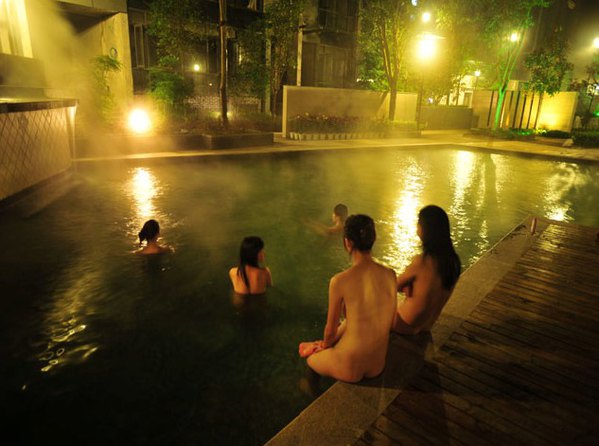
'The 2nd edition of the « Ba'nan Hot Springs Tourism Cultural Festival » near Chongqing has opened on monday. The organizers invited eight pretty models to celebrate the back-to-nature theme by bathing naked...'.
It's unclear whether this was a poor attempt to gain coverage or reflects the reality of soaking here.
However, in the 'Getting Naked: Nudism in China' article, published in 2010, Ba'nan hot spring merits this paragraph:
'... in Sichuan Province, nudism seems to be all the rage. Chongqing Girls Nude Bathing Area sounds more like the title of a dodgy DVD, but it’s actually an area set aside for women in the Ba’nan District’s tranquil East Spring Village. The pool has been in use since the Ming Dynasty, and its water is said to cure blindness. If you fancy a dip, you’ll be pleased to know that it’s open to tourists. Female ones'.
Why only females beats me. Despite this often referred to article, there seems little or none other proof that this practice really exists.

That was until I found this Chinese language website which refers to the Eastern / Ba'nan hot spring and provides photographic proof both of the men and the women's baths:


Stemming from the same period (Nov. 2011), this Chinese language website notes that due to a variety of reasons the hot springs were closed, but locals still took the waters by climbing over the fence. It also suggests more idyllic bathing:


Many more references to al-fresco bathing in Chongqing, f.i. this from the soakingspirit tumblr, which gives an insight into the history of the site, apparently it became famous after curing blindness.

Big plans are underway for this set of springs, though the development report is chaotic.

Elsewhere in Ba'nan district there is the New Orient Hot Spring Hotel which tripadvisor gives a meagre 3 and a half star. And the Sunshine Hot Spring Resort (tripadvisor unrated), while those who favour dong as in Dong Hot Spring Scenic resort may wish to stay there, tripadvisor: 4 stars

Ordinary people
Then there are hot springs in
Tongjing, Yubei district not one of the four wind direction hot springs.
'Tongjing Hot Spring is world famous, hailed as the best hot springs in China'.
Whether this accolade fits the reality or not, plans are under way to re-open these already sprawling facilities in 2014:
'It is expected to become the most beautiful scenic area featuring a hot spring in west China and also the first 5A hot spring tourist attraction in Chongqing.
Unlike some scenic areas, the price is affirmed to be affordable for ordinary people after transformation and will not rise significantly'.
Other hot springs are
The Beidiyiyuan, Jiulongpo District (mention) is often shortened to Beity. Tripadvisor rates this resort as 4,5 stars, though it seems more focus is on the hotel part. Not all is well though?
'hotel is truly 5* nice nice room with special hot spring bath tub included downside to many light switches approx. 14 of them in the room to manage them insane'.
Also located in Jiulongpo district is the  Sun Kingdom Hot Spring Golf Club (source), which is very much a golfing hotel with little or no reference to a hot spring.

Then there is the Tianci Hot Spring resort, more info can be obtained from this website. Tripadvisor give it 4 and a half stars.

Haitangxiaoyue sometimes referred to as Ronghui are said to be Chongqings best urban hot springs. Having 32 pools source Tripadvisor notes 5 stars for this resort complex. Though search for Ronghui and the rating drops!
'This place blows away any spa we’ve been to in the U.S.! It was huge with tons of different types of pools, including wine, green tea, milk, and more. You could easily spend a whole day here, and for two of us it was about $55 U.S.! If we had more time I definitely would have taken advantage of a massage, which was something like 168 rmb ($27 U.S.). Everything was co-ed, so swimsuits were required'.

Wednesday, September 1, 2010

China's South-east

Besides the many hot springs previously featured on the many entries on China, China possesses an astounding amount of hot springs scattered elsewhere in the country. What follows are just some of the more special hot springs. If you believe that a certain hot spring should be added, feel free to contact me (see sidebar).

Unfortunately this blog entry will only focus on Guangxi and Guizhou, these regions contain a number of hot springs sufficient to warrant their own blog entry ...


Guizhou and Miao custom
Though most hot soaks derive their inclusion in this chapter due to their uniqueness, the hot spring of Jianhe (Qiandongnan Miao and Dong AP, Guizhou) is here for the way in which the hot springs are enjoyed. From
Chinavista.com the following:
'When the Miao drum dance performance ended, it was five o'clock in the afternoon. We took a car to the hot spring, which was 1.5 km away. It took only a short time to get there. Jianhe Hot Spring is located at the foot of a slope, surrounded by mountains on three sides and facing a flatland on one side. In 1998 Jianhe County introduced 6 million yuan of overseas investment to build a swimming pool and some auxiliary facilities at the hot springs. It opened to tourists not long ago. Every day 50-100 people come here to have a hot spring bath.
When we arrived here, local Miao People were bathing in the two pools, one for men, and the other for women. The pool for men was on the upper level. Five Miao young men were having a bath, stark naked. The pool for women was on a lower level with some having a bath and the rest washing clothes. Seeing me, the women turned their backs and said "Shame," while giggling. A young Miao man who came with me told them in their bathing and washing.
According to local tour guides, it is an ancient local custom to have a bath in hot springs, but no one knows when this custom began. For generations the Miao people have been doing just this.
Because the Miaos often have baths in hot springs, they have good skin and are strong and attractive. It seems that frequent hot spring bathing helps maintain a healthy metabolism, keep skin fair and also make you attractive as well'.
Soaking the recipe for success for the longevity?
Lizzy and Nathelie had a different experience. Dated from 2013 their visit to Jianhe  is as follows:
'Natalie and I (Lizzy) were warned that the water at the hot springs was great, but that the facilities were "backwards."
...
The Jianhe Hot Springs were quite nice in comparison with many US hot springs. The pool was clean and we were provided with a personal locker to store our belongings. The changing rooms and shower rooms were overcrowded, but that's to be expected in China'.
It seems things are changing or there have been facilities created for tourists?

 The modern Jianhe? Source. Vs the traditional soak:

Reputations
Elsewhere in Guizhou province there are believed to be 18 other natural hot springs (source), while there are also 9 less natural hot springs.

Xifeng  hot springs are noted for their high volumes of flow (source). Other sources of info on Xifeng can be found here, here and here.

Chelang:
'There is a hot spring on both sides of the valley in one section, and there are ethnic houses near them. The water temperature of the hot spring stays between 38°C and 40°C all the year round'.
Wudang district is mentioned here for having three hot springs: 
'.... including the Baoli international hot spring [hotel], Guiyu hot spring and Quan Tianxia hot spring [hotel]'.

Shiqian is another town where highlighting hot springs through a festival seems commonplace. This article highlights Shiqian's Hot Spring Festival Culture and Tourism:
'It is understood that Shiqian County is located in the northeast of Guizhou is the old revolutionary base areas, when Red Army had twice been shiqian. Now in this piece of forest cover close to 48 percent of the clay on the ground, not only state-level key cultural relics Longevity Palace, as well as Chinese history and culture village upstairs Guzhai, especially the very rich in geothermal resources are currently known to the hot springs out of the dew point there are 20 of the 36 daily flow of 2.2 million metric tons, the water temperature 45 degrees Celsius, the water generally contain zinc, selenium, radon, strontium, lithium, silica and other trace elements beneficial to humans, water quality consistent with the medical mineral water standards and consistent with standards of drinking mineral water can be directly bathing, drinking, the country's unique rare in the world. Spa group in the core area of the layout of the county seat, and water resources, the largest in the country has only Shiqian, in the development and utilization of the hot springs for centuries formed a unique "hot spring culture," known as "spring city" reputation'.
There are no less than 17 hot springs in or around Shiqian (source).  This website adds:
'The springs rise some distance up the mountainside, so in the old days local officials built their bathhouse at the town's highest point in order to get the hottest, cleanest water. Below that was the public men's bath and, right at the bottom, the women's bath, whose water was also used for washing clothes.
None but the oldest residents remember this arrangement. Today the public bathhouse by the riverside is divided into men's and women's sections, while up the hill is a single complex housing private tubs that cost from 20 yuan to 40 yuan an hour. It's tremendously popular with locals¡ÂȘstreams of wet-haired bathers accompanied me back into town along the ancient street that runs parallel with the river'.
Another experience:
'In Shiqian, there is a hotel, build on top of the springs and to enjoy them, you must pay the hotel for either the public bath or the private one. Since the school was paying we went for the private one and while there was no nature to enjoy, save for the hot spring water itself, the experience was the most soothing I have had in China. The private room was actually quite nice. The tub was a on the right side of the room and was a little small, but workable. On the left side of the room was what looked like a lay-in shallow jacuzzi, but the attendant said it didn’t work. There was also a toilet and a stand up shower in the back of the room and shampoo and body wash. The water that filled the tub was the perfect temperature for me and as I stepped in I could feel all of the noise and tension that China dumps on me on a daily basis disappearing into the steam. I always love returning to the element I feel most at home in, and this time there was more than ever to enjoy – the minerals, the heat, the silence, the relief, the meditation'.  
But how many are there really? This website draws attention to Sinan county, Tongren prefecture: 
'The county, rich in geothermal resources, boasts 11 hot spring sites in Yingwuxi Town, Xinglong Township, Sandaoshui Township and Tianqiao Township, which produce 12,000 tons of spring water per day. The water is rich in various minerals and ranges in temperature from 40°C to 58°C. There are presently four spa resorts under development: Yingwuxi Spa Resort, Luowantuo Spa Resort, Xinglong Spa Resort and Tianqiao Spa Resort'.

A cave soak
West of Guizhou lies the coastal province of Guangxi which is home to one of China's most prized natural tourist destinations, Guilin. 

Not far from Guilin is Yangshuo. Aside of the rice terraces (one of the main attractions of Yangshuo) is the Longsheng Hot Springs National Forest Park:
'The best known attraction in the park is the sixteen hot springs. These springs can spout over 1,200 meters from underground with water temperatures ranging from 45C(113F) to 58C(136F). Experts have determined that the waters contain various elements including zinc, manganese, lithium, strontium and iron that are beneficial to health. Bathing in the springs is not only healthful, but can reputedly alleviate diseases such as cardiopathy and rheumatism as well as certain skin conditions. Unlike other hot springs, the water here is so pure and limpid that it can be drunk directly from the source. It is no wonder that Longsheng is the most famous hot springs in south China'.
One of the hot springs is located inside a cave. An experience:
'We ventured out the the Moon Water Cave, a ridiculously enormous cavern in one of the mountains that also held a natural hot spring and mud bath. The mud bath turned out to be freezing, but it was a nice warm-up to the hot spring - and a quality photo-op as well'.
There is what this blogger describes as a 'mega posh' hotel (Longsheng Hot Springs Hotel) with no guests. An accompanying photo is intriguing entitled 'Rub-a-dub-dub' the authors are bathing in hot tubs with a large plastic bag on the inside presumably for keeping the tub water tight? Another reviewer described it as follows:
'life is too short to spend any of it here'
As said nearby is the cave (Moon Water Cave) with a mud pool (cold) and an unique hot spring inside the cave. However most visitors focus on the cold mud experience ...

hot springs inside yangshuo's water caveFrom eikzilla.
'hot springs inside yangshuo's water cave'
Eikzilla also has a nice picture of the corresponding signboard announcing the attraction.

Like the Zhuang do?
Elsewhere in Guangxi are hot springs of Lingshui, Jiiu Qu Wan, Jiahecheng, Hezhou (Gupo Mountain), Hezhou (Luhua), Xiangzhou

('The Hot Spring of Xiangzhou is known as “No. 1 hot spring in the middle-of –south of China”'. source)
and Yulin the city of which has no less than six hot springs:
'Land Sichuan hot spring, Xie Lu hot spring, Sand Lake hot spring, Warm Luo hot spring, Lebanon Village hot spring, Mausoleum Mountain hot spring' (source).
The aforementioned Hezhou hot spring(s?) are apparently better known for their bathing habits, especially of the
'young women of Zhuang ethnic group'.
Click further for the web entry complete with pictures. Whether or not this is just a cheap ploy to attract half the world's population (or more) or a correct presentation of reality is not entirely clear. At least there is the following info:
'There are three hot springs in the mountain town [Hezhou] and local Zhuang people maintain the ancient custom of bathing in the open air. They believe that bathing without baring one’s body completely will profane the sacred water'.
Others would describe exactly this as profane ...
 
Updated June 2014

Friday, July 2, 2010

Blind faith in back to nature?

Chongqing
As well as being provincial capital Chongqing was formerly a part of Sichuan province.
It is said that Chongqing is famous for it's hot springs:
'There are dozens of them located throughout the city. The water temperatures at them are kept at 35-37 degrees Celsius (95-98 degrees Fahrenheit). People have been coming to Chongqing for centuries to visit the local hot springs due to the high mineral content of the waters. It is said that the alkali minerals found in the waters have beneficial medicinal properties, which are said to be effective in curing arthritis, and skin diseases'.
With dozens of them located within the confines of the city we can't expect very natural conditions and that's not the reason I've decided to include these hot springs in this blog. After reading you'll know ...

As well as there being so many located close to the city, the locals also have problems in giving them names and as such we end up with the hot springs of the four wind directions.

South, West, North
Info on Chongqing's South hot spring.
'The Southern Hot Springs Park has about 110 bathrooms and three swimming pools - outdoor and indoor swimming pools with one for children. The hot springs contain abundant minerals and taking a hot spring bath can rejuvenate body metabolism and cure some diseases, such as those of the skin, arthritis and rheumatism'.
Info on the North hot spring:
'There are ten springs altogether in the park and the temperature of the water is a constant 35-37 degrees C. The water contains alkali minerals that are considered as having beneficial medicinal properties. The warm water offers an excellent way to relax from the stresses of day to day existence and it also benefits those who suffer from skin problems, arthritis and many other common ailments. Apart from a standard swimming pool there are 75 indoor bathrooms, a newly built triangular indoor swimming pool and a play pool for children'.
Info on Chongqing Central hot spring is a lot sparser, in fact there's just one mention.

Tongliang is the name given to the western hot spring(s?). The hot springs are
'located at Xiquan Town, twenty kilometers south of Tongliang county . ... As early as the Yuan Dynasty (1279-1368), the poet Meng Huai wrote a few lines in admiration of the spring'.
Back to nature?
Ba'nan
is the name given to
the hot spring otherwise known as the East hot spring. Ba'nan seems to be more different than most hot springs. Since three years it organizes hot spring festivals, though it's unsure what it actually entails. They must be pretty desperate because last years issue was reported as follows:
'The 2nd edition of the « Ba'nan Hot Springs Tourism Cultural Festival » near Chongqing has opened on monday. The organizers invited eight pretty models to celebrate the back-to-nature theme by bathing naked...'.
It's unclear whether this was a poor attempt to gain coverage or reflects the reality of soaking here. In the 'Getting Naked: Nudism in China' article, published earlier this year, Ba'nan hot spring merits this paragraph:
'... in Sichuan Province, nudism seems to be all the rage. Chongqing Girls Nude Bathing Area sounds more like the title of a dodgy DVD, but it’s actually an area set aside for women in the Ba’nan District’s tranquil East Spring Village. The pool has been in use since the Ming Dynasty, and its water is said to cure blindness. If you fancy a dip, you’ll be pleased to know that it’s open to tourists. Female ones'.
Why only females beats me. Despite this often referred to article, there seems little or none other proof that this practice really exists.
Big plans are underway for this set of springs, though the development report is chaotic.

Nice pic, but what's the subscript mention?
'@chongqing's XX spring
wiz rachel
by:zong
infact,the water was cold and dirty that day'.
By Ruby's illusion .

Others
Then there are hot springs in
Tongjing, Yubei district not one of the four wind direction hot springs, but the fifth pearl no less.
'Tongjing Hot Spring is world famous, hailed as the best hot springs in China'.
Other hot springs are
- Beidiyiyuan (mention),
- Haitangxiaoyue (mention),
- New Orient Hot Spring Hotel (tripadvisor),
- Sun Kingdom Hot Spring Golf Club (golfing asia),
- Sunshine Hot Spring Resort Hotel in Ba'nan (Chinatraveldepot),
- Brilliant Spa (website),
- Tianci Hot Spring Resort (travbuddy) and
-
Haiyu Hot Spring Hotel Chongqing (travelpod).