Showing posts with label eau chaud. Show all posts

Wednesday, April 2, 2014

Diminish your desire

.
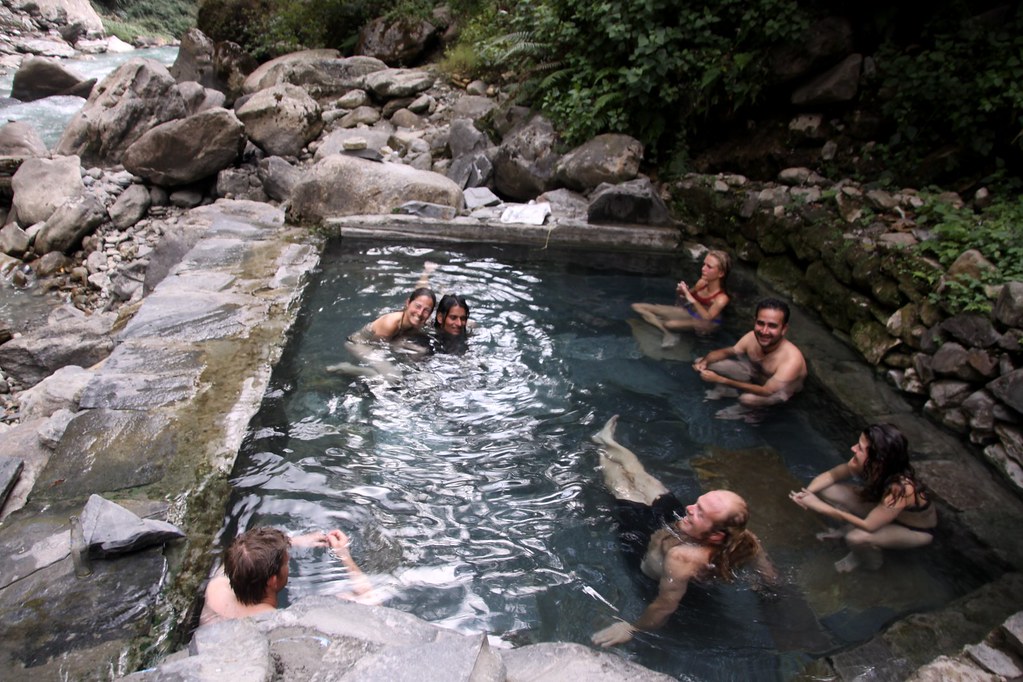
Chilime Tatopani, Nepal. Great photo's from Le Voyage de Philmy

It's not often that I put in an update on this blog site. And well, actually i don't have much ...
Avid readers may have noticed a couple of updates in the last 4 months, especially concerning Bhutan, where the original article has been split into a hot stone bath section and the remainder still focussed on hot springs of Bhutan.
Other sections updated have been on Yunnan's Yuxi and South/East. While I have also redone the Kazakhstan, the Kyrgyz and India's Uttarakhand. Phew!

Here's a spin of some recent photo's and blog entries:
  • India
'they built the temple around a natural hot springs, made one room for women and one for men'
From Ava's Faux Toes Yamunotri (Uttarakhand, India) visit.

From Sikkim another mountain gem:
 
'Hot springs right next to the lake. #hotsprings #teesta #lake #west #sikkim'
  • Nepal
     Jhinnu hot spring, source: rain rongpuk
    • Tajikistan
    Another entertaining blog entry on the hot springs of Bibi Fatima. Goatsonthroad:
    'The 5 of us jumped out of the car and were surprised at the amount of local people waiting in line. Women have a turn for 20 minutes, then, it’s the men’s turn for 20 minutes, alternating on and off every 20 minutes each and every day. Nick and Jason had their swimming shorts and Jess and I whipped out our bikinis.
    Nurali sort of looked at us with the clothes in our hands but didn’t say anything at first. Finally, I asked him if it’s ok to wear a bikini (thinking maybe it was a bit too inappropriate for this part of the world). He said, “no, you wear nothing”. Huh? Then he asked one of the Tajik women and she looked at me very confused and shook her head. Naked it was! I have to say, I’ve been in a bath house in Almaty, Kazakhstan and in a hammam in Istanbul, Turkey, but never have I been naked in a hot spring with strangers.
    When it was our turn, Jess and I made our way into the hot springs with 5 other women. We were in awe of what we saw – not the naked bodies, but the actual hot spring! We stepped down about 10 stairs and found ourselves at the bottom of a cave. Around us were natural cave walls. The steaming hot water is constantly running through this cave, making it always very hot and always very clean. Because so much water is passing through, it makes a perfect pool for relaxing in.
    This wasn’t your ordinary hot spring though, Bibi Fatima is the place to go to boost fertility. No wonder there were so many women in line! Although I didn’t want any help with my fertility levels, I went in anyways. The other women in there immediately took charge. There were many things I had to do in order to make sure I got the most out of my fertility boosting trip to the hot springs:
    1. Drink the running water (I opted out of this);
    2. Touch a particular part of the stone with my hands, then with my lips and then with my forehead;
    3. Put water that had collected in a small pool over my eyes, three times;
    4. There was a small cave within the cave that women believe looks like a womb. I had to climb up there (naked, don’t forget), go inside, go under the hot water and pick up a handful of small stones;
    5. Put the biggest, whitest stones I found under my tongue for the duration of the bathing;
    6. Walk out of the hot springs backwards; and
    7. Don’t use a towel to dry off. Doing so would wipe away all of my fertility chances.
    Bibi Fatima hot spring from soakingspirit:

    • China
    A new tourist concept? Tinyadventures adds hot spring camping tours:
    'Camping at a rural hot spring offers a relaxing combination of a hot bath and possibilities to cycle or walk in a typical rural Yunnan setting'.
    'Hot spring along the Pudu river under an old footbridge'.
    When winter comes, nothing is more relaxing than a hot spring bath. It is the perfect remedy for recharging your mind and body when the fierce cold overtakes you and diminishes your desire to step out of the warm house. This photo shows the Lianhuan Lake Hot Spring in Daqing City, northeast China's Heilongjiang Province. [Photo:China.org.cn]
    source
    • Bhutan 
    Eastwards, from Bhutan, here's a blog entry on Gasa hot spring from the travels in Bhutan tumblr:
    'Trip to Gasa - March 29-31, 2013
    I’ve been doing a poor job of keeping this blog updated (as evidenced from the date of the trip I’m only now getting around to write), so I’m sure a few details will escape my memory. Ah, well. On Friday, March 29 we all piled in the tour bus to head to Gasa. It’s a popular camping site, known especially for its healing hot springs. We intended to spend the weekend camping, hiking, and soaking in the baths. The weather was wet and rainy most of the time, but we didn’t mind terribly. It made navigating slippery, muddy paths a little difficult (even more difficult when you’re lugging packs and walking in the dark), and it meant that none of us had dry clothes by the time Sunday came around (most of us made the mistake of trying to dry our bathing suits and towels on the top of the tents, not realizing that it was going to downpour during the night and our things would get even more sodden). But we still had a fun time.
    Friday was spent mostly traveling - we passed by Dochula (more on that in another post), a site with 108 chortens, or stupas. We drove past Punakha Dzong and took pictures. More on that later, too, since we got the chance to visit it over spring break.
    Along the way, stopping for a bathroom break by the side of the road, Tsewang warned us against leeches. We were entering a wetter, almost sub-tropical climate, and it was a danger to watch out for. And he was right - almost immediately one of our group found a tiny leech, about the size of an inchworm, on his ankle.
    We reached the campsite without too much fuss, though it was now dark outside and we had to walk the aforementioned muddy, slippery trail in pitch-black. We kept looking around at the dark on all sides and saying, “I’ll bet this is a really beautiful view when you can see it.” Luckily most of us had tiny flashlights on our phones, so we reached the campsite after about 30 minutes without too many fatalities.
    The tents had already been set up for us, since Tsewang sent the crew ahead. And dinner was cooking. We put our things in the tents and had a candle-lit dinner in a mess tent. It might have been our appetites, or maybe the effect of eating outside among the elements, but most of us proclaimed it the ‘best meal’ we’d eaten so far in Bhutan. After dinner we put on our bathing suits and headed down to the hot springs to check them out.
    There were three different enclosures, ranging in intensity of heat. Unknowingly we started with the coolest and easiest to acclimate to - it was about the temperature of warm bathwater, and felt really great after that stressful hike in the dark. The water comes in through a little wooden spout in the side, and drains out the opposite side through holes in the walls. The springs were all square, wooden buildings with a roof, but were still “open-air,” and it felt really nice to alternate sitting on the side and feeling the cold night air with lowering into the steamy water. The springs are supposed to heal your ailments, and it’s especially effective, we were told by other Bhutanese visitors, to take a drink directly from the spout - but of course, you need to drink an odd number of times, since odd numbers are more auspicious. (In fact, we were told to visit the springs an odd number of times, too. Three is a good number.)
    One of the Bhutanese men in the springs engaged us in conversation and decided to take us under his wing by showing us around to the other two springs. He goaded us into participating in “challenges” to see who could stay in the water the longest (I won). He persuaded us to try the hottest spring, which none of us could handle for very long. It was hot enough that we felt sure we could have steeped tea in the bath.
    After we’d had enough, we went back to the tents, which were surprisingly comfortable. On Saturday, we had a full day ahead of us: hiking up to Gasa Dzong. It was a fairly long hike, made more difficult by the fact that I’d done something to my knee (I think I popped my meniscus out of place, which made hiking painful). The views, as always, were incredible.
    Gasa Dzong itself was a nice visit, and was my favorite Dzong until I stepped inside Punakha Dzong later. It had several levels, with green things growing on the stone walls, and went almost straight up inside the enclosure like a big castle. The monks were just starting lunch when we arrived, and so we saw them all congregate and watch us curiously when we went inside. We watched them just as curiously, and were all tickled when we saw them hanging out on one of the roofs.
    After Gasa Dzong, we headed back to the campsite and made it in time for lunch, after which we took another dip in the springs while others explored the nearby river. The afternoon was spent leisurely. At dinner, we managed to get a lot of interesting, funny stories from our Professor about his worldly travels (he’s an anthropologist who has focused his research on Nepal). After the adults left, we started telling spooky stories (surprisingly effective for frightening even the most resilient among us. It’s hard to stay stoic in a mess tent when the dark is pressing up on all sides and you can barely see the people sitting across the table), and then embarrassing stories, and THEN we achieved the pinnacle of embarrassing stories when an embarrassing incident happened right in front of us as one of the girls in the group suddenly jumped up hollering, “There’s a leech on my butt!” and pulled her pants down in front of all of us so we could help her remove it. After that point we decided we couldn’t get more embarrassing than that, so we got into our bathing suits and went back into the hot springs.
    Sunday was relatively uneventful, since it was another day of traveling. And that was our trip to Gasa.

    And then to cap it off, just another recent picca on a hot stone bath of Bhutan. Note that this posting is slowly becoming one of the most sought after, wonder why?
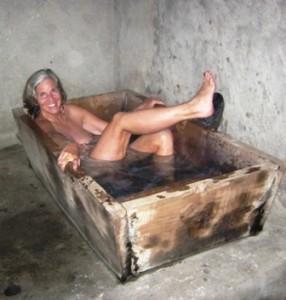
    'Did I mention the hot stone bath?'

    Saturday, January 18, 2014

    The sacred

    Pursuit of tsachu's
    The reclusive Kingdom of Bhutan is well-known for it's pursuit of happiness, would this include taking time out for soaking in hot springs?

    An unknown location of a hot spring, visited by a Japanese blogger who after translation refers this as Do-unman hot spring. But it does seem that the locals have a liking of their soaks ...
    Kencho Wangdi in a thoroughly informative article in the Kuensel stated the following:
    'Japanese love it [soaking in hot springs], if not for its medicinal value, for its warmth and therapeutic comfort. Visitors believe the thermal springs are great for relieving stress and tension too.
    Traditional medicine doctors (Dungtshos) in Thimphu [Bhutan's capital], though, say that it is not good for people with high blood pressure, eye and dizziness disease, and with heart ailments.
    Gasa tshachhu’s [tsachu or tshacchu are Bhutanese for hot spring] historical records are sketchy at best as it is for numerous other tshachhus in the country. Dungtsho Yeshey Dorji of the institute of traditional medicine services says that the country’s ancient traditional medicine doctors discovered the medicinal values of the tshachhus and spread the discovery. Because of their curative powers tshachhus were held sacred by the Bhutanese, many believing them to have been touched by divine hands. It is said that Bhutanese warriors wounded in battles sought tshachhus to soak in and applied the warm mud as salve for wounds. Sometimes they traveled for weeks to bathe their wounds in the water. Traditional medicine doctors have long since been prescribing the healing waters for their patients.
    Observers also speculate if with modernisation tshachhus would retain their magic for long. In the west hot springs lost out to modern medications which held out the promise for rapid cures of many chronic diseases, which seemed more attractive than several weeks of bathing and other water-related treatments. Physicians were also not all convinced of their medicinal value mainly because no scientific proof existed.
    But for elderly Bhutanese like Ap Lhap Tshering, 81, from Lhuentse, a regular visitor to Gasa tshachhu, the magic will never wane. "It's nature's way of healing people."
    The looks like a comprehensive answer. Bhutanese must love soaking.
    In the article entitled 'The Healing Springs of Bhutan'
    ugina adds:
    'During the winter months, many people walk to these hot spring spots or "Tsachus" as they are called. People believe that soaking in this water will cure illnesses, such as stomach ailments, headache, skin problems and the list goes on and on'.
    The only scientific research I could find on Bhutan's hot springs (P. Wanchuk & Dorji, Y., 2007) includes:
    'Tshachu literally means “hot water” and could include the man-made boiled water that is created in artificial conditions. However, as defined in the gSo-ba Rig-pa tradition, tshachu in this context means only that water originating from a “natural source and emanating from natural phenomena which have associated hot properties”. Given its origin, the water contains a combination of coal (rdo-sol), sulphur (mu-zi) and imestone (rdo-sho). Because of the presence of these minerals most of the tshachu have medicinal value. Spiritually, it is believed that tshachu owe their origin to the good wishes and blessings of Buddhas and Boddhisattavas. Hence, almost all tshachu are also held to be gNyes (sacred sites)'.
    Which is a lot more than modern day wellness centers can give... It includes information that Bhutan plays host to 10 hot springs, though I'll be able to get references to 9 ....

    The significance of hot springs and their opportunity to attract tourists has made the government to present a December 2010 overview on their tourism web site. In all they mention 5 hot springs, this blog posting will do better ...

    Lhaden in the hot springs, Gasa by John Wehrheim.
    But when talking about the Bhutanese love of hot water one must also mention the existence of the typical Bhutanese custom of hot stone baths. Spring water is diverted into wooden tubs to which are added stones which have been heated over a fire often for hours on end. The result: bliss!

    Read more about hot stone baths in this posting.

    So where are the soak sites?
    Dur
    tsachu (Bhumthang) is the highlight of 10-day trek traversing the Bhutanese portions of the Himalaya without it being too strenuous. The trek is actually named after the hot spring.
    Despite this though there is little info on the hot springs themselves ..., that is with the exception of Wikitravel:

    'A one day trek from road head. The trek is arduous, but stunningly beautiful. Blue sheep, musk deer and Himalayan bear are common in the Duer Hot Spring area'.
    A short story on the keeper of Dur hotspring (my ambition) by crankygerman:
    '... he will show you with a wry smile how to disrobe and make proper use of them'.
    Another hot spring (known as Gasa Tsachu) is likewise known as it is en-route on the more worn out trekking trails of Bhutan. It is (or was) actually the main destination of a 11-day trek.

    On yanatravel.com a first hand account to the old site as reported by Phintsho Dorji:
    'The hot springs have five ponds. Each is fed from the different springs and each treats a different ailment. Though there are bathrooms and shower rooms and a notice instructing the visitors, ‘Do not enter the pond before taking shower from this bath house’, people enter the ponds without taking bath and that too with their dirty clothes on'.
    In 2009 however, it saw a washout occur when a nearby stream managed to undercut the bathing facilities as reported by Kuensel (12 July 2009):
    'The healing waters of the country’s most famous hot spring now flow under the Mochu river, which has taken a new course after the May 26 flood that completely washed away the five soaking ponds and the VIP bathhouse built around the spring'.
    Reports since though have reported that renovations are underway.
     
    'This area used to be green, lush, and developed with many tubs before the flood in 2009. There is now one pool in the hut and an other outside, along with the bathing area to the lower right of the pool'.
    Photo by Craig Learned.

    An update on Soaking in Southeast Asia refers to a bidding war by Japanese and Italians ..., while in October 2012 the same site mentions that the hot spring is open for business again.
    Though there is the reality of the conditions of the Gasa tsachu and development in general as reported by
    tripadvisor:

    'Gasa Tshachu trek is no more an attraction after the hot spring was washed away by the flood this year. Now there is dirt track just four hours walk from Gasa and two hours from the hot spring site'.
    The former refers to the new road which now makes the trek just 2-3 hours away from the roadhead. Bhutan Observer (originally from 29 May 2009, the link now not functioning):
    'Passang, 55, a horseman from Zomina, said before the arrival of the road, he used to get Nu 400 for a horse to carry a person and his luggage from the road end at Tashithang to the tshachhu [Gasa hot spring]. But now, he gets only Nu 300 for a horse. He said the coming of the road would directly affect the livelihood of about 100 horsemen'.
    The road seems to be on. The Bhutanese reports (24 March 2012) on the road initiative. The locals seem to be intent on the road passing near or through the hot springs area, whereas officials are arguing that they will never get the environmental clearance. In that case the road would by-pass the hot springs by 3-4 km.
    Some things never change or do they?
    'In the past, visitors relieved themselves in the open and farmers brought domestic animals - pigs, horses and cows to the tshachhu for broken joints and other ailments. Animals are now banned from the tshachhu'.
    That positive note from Kencho Wangdi in the Kuensel (14 January 2009).
     
    Erik Skydive's picture on Gasa TsaChu as it was.

    BBS reports (April 2013) that full development will require another two years:
    'The Gasa Dzongdag [local governor] , Sonam Jigme, says works on the guest houses are not complete yet and the dzongkhag will need at least two more years for the entire hot spring site to be completed. there are plans for a medical unit, a lhakhang, and even a parking lot at the site.
    The Dzongdag told BBS that confusion over the completion of the site had begun aftersome media reports claimed the hot spring had been completed, encouraging premature visits to the hot spring'.
    Prayer
    Overall Mr. Wangdi (see above) has a very informative article not only on Gasa but on hot springs in Bhutan in general (see also above fragment in the introduction). He also mentions:
    '... Nye [hot spring] in Kurtoe, Chuphu in Punakha and Dunbang in Zhemgang. They are all difficult to reach and entail more than a day’s walk through the rugged terrain'.
    The already mentioned Wanchuk & Dorji (2007) have an extensive overview of what they refer to as gNye hot spring noting that it is the most sacred of Bhutan's hot springs. Actually existing out of three distinctive pools, these springs see little soaking folk due to it's remoteness.
    'Many of these traditional practices described for the visitors to Kurtoe gNyes tshachu may apply to all the tshachu and their users. First and foremost, on arrival, people pay homage to the Guardian Deity of the tshachu by offering a specific prayer. The Guardian Deity of the gNyes tshachu is called gNod-sbyin-rgod-ma-kha and his homage prayer is as follows:
    gNod-sbyin-chen-po-rgod-ma-kha
    Ngyur-smrig-gos-gyon-rkang-gling-'bud
    Kha-char-bu-yubs-thog-ser-gtong
    Yul-bdag-chen-po-khyod-la-bstod'. 
    It continues:
    'While visiting the Kurtoe gNyes tshachu, people believe that the Guardian Deity gNod-sbyin-rgod-ma-kha disapproves of the following:
    1. The presence of clothes of the dead or of those
    attending the delivery of babies.
    2. Shouting or whistling loudly.
    3. Throwing meat or blood in the source of tshachu and
    its surrounding areas.
    4. Burning meat or animal skin.
    5. Defecating or urinating in the tshachu pools.
    6. Having sexual intercourse inside the tshachu pools.
    7. Bathing in pairs especially couples, and
    8. Women and girls bathing when menstruating'.
    Not much is known about Dunbang hot spring, though I suspect it refers to Dunmang, see below.

    What a waste
    Chuphu is much better known as Chubu. Or Chhubu. As stated above, it is located in Punakha, Chubu is often visited.
    From recent photo's (by yasu kita) it is evidently a very rustic affair; a small cemented pool with a low corrugated iron roof over it. Already a decenium ago, local government mentioned that
    'The Tshachhu, however, lacks proper pond and accommodation facilities'.
    Does not look like much has changed since.
    Looking further back in time, this
    site comes with a plausible reason why the spring is sacred:
    'Many great master visited this Landlocked country in different centuries. As well during 8th century, the great Ngingmapa Master Guru Padmasambhava (lotus born) visited Bhutan, subdued the evils and blessed whole corner of the valley where he also introduced Hot spring for the well being of the sentient [= responsive, perceptive] beings. So, with the strong believes, hundreds of people hiked to the particular places where they have hot spring to take bath, especially the victims of different sorts of diseases. And by taking bath in the hot spring, it can heals different kinds of diseases like Tuberculosis, sinus, body-ache etc'.
    Sangey Tashey in a very recent blog mentions that due to a new road it's only a 2-3 hour walk.


    The above photo comes from this website and contains many a detail about the place as well as daily life during the soaking season. It notes:
    'The place is muddy and humid. But it’s seething with heat. It is far-flung and inhospitable. But the place is throbbing with life. Chhubu Tshachhu (hot springs) in Punakha is nature at its most bountiful. Located at 2,930 metres above sea level, Chhubu hot springs are more than two hours’ walk from the road head in Walathang from where visitors hire horses to carry their rations mostly comprising local rice, meat, butter, cheese and eggs. The mountain trail gently snakes through a chir pine forest into the cool, temperate mixed forest.
    The hot springs see a chain of people from across Bhutan for more than six months in a year. In the last month of the Bhutanese calendar, the hot springs gushing out of the steep, swampy hillside are inundated with more than 1,000 visitors, says Namgay Wangchuk, 57, the caretaker of the tshachhu. Namgay Wangchuk is popularly known by the title nedag (estate owner) but he says the title is inappropriate because he believes that the ‘real nedag’ or local deities own the tshachhu and not the caretaker.
    Namgay says that, during the peak season, more than 100 colourful tents sprout up near the tshachhu transforming the hillside into a vibrant village of strangers. The only guest house cannot accommodate more than 60 people.
    ...
    Chhubu Tshachhu has two ponds separated by a flight of concrete steps. Measuring 43.50 degree Celsius, the first pond is found to cure skin and stomach diseases, tuberculosis and some minor ailments. The second pond, which is 145 average man’s steps below by the bank of the tumbling Tshachhu Phu stream, measures 45.60 degree Celsius.
    ...
    Regular tshachhu visitors say the place surrounding the tshachhu has improved in sanitation but it has become dirtier with waste. Dorji Wangchuk, 56, from Chapcha had been to the tshachhu when he was 15. “At that time, one could hardly find a clean space to walk around,” he recollects. “Every metre of the ground surrounding the tshachhu was filled with human excreta.” After three makeshift latrines were built in 2009, sanitation has improved, but with the number of people visiting the tshachhu increasing by the year, waste management is a big challenge, says caretaker Namgay Wangchuk.
    Plastic wrappers and bottles fly around. For lack of a waste disposal site, waste is regularly burnt sending fumes of intoxicating smoke into the clean mountain air. Namgay Wangchuk says burning of waste angers the deities of the place, khachep Draley Gyep and Gomo, who retaliate by causing rains and windstorms.
    The tshachhu doesn’t have clean drinking water. Three outdoor taps became defunct barely a few months after they had been built by a contractor in 2009. The leaking tanks and broken pipes were never repaired.
    A decent place to camp is on the top of all tshachhu visitors’ wish list.
    Apart from a caretaker, who is paid Nu 100 a month by the government, there is neither an organised waste management strategy nor sanitation drive initiated at the tshachhu. A senior monk says, “The bounty of nature must be enjoyed sustainably.”
    Hordes
    'Koma Tsachu (Punakha) is a vigorous two hour walk from the small community of Mitesgang. There are three bathing pools covered by simple rooves, and a four roomed building with solar lighting where sleeping bags and mats can be laid (there is no charge for staying in the building). Outside, there is ample room to pitch tents and rock overhangs to camp under (source)'.
    Then there is an excellent report on a visit to Koma tsachu by Phuntsok Rabten published in the Bhutan Observer (26 April 2008).
    'Nestled alongside the creek in this picturesque jungle were the three pools of the hot springs. Amongst the scattering of tents and makeshift camps were two public toilets, three outdoor running taps and a most decent guest house of five rooms and two attached bathrooms, facilitated with solar electricity and water supply. Here, the music of modern amenities played in rhythm with the wild beat of the jungle drums. Koma Tsachu sees revelers and visitors round the year. Spring-time sees the most influx while the student hordes invade the tsachu during holidays. There were about 30 people when we arrived'.
    Complacent
    Back in 2006 the Kuensel reported on the bridge to Dunmang tsachu (Zhemgang):
    '“A new suspension bridge will be constructed next year,” he said. Meanwhile the travellers through the tsachu zam are advised to be careful while passing through this bridge. People as far as from Thimphu and Haa in the west and from Trashigang and Trash Yangtse in the east visit the Dunmang tsachu from November till march. The tsachu’s three ponds with water temperatures measuring between 42 degrees to 52 degrees, is believed to cure diseases like tuberculosis, and sinusitis besides healing aches and wounds. A village elder from Kheng Gongphu said that the temperature of the water had been decreasing over the years. “We used to boil eggs in the tsachu not long ago,” said Ap Sangay, 90. “In the absence of hospitals in the past, the tsachu was very indispensable for us.” Thousands of people visit the tsachu every year'.
    More recent info (April 2013) from this BBS report on Dunmang (sometimes referred to as Dungmang or even Duenmang), though notably mentions the lack of facilities.
    Sonam describes Dunmang as marvelous. He aslo had the following discussion:
    'As I went for a dip late into the night, as if in trance, I was drawn into a conversation by the meandering Mangdechhu [the nearby river!]. Of the many lessons it taught me, she cautioned me that I was already into the 25th year since I was born and that I do not have any concrete achievements to my credit. She also told me that my life was fleeting, just as her flow downstream.
    Upon asking about how I could overcome this crisis, she just told me very bluntly that I would rust if I chose to rest and thereby, she put an end to our conversation quite abruptly.
    I am assuming, she meant that I need to conquer complacency and work rather very hard!!!'
    Seeing is believing  
    Gaining in popularity Gelephu tshachu was once less well-known. Kuensel reported in 2003 that renovations were on the horizon.
    'It will be the first major renovation since the hot springs were opened to public in 1962'.
    Possibly the renovations were in answer to an earlier that year published report in the Bhutan Today. In the article are mentioned inadequate bathing facilities, a decrepit guesthouse and non-existent toilets.
    The
    BBS even mentions conjunctivitis outbreak at this hot spring:
    '... the outbreak occurred after an old couple infected by conjunctivitis soaked in the Tshachu'.
    Hot-tubbing Gulephu style ... (source)

    However, possibly sine the renovation the hot springs of  Gulephu have seen an upswing in both visitors as well as reports. 
    With a characteristic stone lined pool, bathers are now packed as sardines. Reports are made that this is slightly uncomfortable ...
    'But in recent times, owing to the lack of separate chambers for men and women, many, who have come to soak in the hot spring, privacy, or the “lack of it”, has become an issue.'
    The article continues:
    'To ensure this did not lead to depriving genuine users from availing the facility, they would introduce different timings for men and women, who visited the hot spring. Pema Wangdi [Gelephu dungpa = local official] said this would also ease congestion at the site while, at the same time, help to keep the tsachu clean. He said it would prevent dirtying the area, thus avoiding the spread of “skin diseases”, which many visitors complained of, once they visited the bath. The hot spring has five tubs, including the pre-bathing tub. Each can accommodate about 20 to 30 persons at a time'.
    Gulephu Hot Spring (Tshachu), Bhutan (source)

    Yet, the Kuensel (February 8, 2013) reports that the staggered timings aren't working well. Massive visiting numbers has lead to some soakers not being able to soak, whereas others ended up injured from their soaking experience! See below, photo accompanying article:


    Elsewhere
    Duethang in Ura, Bumthang is expected to be another better developed hot spring site.

    This link goers to a photo with the caption mentioning a hot spring at Woche village.

    In all, the above notes 9 distinctive Bhutanese hot springs.

    Notes:
    P. Wanchuk & Dorji, Y. (2007) Historical Roots, Spiritual Significance and the Health Benefits of mKhempa-lJong gNyes Tshachu (hot spring) in Lhuntshe Journal of Bhutan Studies Vol. 16, Summer 2007, pp 112-128. Thimphu, Bhutan

    Wednesday, December 1, 2010

    Consuming

    'Hot Springs at Iturup Island'. 
    By Julie Robinson
    Heading south
    Following through with the feature on Eastern Russia's soaks, the smaller sections of the puzzle
    yet to be pieced together need to be filled in.
     

    The Kuril islands are a string of (volcanic) islands which bridge the distance between Kamchatka and Japan's northern Hokkaido island.


    Northern Paramushir island, one of the Kuril's biggest islands, is home to hot springs of Verkhneyuryevskiye (source) and there is also the mention of hot springs near Karpinsky volcano and near Ebeko (source). That said there's nothing much than these mentions.

    Continuing south, one of the Kuril islands is the uninhabited Ushishir, which according to Wikipedia translates from the Ainu language as hot spring, a nice name for an island.  The island actually consists of two islands connected by a small spit. The southern part is called Yankicha.
    Yankicha island features heavily on Kuril island cruises. It's hot spring seems too unique to miss. This site claims:
    'Near the lip of the lagoon a srape in the beach fills with thermal waters;no natural hot spring bath can have a more spectacular setting',
    a claim they attribute to Micheal Bright [1]. Others add:
    'Yankicha is considered by many to be one of the most visually scenic islands in the Kurils. The ancient Ainu people used the thermal area of Yankicha for initiation rites that lasted three days and three nights, in which young men in ceremonial furs were bound together by ropes on wooden platforms over the boiling springs'. 
    Photo of the Yankicha soak. Without the furs...
    'Maxim, an officer from our navigation team, tries the impromptu hot spring feed bath'.

    Others seem more inventive:
    'With characteristic Russian make-do-with-what-we-have-ness we managed to construct a makeshift pool with one of our tents! Who’d have thought we’d be getting all touristy-resorty in this desolate place? Was nice to have a warm dip, as if to make up for the earlier cold shower. Karma :)'.
    See also the Global Volcanism Programme's entry on Ushishir.

    Closeby Rasshua island has 'numerous' hot springs.


    Urup island is attributed to have hot springs on the flanks of the volcano Tri Sestry (source). As below:


    hitokappu.bg:
    'Hot spring. Uninhabited [but ....] Urup, Kuril Island Đ“ĐŸŃ€ŃŃ‡ĐžĐč ĐžŃŃ‚ĐŸŃ‡ĐœĐžĐș. ĐĐ”ĐŸĐ±ĐžŃ‚Đ°Đ”ĐŒŃ‹Đč ĐŸŃŃ‚Ń€ĐŸĐČ ĐŁŃ€ŃƒĐż, ĐšŃƒŃ€ĐžĐ»ŃŒŃĐșОД ĐŸŃŃ‚Ń€ĐŸĐČа'.

    The South Kurils
    Iturup (sometimes spelt as Etorofu) is the northern most island of the southern Kurils. A no name hot spring is situated 'above' the town of Kuril'sk (source). Or Kurilsk.
    On flickr are photo's of the Iwo River (?) hot spring (resort) by ataq411, while FoxySakh has a set of photo's of the island, including a more updated version of the photo below.

    A 1992 photo by Shepard Sherbell taken on Iturup with the following caption:
    'Man in Hot Spring in the Kuril Islands'.

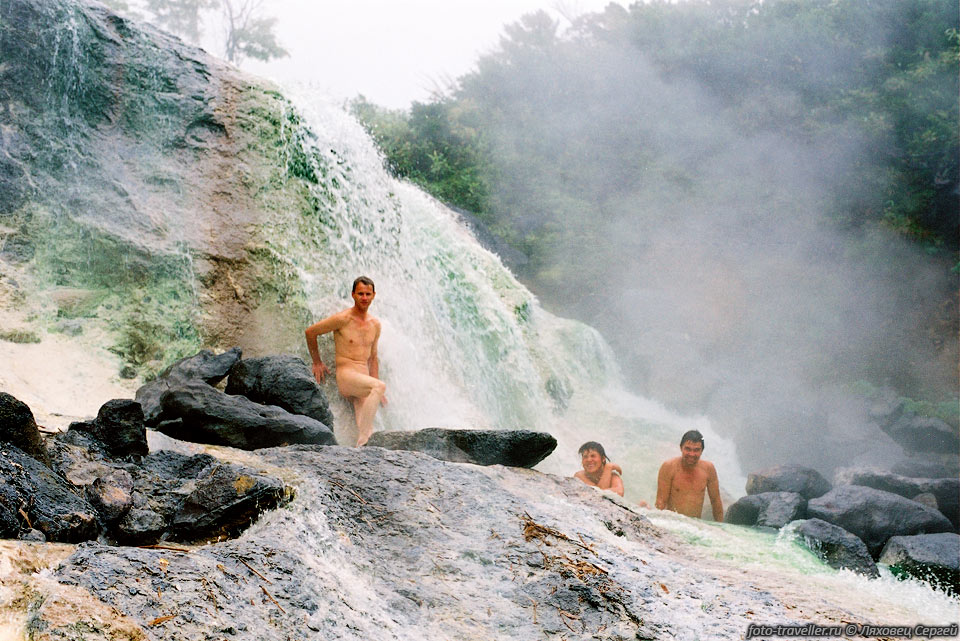
    Note also the idyllic hot waterfall in the lead photo to this blog. More photo's can be found here. Looks like a fantastic place to soak.


    Interesting
    South of Iturup and closest to Japan is the island of Kunashir. Wikipedia:
    'Kunashir is formed by four volcanoes which were separate islands but have since joined together by low-lying areas with lakes and hot springs'.
    Aaltjeaworldwiseexplorer added on a now defunct blog that
    '... some of them natural, others contained in regular pools and a beach filled with hot black rocks, called “Black Beach” which is owned by the military'.
    Apparently this references to a ruin of a hot spring, which still affords soaking. Others mention hot beach. Below gives an impression, but not very beach like:

    From the original Russian, googles translates this:
    'Well, locals, of course, use this feature preaktivneyshe: firstly, almost half of the South Kuril heated by geothermal station, and secondly, wherever possible air baths, swimming baths and Kupalenka. For example - that this is the source of "Sink" on Hot Beach. Charming place with three swimming pools with water 30, 40 and 50 degrees'.
    There is this photo of surely a beach hot spring, but don't know whether or not it's at the same location. But on Kunashir.

    From damn interesting some biological significance:
    'In a hot spring on the Russian volcanic island of Kunashir, there lives a particular type of microbe which consumes poisonous carbon monoxide as nourishment, and exhales hydrogen. The microbe is called C. hydrogenoformans, and researchers at the The Institute for Genomic Research recently finished analyzing its complete genome sequence.
    One day, the carbon monoxide waste from other industries may be used to feed vats of these microbes, and the resulting hydrogen could be collected and used to power the fuel cells of tomorrow'.
    ДоĐșОД ĐżŃ€ĐžŃ€ĐŸĐŽĐœŃ‹Đ” ĐČĐ°ĐœĐœĐŸŃ‡ĐșĐž ĐœĐ° руч. КОслыĐč, Đ±Đ”Ń€ŃƒŃ‰ĐžĐč ĐœĐ°Ń‡Đ°Đ»ĐŸ ĐœĐ° Ń„ŃƒĐŒĐ°Ń€ĐŸĐ»ŃŒĐœĐŸĐŒ ĐżĐŸĐ»Đ” ĐČулĐșĐ°ĐœĐ° ĐœĐ”ĐœĐŽĐ”Đ»Đ”Đ”ĐČĐŸemojiemojiemojiĐ’ĐŸĐŽĐ° ĐČ Ń€ŃƒŃ‡ŃŒĐ” Ń‚Đ”ĐżĐ»Đ°Ń Đž ĐœĐ° ĐČĐșус ĐŽĐ”ĐčстĐČĐžŃ‚Đ”Đ»ŃŒĐœĐŸ ĐŸŃ‡Đ”ĐœŃŒ ĐșĐžŃĐ»Đ°Ń #nature#russia#Fumarole#Volcano#kuril#kunashir#ĐżŃ€ĐžŃ€ĐŸĐŽĐ°#ĐșŃƒŃ€ĐžĐ»Ń‹
    #ĐșŃƒĐœĐ°ŃˆĐžŃ€#Tourism#Ń‚ŃƒŃ€ĐžĐ·ĐŒ 
    Across the sea
    Finally we cross over the Sea of Okhotsk at it's narrowest to the large island of Sakhalin

    The wikitravel entry on Nogliki mentions Goryachie Kluchi:
    'Goryachie Kluchi (Đ“ĐŸŃ€ŃŃ‡ĐžĐ” КлючО) is a volcanic mountain mountain area, and a village, on a tough dirt road north of town, it has a hot spring to boot.'
    This Russian language website has a couple of  photo's of the hot spring and some descriptions which when translated reveals that it's 200 km, 3 hours from the town of Okha. It's a very basic shed on a deeper pond. Surrounding is a swamp with some healing mud.

    Or there is this reference:
    'Hot springs are waiting for tourists not only in the Kuriles, but also in the north Noglinskom area of Sakhalin'.
     
    A 15m high hot waterfall on Sakhalin (or near the Baranski volcano. Oh, ... that's on Iturup!), from a Russsian photo website:
    'Đ“ĐŸŃ€ŃŃ‡ĐžĐč ĐČĐŸĐŽĐŸĐżĐ°ĐŽ ĐČŃ‹ŃĐŸŃ‚ĐŸĐč 15 ĐŒĐ”Ń‚Ń€ĐŸĐČ ĐœĐ° 3-Đč ŃĐ”Ń€ĐœĐŸĐč рДчĐșĐ”'.

    And that seems to wrap up this blog entry. 

    [Updated April 2015]

    Notes:
    [1] Bright, M. (2005) 1,001 Natural Wonders You Must See Before You Die. Barron's Educational Series, New York, U.S.A.

    Thursday, December 17, 2009

    Up the Marsyangdi

    Surprisingly there are a great many of smaller hot springs along the Marsyangdi river which first runs north between the Annapurna and Manaslu mountain massifs and then east above the Annapurna's. This is part of the famous multi-week long Annapurna trek to which development is catching up with, in the form of a road.

    Same same but still the same?
    Starting in Lamjung district, the first hot spring north along the Marsyangdi is that of
    Bhulbhule (Bulbule). No pics I'm afraid, but a number of mentions:
    'Another hot spring both spot at Bhulbhule'.
    'We reach the HOT SPRING bath spot at Bulbule Khar after ascending along the banks of the river'.

    'After ascending along the banks of the river, you reach the hot spring bath spot at Bulbule Khar'.
    Not very far from Bhulbhule is the hot spring of Bahundanda. Let's hope it's not the same ...
     

    'Bahundanda hot spring on the Main Central Thrust, in the Marsyandi Valley, central Nepal. Waters are heated by the elevated geothermal gradient, and mix with deep-sourced carbon dioxide before degassing at the surface'.
    (source)

    At least I know it must be the same as the photo above, at least if I believe this description:
    'Our visit to Bahundanda was made particularly memorable by our early morning side trip to a local hot spring. The tea house owner sent his pint-sized nephew to show us the way. He sang and smiled and taught us the names of the trees and the bitter sweet fruit he picked for us to try. We tried to reciprocate with our own brand of song and dance and discovered "Twinkle Twinkle Little Star" is a more universally recognized tune than previously realized. The hot spring itself was a sulfurous orange pool above the frosty waters of the Marsyangdi that boiled around house-sized boulders 100 meters below'.
    xnepali.net has the folowing photo of Bahundanda:  

    It also refers to a certain blogger claiming that there are 3-7 hot springs along the Marsyangdi; that blog is this blog!

    Another first hand experience (with photo):
    'We got off to an early start today and skipped breakfast while Elia, Ryan, Jacque and myself descended back down the 400m we had climbed yesterday to the river for a quick dip in some hot springs. We started by taking a quick dip in the cold river before quickly scrambling back into the empty hot spring pool. After a couple of minutes of soaking in it one of the locals came down and said "hot one up there" and proceeded to insist that we accompany him to the hotter of the pools. There the locals all encouraged us to try the hottest pool and it was quickly discovered that the hottest pool was scorching. The pool was at least 50 degrees and probably closer to 60. So we all settled to relax in the slightly more temperate pool next to it. The locals then proceeded to entertain themselves by watching us drink some local homemade liquor. Man was that stuff strong. After the dip in the hot springs we climbed our way back up to Bahundanda and enjoyed a great breakfast before heading out for that days trekking'.

    Then, hardly much more to the north of Bahundanda comes the village / hotspring of Syanje. This hot spring though seems less impressive (note the now broken link ...):
    'Our first day took us past Bhulbhule and Bahundanda to the very small village of Syanje, where our map showed a hot spring. Unfortunately, the spring was a mere trickle on the opposite side of the river, and was only luke warm after being piped across through a small garden hose. It was pleasant, however, after hiking for a couple of hours in the rain'.
    Precise location (but another broken link):
    'Beyond Syange the valley narrows much more. Keep on to Shree Chaur (30 min after Syange) where there´s a hot spring across the river'.
    No chance
    Possibly Syanje, the next upstream soak is referred to as
    Jagat, a place about half an hour's walk away from Syanje. A good description (but a poor link; gone again. What is it with links to inspired Nepali soaks?):
    'We find a place to stay called 'Manaslu Lodge' which looks pretty primative. We have heard there is a hot spring near this town so we are eager to find this and have a warm soak. There is still an hour and a half of sunlight left so we bounch of down the road in the direction of the springs with our towels and soap. It has only been two days with any warm water to wash in but we are feeling as filthy as pigs and the prospect of a hot soak is thrilling stuff. Unfortunately to get to the springs we discover we have to descend a 100m down the gorge to the river bed. It is a long way to go. We see some of the others down there and they wave back to us - so we assume it must be OK. We eventually scramble to the bottom of the gorge. The spring is just a little foot deep puddle. Not possible to soak anything other than our footsies. The water is boiling hot, maybe over 40 degrees and a bit of a treat for the feet, but the rest of our bodies are aching and dirty and more than a litle disappointed. No chance of a hair wash for the girls'.
    If they would have read this they would have been forewarned:
    'There is a hot spring 15 minutes down the hill below the Manaslu lodge, however it is not recommended'.
    And to confuse you all, the same Jagat hot spring (and thus possibly Syange hot spring) is also referred to as Chamje hot spring. Leading to think it is one and the same hot spring is this LP forum entry by writetolouis (aaargh ... again the link has disappeared!):
    'Chame has a hot spring that I was originally excited about because I thought I could sit in it and soak my legs from trekking, but it turned out that the hot spring was about as big as one of my feet; too bad'.
    Another iffy experience:
    'In the afternoon KC took me to some hot springs (actually a singular hot spring) which are found on the edge of the Marshyangdi River which runs directly through Chame. Here I was to take a bath, local style. The hot spring was pretty pathetic, it took a while to actually locate the tiny dribble of water it distributed and the water it did spout out was only slightly warmer than tepid. However, it was located on the edge of a beautiful fast flowing river and performing my cleaning rituals with an avid audience of local villagers in a very public spot was a new and interesting experience!' 
    Then after entering Manang district comes La Ta Marang hot spring or possible Timang Besi, neither though seems as to be interesting/visitable enough to award a mention on i-net, besides here.

    Engineered
    Chame, the Manang district headquarters has it's own hot spring:
    'Not much of a hot spring, although it was blistering hot. The remnants of an old pool were right next to the extremely powerful Marsyandgi river. It likely had washed the pool away several times. It was pleasant thought to simply sit and soak our aching feet in the scalding mud'.
    Though as elsewhere along the Marsyangdi soakers are disappointed:
    'We intentionally chose a lodge on the far side of the village to be close to the hot springs. Our first order of business was to go and check them out. We were immediately disappointed. What we encountered, while a hot spring, was only about 3 ft x 5 ft and only 1-2 ft deep - not ideal for a soak. The only thing you could really do was stick your hands and feet in it. It was very hot, too hot, possibly, to get in anyways. We opted for a shower and doing laundry instead'.
    Or do as these did:

    'The first hot spring of the trail (Chame Hot Springs)... the pipe was broken and as you can see, these kids were shivering in 2 inches of luke warm water. ...
    So we engineers had to prove ourselves, and borrowed a few sections of hose from our hostel and did some siphoning...
    And Voila! Hot springs in action. At least 2 dozen folks had come and given up on it before we came to the rescue...'.
    The Nar Phu valley, a valley heading north from the Marsyangdi, has a hot spring according to this trekking website:
    'A hot spring near the "Hulakin Odar" (Postman cave) on the bank of the Nar River officers a soothings naturall bath!. The bathapart from being a natural therapy is believed to cure sking ailments'.
    So herewith concludes the chapter on the Marsyangdi and hot springs. Anywhere between four and eight hot springs.
    [updated Feb 2013]