Chilime hot spring by RP
Low walls
On the road to Tibet (northeast of Kathmandu) lies Kodari which is the last village before crossing the bridge to China. Note that the persons on the other side of the river are nearly 3 hours ahead of the Nepali, forcing them to get up and get to work in the pitch dark.
Anyway, Kodari is basically a 2 km long village with houses and buildings along the road and squeezed between the road and the river.
The hot springs themselves are far from a delite. More like a hot shower in a damp and dark room. Then again, they are easily accessible and during the winter, Nepali flock here to take the waters, so who am I to complain?
Rough Guide's has an extensive guide on this hot spring:
Closeby to Kodari is the Last Resort, an action laden resort for the not so faint-hearted. But a great place to stay.
On the road to Tibet (northeast of Kathmandu) lies Kodari which is the last village before crossing the bridge to China. Note that the persons on the other side of the river are nearly 3 hours ahead of the Nepali, forcing them to get up and get to work in the pitch dark.
Anyway, Kodari is basically a 2 km long village with houses and buildings along the road and squeezed between the road and the river.
The hot springs themselves are far from a delite. More like a hot shower in a damp and dark room. Then again, they are easily accessible and during the winter, Nepali flock here to take the waters, so who am I to complain?
Rough Guide's has an extensive guide on this hot spring:
'The signposted hot springs are at the northern end of the village, down steps towards the river. A hot tub it's not: the water splashes out of pipes into a concrete pool and is used strictly for washing'.Yusuf Abdol Hamid has an extensive write up on the Tatopani, published by ECS Nepal. One observation:
'Separated by a low concrete partition are the male and female showers, where sprightly colored lion heads spout the spring water between their fanged teeth. A word of caution: despite Nepal’s conservative trappings, it’s not uncommon to witness gratuitous displays of female nudity, mostly amongst the older women who occasionally stray inadvertantly into the male showers'.Below is a picture to the article, welcoming?

Closeby to Kodari is the Last Resort, an action laden resort for the not so faint-hearted. But a great place to stay.
Exaggerating
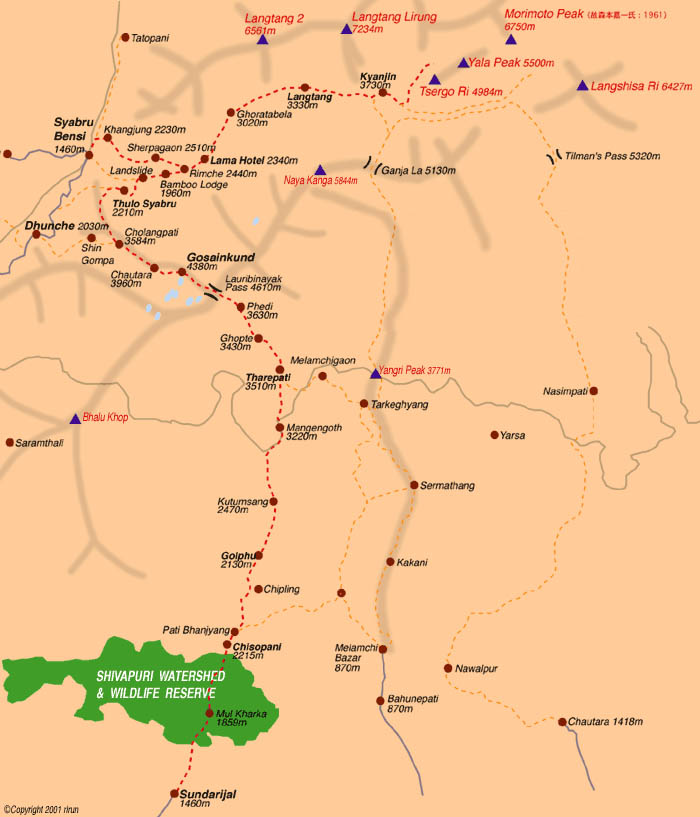
Directly north of Kathmandu up and along the Trisuli river lies the district of Rasuwa and towns such as Dhunche and Syabrubesi, gateways to the Langtang National Park and Gosaikunda, a holy mountain lake.
Lately treks (Tamang Heritage Trail) are also heading westwards and are incorporating a hot spring Chilime, though it's also referred to as Tatopani (hot water). Possibly the largest in Nepal?
I visited Chilime back in 2001, it's a full days walk up the mountain side. From current pictures I deduce that at least the springs themselves have not changed.
'In Tatopani hot springs await you. The thermal baths are known for their health-giving properties for a variety of illnesses. Local people stay here for one week and longer. Please wear Nepali style bathing suits (ankle-length skirts for women, shorts for me'
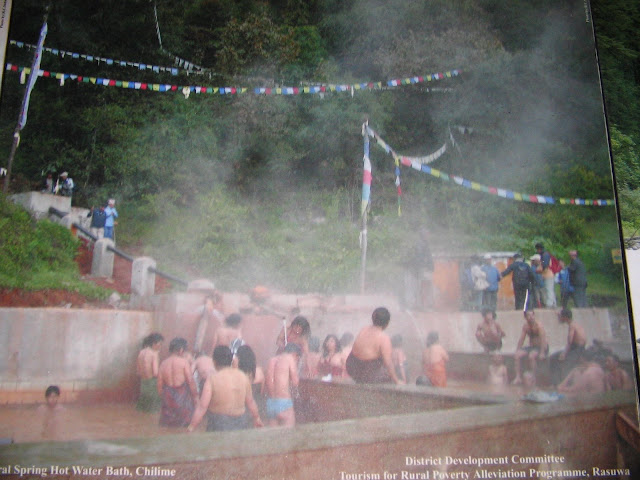
Local bathing customs? Photo published by Travel to Care
A Carpetbagger's Tale has her own experience:
'Changing into boxers and t-shirts, we gathered our towels and flip flops and walked to the hot spring. The three square-shaped pools were each filled with murky, brownish water, and a thin sheen of what looked like oil coated the water like skin. We got in. For an hour, we sat in the hot water, enjoying the warmth and steam. In the pool next to ours, a dozen women were lounging, wearing red sarongs that bared their shoulders but covered them to their knees. On their heads, they'd wrapped up their hair in plastic bags. Some of the women were Buddhist nuns, and their closely shaved hair and red bathing robes seemed out of place in the steam. The men in our pool and the pool to the other side had hairstyles that we've seen on some of the saddhus - a close crop with a tuft of hair at the crown in the back. They have a piece of string tied under their armpit like a shoulder bag with no bag and another tied around their waist. After a while, two very old Tamang women approached the pools. Dressed in their traditional long wrap dress, woolen tunic, top hat, and fabric belts, they took their time de-layering. Although our guide book had warned us to dress modestly at the pools, it seemed like maybe it wasn't as big of a deal as they had thought. These two very old, very wrinkled women were completely topless, and they wrapped their impossibly long braids around their heads like a crown before they walked into the water and stood under the fountains'.Back in the nineties, there were no guesthouses, just a couple of huts to overnight in and hardly any other facilities. That seems to have changed, luckily. It was (and probably still is) quite out of the way and attracts mostly Nepali soakers. Do note this late 2012 newssnippet (Nepalireporter):
'Tourists have also started staying longer at the Tatopani which has further boosted tourism in the area. There are more than 10 hotels and lodges in Tatopani area'.
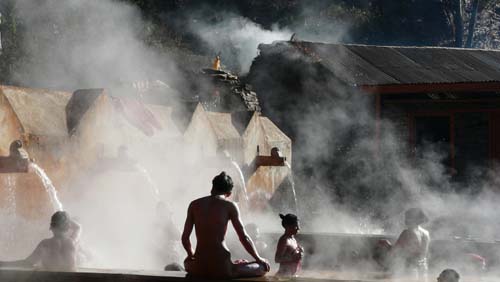
'Early morning, at the height of 2500 meters, in december, it is cool but hot springs are very hot. The next trekking trip at Tatopani, with yoga and hot bath will be in March 2009'.
Eric Lon and Chilime hot spring. Note the (un)dress code.
Another recent experience by Niraj Karki and published by ECS Nepal (website down) sings the charms of Chilime Tatopani:
'When we went there that fine rainy day in August, it was absolutely empty – we had a whole lodge to ourselves for which we (group of four) paid 300 rupees. The local alcohol made from fermented millet was 30 rupees for a bottle and we had the hot spring all to ourselves. I am in no way exaggerating when I say that Tatopani has been till now one of the best experiences of my life. In fact, I cannot do it justice, which is why I will not describe the sensation. It is a personal experience for everyone. I will describe the setting, and leave your mind to imagine and for yourself to discover. Imagine if you can the feeling of finding an oasis in the desert after a hard day in the sun. It’s like that reaching this place after a hike in the cold rain - the feeling of being in hot spring in a light drizzle of rain - your body placed in the melt of two extremes - the coolness of the falling rain meeting the warmth of the burning hot water, amidst a quiet, calm, tranquil surrounding bathed in a sea of mist'.
Not all hallelujah. Rameshwar Khadka reports (oh blog post gone ..., originally from 2011; oh no, originally it is from 2010 and not from wordpress but on blogger!) on a visit by the Eco Himal team to Chilime. He notes:

Awesome
At the foot of the trek to Chilime lies a lesser known hot springs. Syabrubesi (Wikipedia contends it's Syafru-besi), one of the main towns in the area, has it's own hot spring, nearby the river. More scientific info has been published on this hot spring.

'The Hot spring Management Committee is responsible for managing the hot spring in Tatopani. The committee charges rupees 10 for each Nepali and rupees 50 for each foreigners to take bath in the hot spring. TRPAP constructed two pools and taps to manage the hot water. The tap for natural spring water and public toilet were also constructed. However, they are not functioning well. The team made enquiry about the natural spring water tap. The local people replied that there is a dispute in using the water in the locality. Similarly the public toilet was very dirty and it was not functioning well as there was no water supply'.
Another picture from MTB Kathmandu
Awesome
At the foot of the trek to Chilime lies a lesser known hot springs. Syabrubesi (Wikipedia contends it's Syafru-besi), one of the main towns in the area, has it's own hot spring, nearby the river. More scientific info has been published on this hot spring.
'Bathing in the hot springs - Syabrubesi'
The Syabrubesi tourist information adds awesome surroundings as a component of this hot spring as well as listing that the bi-carbonate sulfate spring waters are hotter than 40 degree centigrade.
'... a small hot spring on the opposite river bank at 1810 meter'.
Into thin air does manage to find this hot spring and posts his photo (with low resolution):
'On the way down we discovered these Hot Springs -- Bliss !!!!! '
Then there is most probably a hot spring half a days walk north of Syabrubesi into the restricted area of Rasuwagadi. Unfortunately my only proof of this is a map with a Tatopani due north. Possibly it could well be the hot spring of Syabrubesi itself.
[update June 2013]
[update June 2013]