Showing posts with label Uzbekistan. Show all posts

Wednesday, December 11, 2019

Powder

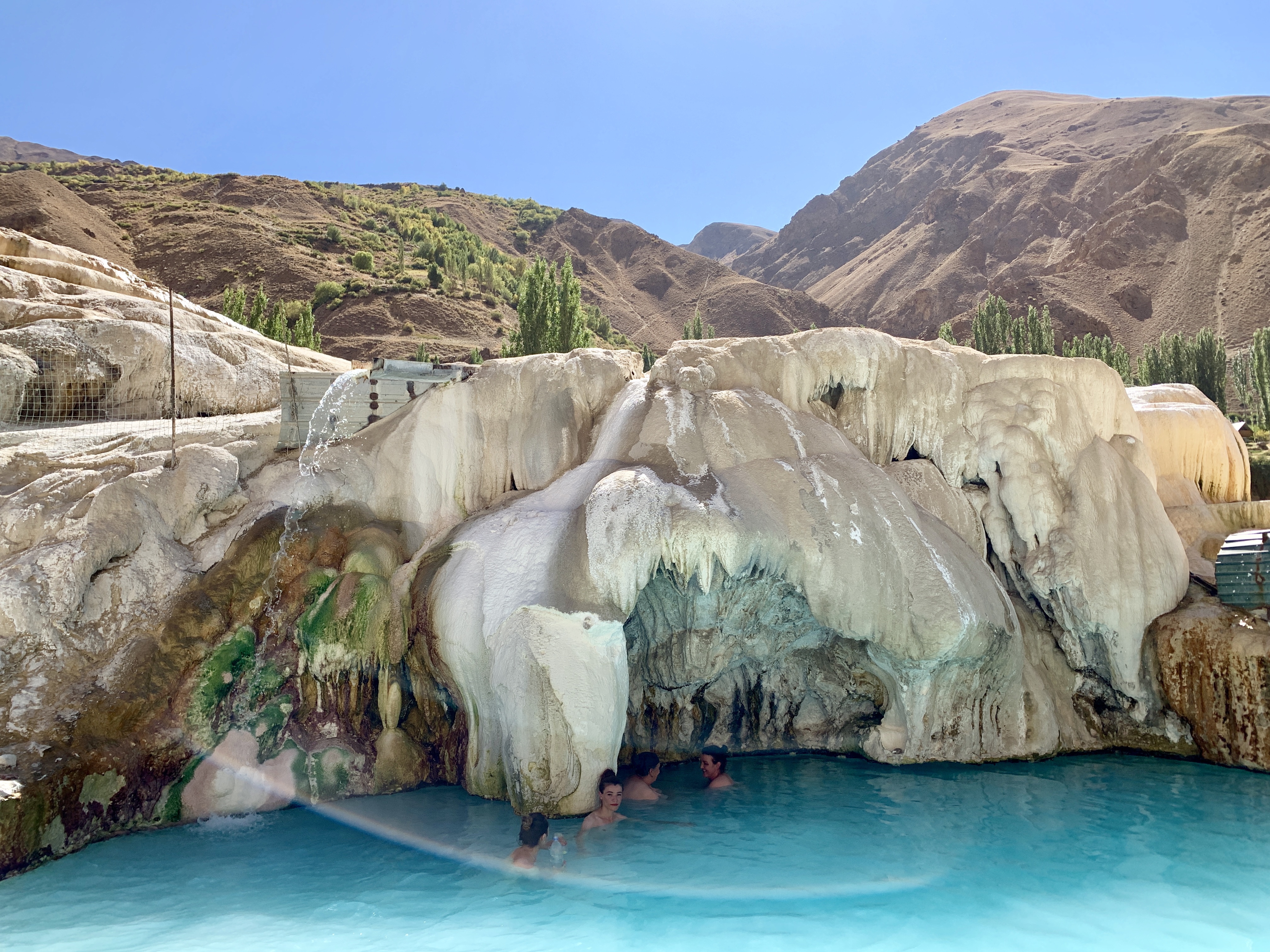
Hot springs in the Pamir 2september2019
.
.
.
#pamirhighway#hotsprings#instagramer
#mongolrally2019#all_shots#amazing#art#awesome#baby#beautiful#bestoftheday
#bored#clouds#cool#family#fashion#follow#friends#fun#funny#golook#gramoftheday 
#hot#happy#igdaily
A quick tour of the region, with photo's and info.
We're starting off in Tajikistan (above and following), at the starting point of the Wakhan corridor: the photogenic Garm Chasma hot spring. 
Following is a description from the blog lillafamiljenreiser (Sep. 29); from Swedish it translates as:
'At 12 o'clock we drove out again from Khorog towards the hot spring we were told yesterday - Garmchashma Hot Spring. It is a source of thousands of years, with lots of minerals and lime in the water. We arrived at 2 pm and went in and bathed. From 2 pm to 3 pm, women were allowed to swim outdoors, in the natural spring and men were allowed to swim indoors. Lucky me! I brought the kids with me, because the air indoors where the men were allowed to swim was like a sauna. The water was very warm, well above 42 degrees, so the kids didn't want to swim but sat mostly and watched'.
 

Below, from the border region of Uzbekistan with Kazachstan, referred to as Pskem (the river?), Tashkent region:
Our Swimmingpool on 3000m. Relaxing after big powder runs. No better place to be. Our next trips going back there. @philippherfort_photography .
.
.
#mountainsarecalling #hotspring #nobetterplace #travel #travelblogger
#travelphotography #panorama #mountains #themountainsarecalling
#winterwonderland #uzbekistan #tianshanmountains #snow
#freeride #heliskiing
Harsh
More to the south.
Hide-onsen-packer is near Nepal's Annapurna mountains and has a series of hot spring photo's and descriptions up, mostly from near Beni town. 
The following are a selection of photo's with full descriptions (translated) from his instagram account, but minus tags.


Bhurung Hot Spring
bathing fee NRs150 (locals NRs50) 
Google map notation is made in Tatopani hot springs
famous place in most tourist people often enter after the trekking  toilet Walk Room resting place is the hotel and restaurant is the hotel, meals and beer (400NRs) Yes tub, two is hot water and shallow intense heat deepen, shower there may be scenery in the open-air bath, tub also wide  Izumi the quality is usually free-flowing, it seems to have caught a source in the pipe wonder if was just a slight sulfur smell? Simple spring wonder withholding is quite hot because Kana about 48 ℃ and not Ika put the cold water running over a pipe near the harsh feel to bathe  here, of course Didi (meaning older sister) is next door in'm hot springs that are washing scrub and  
[directions] several places hot spring at a distance of about 1 hour and 30 minutes north from the "Beni" is dotted and from "Kalipul bus Stop" out also bus charter if over  one 500NRs if omnibus jeep charter Asking Price ~ 5000NRs 3000 2500NRs in Kikikomi and negotiations about an hour.
Then more entries on Singha Tatopani and on Ratopani. And more:

Paudawaru hot spring in Tatopani ♨️ [left]
Paudwar Hot Spring bathing fee 50NRs  here scenery is the strongest most well unexplored region sense until now plenty 
surrounded by mountains, see the waterfall, houses of goats Mushiri the grass
Location that it is sunny Taugiri Mountains Ogameru  tub three
since the flow source in front of the eyes taste some  spring quality is, usually have a smooth slightly, I wonder if that is included because the sulfur smell is ? But simple spring wonder 
withholding pretty but steam is standing temperature in the bathtub is a 45 ℃ and the heat Me but are not contain something  of Nepal locals bathing method is characteristic while drinking water, the plastic bag to head a simple sauna is near the source's women of the oasis in the perfect sauna 
[directions] notation without the Google map  from Tatopani hot spring there is a mountain road entrance when you move about 5 minutes by car where quite confusing Ali signboard also smaller  from there, the mountain path of a single road moved about 20 minutes the end of the road past because there is a private house on the way to the left also advance some time straight


Secar hot spring in Tatopani ♨️ [right]
Shekharu Hot Spring
bathing royalty-free time of the relationship with the rainy season abandoned likely to have been submerged in the
described in Awasan information @shunawamura 
[Directions] No description in Google map  from Beni for about one hour north from the bottom of one and a half hours walking movement is necessary and not go with the local people demanding 1-2 reference image

 
Well, not so far away (Jagat), a different kind of photo:


to my future lover⁣⁣ 🌹⁣i plan to seduce you with my love. ⁣⁣⁣to get down on my knees ⁣⁣⁣and pray with you. ⁣⁣⁣im going to show you the world ⁣⁣⁣through the eyes of a powerful woman. ⁣⁣⁣as you hold me with the hands of passion. ⁣⁣⁣the roots of your love will contort ⁣⁣⁣into the stars of your truest nature. ⁣⁣⁣my roots now intertwine with the alchemy ⁣⁣⁣that carry you into my realm. ⁣⁣⁣i feel you moving closer to me ⁣⁣⁣through the language of the wind. ⁣⁣⁣the gravity that pulls us apart ⁣⁣⁣will one day become the magnetic forcethat brings us together. ⁣⁣⁣you haven’t discovered me, ⁣⁣⁣as i am blooming ⁣⁣⁣within the depths of the jungles, ⁣⁣⁣in the structures of the mountains ⁣⁣⁣and in the rivers which flow east. ⁣⁣⁣so continue to swim in the waters of self discovery. because once you find yourself whole.. ⁣⁣⁣there you will find me 🧚‍♀️🦅 ⁣⁣⁣•••⁣⁣#tantra #tantric #lovepoem #lovestory #trauma #depressionhelp #naturegirl #beautifulfruit #fruitfuel #solotravel #hotsprings #openheart #awaken #balance #thirdeyevision #travelasia #travelnepal🇳🇵 #travelsolo #nakedart #artofinstagram #nudityisbeautiful #bodyconfidencemovement #bodyisatemple #healthcoach
Lonely Planet's forum has an entry on Nepal's Tatopani. Initial post (5 months ago):
'Pls let me know whether it is up and running again after the earthquake? Thx'.
The answers are diverse:
'The Hot spring of Tatopani, Myagdi, NEPAL has been working perfectly at the present. ...The ones on Tamang Heritage Trail don't work. Pools were empty in fall 2019 and I didn't see any efforts in finding the springs again....The Tatopani along the Manaslu Tour, between Khorlabesi and Jagat, had been heavily damaged by the 2015 eartquakes, but was back in to order in November 2017. Ducts were delivering really hot water, but pools were not filled'.
Holidify (Sep. 23) has a full article on the hot springs of Bhutan. The intro:
'Hot springs, which are known as Tshachus, are known for their medicinal properties and are found in different parts of Bhutan. It has been used for centuries by the locals to cure different kinds of body ailments, especially arthritis. The popular tradition amongst Bhutanese is to visit hot springs during the winters. Thanks to the plethora of medicinal flora and multifaceted traditional healing practices dating back to the 7th century, Bhutan has an ancient name ‘Menjung’ which means the land of medicinal herbs.
...
According to Bhutanese spiritual beliefs, the hot spring (tshachu), mineral spring (drubchu) and medicinal water (smenchu) have originated from the blessings of Lord Buddha and Bodhisattvas. These holy water sources are located in the sacred sites, and it's very important to the local population of Bhutan'.
It lists Gasa, D(h)ur, Chuboog, Gelephu and Duenmang hot springs.
Gasa Tshachu or Hot spring in Gasa is the most famous hot mineral spring in Bhutan. It is a place where people from all over the country come to have bath and soak in different ponds due to its curative powers. People believe that soaking in the waters is beneficial to their health and they visit these hot springs to cure various ailments ranging from ulcers to joint pains and sinus troubles. Besides, there are many medicinal waters that are believed to cure various other diseases. Foreigners call it as Bhutanese Beach as it is the only place where all walks of life especially elderly people gather at the place and soak in the same pond. So, visit Gasa and enjoy the hot natural spring bath.
Rust
The instagram account Baikalnature has a not so interesting photo, but with the following text:
'baikalnature.official
Did You Know? — There is a lot of hot springs in the open air around Baikal, where you can swim even in the coldest winter: “Zhemchug” in the Tunkinskaya Valley, Zmeevaya Bay in the Chivyrkuy Bay, springs at Cape Kotelnikovsky, Dzelinda, Khakusy and Goudzhekit in Northern Baikal. Hot springs mean not only useful mineral water, which treats an impressive list of diseases, but also sacred sites'.
Examples. Zhemchug:

sophiakatarina
Close to the small town of Arshan, known for its waterfalls and rusting sanatoriums, is the area generally known as Zhemchug. But when you get off a bus at the main road by Zhemchug, you have to head up north for a few kilometers to find a neighbourhood called Vishka. Vishka is a truly authentic Russian holiday village for regular families. The reason this place has come to be are the mineral hot springs, which you can visit for 200-250 rubles per half hour. Thirty minutes is plenty, because at least at ’Akvapark’ (pictured) the water is close to 60 degrees Celsius and after a while your body just wants out. The water smells a bit of methane and the Russians say it’s good for the bones. The small village boasts many cafés where the food is good and cheap, and they accept cards almost everywhere. Choose a restaurant by the Irkut river bank for a lovely view from the terrace. I’m staying at a place called Novyy Vek which is not online. I pay 350 rubles per night (outdoor toilet), and an hour of banya here set me back eighty. A popular thing to do here is get a massage, as well. This is truly a place to relax at, as you can see the beautiful Sayan mountains from here very clearly... and there isn’t much else to do anyway. #siperianhommia #zhemchug
And Goudzhekit:

#солнечныйвидсверху
To finalize the Russian section a picture from Kamchatka:

Чудненько проводим время наслаждаясь горячими термальными источниками))#отдых #горячиеисточники #верхнепаратунские #друзья #выходные
Witness
ThinkGeoEnergy (Oct. 15) on Mongolia:
'Today, IGA’s Team and Photo Contest Committee announced the winner of the Photo Contest and thereby a ticket to the World Geothermal Congress 2020. About 70 contributions were sent into the competition including pitches on the photos.
IGA [International Geothermal Association] congratulates Kasia Kurek on winning the award and WGC2020 ticket. Here her pitch for the photos of Tsenkher hot spa in Mongolia here below on the photo collage title “Geothermal unknown magic … ”
“On the 1860 meters above sea, based in the old volcanoes structure a hot geothermal spring flows all year long with unsalted, highly mineralised waters of 86°C. Throughout a system of primitive pipelines the hot geothermal water powers the local households, warms the animals shelters in the harsh Mongolian winter and is used for simple greenhousing.
Thanks to this hot spring the tourism sector emerged and a geothermal spa and a tourist yurts camp is constructed. The geothermal resource is an economic leverage to this small, rural community in the middle of Mongolia.
Tsenkher has no paved road access thus, the geothermal spring is the main the source of energy and thereby the source of community life. Moreover, the geothermal spring is given a magical significance by the locals and village shamans perform their prayers at the source estuary…”.

And finally, the China Daily reports (Mar. 4) on Guizhou hot springs

'Hot spring attractions in Guizhou, a relatively undeveloped province in southwestern China, witnessed a boom in tourist arrivals during last month's Spring Festival holiday.
...
Hot spring bathing has become a popular leisure activity for Chinese travelers in recent years, online travel agency Tuniu said in a news release, adding that there had been a significant increase in bookings for hot spring packages since November.
...
Guizhou's provincial government released a guideline for the development of hot springs tourism last year.
It said the province, home to about 260 registered geothermal locations, will be built into a "hot springs power" by 2020, with the revenue generated expected to account for 20 percent of the province's gross tourism revenue by 2025.
By the end of December, 10 hot spring resorts had been built in Guizhou, with investment totaling about 2.3 billion yuan ($344 million), the guideline said'.
More China, from Gu'ergou (Sichuan), finishing with what is referred to as Tibet. That narrows it down a bit!

Outdoor hot spring infinity pool with 🏔❄️Combining all the good things together✨#四川 #visitsichuan #visitchina #snow #hotsprings #古尔沟 #古尔沟华美达温泉度假酒店 #infinitypool
Day trip with a new friend #hotsprings

Sunday, November 3, 2013

Audit

The leftovers
With blogs listing details on the hot springs of Kazakhstan, Tajikistan and Kyrgyzstan, it's only natural to expect their neighbours (Uzbekistan and Turkmenistan) to also be dotted with nice soaks. 
But actually there aren't that many hot springs. Thus, this single blog post will cover both countries.

Starting off with Uzbekistan is the most simplest as I have yet to find out whether or not there are hot springs in this country.

That was quick.

Turkmenistan: Going underground
Turkmenistan does have the odd hot spring or two. And even a very special and extra ordinary hot spring. Referred to as Kow Ata (Kov Ata, Kovata, Kowata or Bakharden) this a subterranean hot spring. One needs to climb down sets of stairs to get to the thermal waters 60m below ground level.
'The underground lake is formed by a hot spring in a cave 60 m below the ground and stretches over several kilometres. Only the first 70 metres are accessible and sufficiently lit and provide the occasion for a dip in the 36°C water'.
(source).
An experience:
'Kowata is an underground hot spring where they took all the trainees swimming a week ago. It is about 45 minutes from the capital and about 5 kilometers from the border with Iran. You descend down about seven flights of slippery steps with wobbly hand rails, wishing you were wearing metal cleats. As you descend the dimly lit corridor, the air grows hotter and more humid, and eventually carries the smell of eggs from the sulfurous waters of the lake. The water is lovely to swim in; about 82 degrees Fahrenheit, it is like being in a bath. The depth of the water wasn’t clear, but nobody’s feet touched the bottom. However, there were many jutting rocks and ledges where you could rest. We spent about two hours swimming before learning that a half-hour was advised, probably for the same reason that excessive time in a hot tub should be avoided. Still, the water is supposed to be medicinal for your skin, and I have not seen any ill effects. When I told my family in Herrick-Gala that I swam, however, they were extremely apologetic because they don’t know how to swim'.
Not always are experiences in such a positive light.
'We drove for a couple of hours out into the middle of nowhere. The engineer led us to a cave and we went inside. Once our eyes adjusted to the dark we saw a large pool of water. There was a single electric lamp on one side of the cave which didn't do much to cut through the gloomy darkness. Bats hung from the ceiling above and the air was thick with steam and the heavy smell of sulphur.
My colleague and I stripped down to our bathing suits and jumped in. The water was bathtub temperature and very murky. I held my breath and let myself sink down as far as I dared but I couldn't touch the bottom.
Strangely the engineer refused to join us but preferred instead to hang out at the cave's entrance and smoke.
The water temperature was pleasant but the sulphurous smell became overbearing after a while and the atmosphere was just plain creepy. My colleague and I climbed out, dried off and put our clothes back on in silence.
We exited the cave and were climbing back into the car when a rickety, rusted-out old bus pulled up and a dozen locals piled out. They were dressed in colorful, ratty garments and were a pretty ragtag bunch.
"Who are they?" I asked our guide.
"Oh them."
And then he told me that this particular hot spring is famous throughout the country. That its warm sulphur waters supposedly have healing properties and that people with otherwise incurable skin diseases were bussed in to bathe here in as a last resort for a cure...
It took weeks before I was convinced that I hadn't contracted leprosy...'.
Kow Ata Underground Lake / Turkmenistan, Bakharden
Photo by flydime:
'The Bakharden Underground lake Kow Ata is an unusual natural site in the biggest cave of the Kopetdag mountains, located about 107 km south-west of Ashgabat. The Turkmen name Kov-Ata means "father of caves". At a first glance, this underground area looks like a magnificent auditorium : the overall length of the cave is 230 m, its height goes up to 20 m, and its width is at some points 57 m (http://www.odyssei.com/travel-tips/4627.html)'.
Wrapping up, in Turkmenistan there is just one mention of another hot spring, Koytendag:
'the, unique hydrogen sulphate hot spring, "Gainar Baba"'.

Also noteworthy is the Darvaza gas crater, a gas drilling operation gone wrong more than 50 years ago, resulting in a seemingly never ending burning gas crater. Picturesque especially at night it is also located in the deserted hinteralnds of Turkmenistan.

Saturday, October 15, 2011

Northern boundary?

The leftovers
With blogs listing details on the hot springs of both Tajikistan and Kyrgyzstan, it's only natural to expect their neighbours, Uzbekistan, Kazakhstan and Turkmenistan, to also be highlighted. Because there aren't that many hot springs this single blog post will cover all three countries.

Soaking in Uzbekistan - no way!
Starting off with Uzbekistan is the most simplest as I have yet to find out whether or not there are hot springs in this country.

Big country, little soaks
To the north of Uzbekistan lies the immense country of Kazakhstan. Here a few hot springs can be found in the mountains bordering Kyrgyzstan and China. However knowing that there are hot springs does not mean that they can be highlighted. Take for instance the hot spring located near Chimkent (Shymkent). Just the one mention:
'hot spring health spas'.
Elsewhere, there is more info on two close to each other located hot springs, Alma Arasan and Zharkent-Arasan.
Alma-Arasan:
'There are 51 groundwater springs, many of which are used for spa therapy purposes. The Alma- Arasan hot spring water is similar in its chemical composition to French mineral waters of the Pyre-nean type (Aix les Bains, etc.)
...
The temperature of major springs constitutes 35-37 degrees centigrade. With regard to water content, temperature and radioactivity the water is similar to Tshaltubo Springs [famous hot spring in Georgia, the country]. The springs have a good influence on people who suffer from rheumatism, metabolic disease, diseases of peripheral system and blood vessels, as well as on the diseases of women and on the people who were poisoned with copper, lead and other metals. Every year Arasan-Kapal Resort accepts around 2000 patients'.
Other info on Alma concern it's establishment in 1886.

On Zharkent which, by the way, was established in 1967:
'The main medicinal factors are: nitric, chloride-sulphate, sodium water (36C) which contains fluorine, organic substances used for bath and shower'.(source)
Kapal (not (?) to be confused with Kapal-Arasan) possesses a mineral spring with a temperature of 25-28C, not quite soakable?

Aktau, lying on the Caspian sea on youtube with this description:
'A small warm bubbling hot spring, a little ways off-the-path from the road between Karagiye Depression (-132 meters below sea level, 3rd lowest spot on Earth) and Aktau city in Mangystau Province, Republic of Kazakhstan'.
Wikitravel mentions the existence of Radon hot springs ("facilities are very primitive") in the Aktau travel guide with nearby mud baths, possibly the same as above?.

An odd experience is revealed by Jennie Vader on a visit to a banya slash hot spring near Turkestan:
'... and I went to a banya in the middle of the steppe about 30 minutes from Turkestan. The banya is a dome-like structure (called the egg) built over a natural, underground hot spring. We all went into this huge egg and then into our own room which consisted of 2 shower heads and an old bathtub. Basically, you seal up your room and the hot water runs constantly, steaming everything up. You shower like usual and sit in the bathtub of really hot water'.

There are also mentions made of the following hot springs in Kazakhstan: Tamshaly, Ayak-Kalkan (hot spring 180 km from Almaty, in the village of Baseit), a so-called Mountain Thermal Water Resort.

A flickr photo reference to a hot spring in their Kazakhstan set. Have my doubts though.

More recently kazworld.info mentions Dobyn:
'Experts say the hot springs at Dobyn village are enriched with minerals and contain small amounts of nitrogen. The waters contain silica and trace elements of radon, providing the thermal springs with unique medical and healing qualities'.
It goes on to mention how the wellness industry in Kazakhstan is shaping up. Twenty three health centres have been established since 2000, with 13 under construction, among them a
Premium Spa Resort (though the website of the company has no info on this possibility). Two-hundred thousand visits were reported in 2011.

Going underground
Turkmenistan features an extra ordinary hot spring. Referred to as Kow Ata (Kov Ata, Kovata, Kowata or Bakharden) this a subterranean hot spring. One needs to climb down sets of stairs to get to the thermal waters 60m below ground level.
'The underground lake is formed by a hot spring in a cave 60 m below the ground and stretches over several kilometres. Only the first 70 metres are accessible and sufficiently lit and provide the occasion for a dip in the 36°C water'.
(source).
A great photo can be found on flickr (but not posted). An experience:
'Kowata is an underground hot spring where they took all the trainees swimming a week ago. It is about 45 minutes from the capital and about 5 kilometers from the border with Iran. You descend down about seven flights of slippery steps with wobbly hand rails, wishing you were wearing metal cleats. As you descend the dimly lit corridor, the air grows hotter and more humid, and eventually carries the smell of eggs from the sulfurous waters of the lake. The water is lovely to swim in; about 82 degrees Fahrenheit, it is like being in a bath. The depth of the water wasn’t clear, but nobody’s feet touched the bottom. However, there were many jutting rocks and ledges where you could rest. We spent about two hours swimming before learning that a half-hour was advised, probably for the same reason that excessive time in a hot tub should be avoided. Still, the water is supposed to be medicinal for your skin, and I have not seen any ill effects. When I told my family in Herrick-Gala that I swam, however, they were extremely apologetic because they don’t know how to swim'.
Not always are experiences in such a positive light.
'We drove for a couple of hours out into the middle of nowhere. The engineer led us to a cave and we went inside. Once our eyes adjusted to the dark we saw a large pool of water. There was a single electric lamp on one side of the cave which didn't do much to cut through the gloomy darkness. Bats hung from the ceiling above and the air was thick with steam and the heavy smell of sulphur.
My colleague and I stripped down to our bathing suits and jumped in. The water was bathtub temperature and very murky. I held my breath and let myself sink down as far as I dared but I couldn't touch the bottom.
Strangely the engineer refused to join us but preferred instead to hang out at the cave's entrance and smoke.
The water temperature was pleasant but the sulphurous smell became overbearing after a while and the atmosphere was just plain creepy. My colleague and I climbed out, dried off and put our clothes back on in silence.
We exited the cave and were climbing back into the car when a rickety, rusted-out old bus pulled up and a dozen locals piled out. They were dressed in colorful, ratty garments and were a pretty ragtag bunch.
"Who are they?" I asked our guide.
"Oh them."
And then he told me that this particular hot spring is famous throughout the country. That its warm sulphur waters supposedly have healing properties and that people with otherwise incurable skin diseases were bussed in to bathe here in as a last resort for a cure...
It took weeks before I was convinced that I hadn't contracted leprosy...'.

Kow Ata Underground Lake / Turkmenistan, Bakharden
Photo by flydime:
'The Bakharden Underground lake Kow Ata is an unusual natural site in the biggest cave of the Kopetdag mountains, located about 107 km south-west of Ashgabat. The Turkmen name Kov-Ata means "father of caves". At a first glance, this underground area looks like a magnificent auditorium : the overall length of the cave is 230 m, its height goes up to 20 m, and its width is at some points 57 m (http://www.odyssei.com/travel-tips/4627.html)'.
Wrapping up, in Turkmenistan there is just one mention of another hot spring, Koytendag:
'the, unique hydrogen sulphate hot spring, "Gainar Baba"'.

Thursday, September 9, 2010

Northern boundary?

The leftovers
With blogs listing details on the hot springs of both Tajikistan and Kyrgyzstan, it's only natural to expect their neighbours, Uzbekistan, Kazakhstan and Turkmenistan, to also be highlighted. Because there aren't that many hot springs this single blog post will cover all three countries.

Soaking in Uzbekistan - no way!
Starting off with Uzbekistan is the most simplest as I have yet to find out whether or not there are hot springs in this country.

Big country, little soaks
To the north of Uzbekistan lies the immense country of Kazakhstan. Here a few hot springs can be found in the mountains bordering Kyrgyzstan and China. However knowing that there are hot springs does not mean that they can be highlighted. Take for instance the hot spring located near Chimkent (Shymkent). Just the one mention:
'hot spring health spas'.
Elsewhere there is more info on two close to each other located hot springs, Alma Arasan and Zharkent-Arasan.
Alma-Arasan:
'There are 51 groundwater springs, many of which are used for spa therapy purposes. The Alma- Arasan hot spring water is similar in its chemical composition to French mineral waters of the Pyre-nean type (Aix les Bains, etc.)
...
The temperature of major springs constitutes 35-37 degrees centigrade. With regard to water content, temperature and radioactivity the water is similar to Tshaltubo Springs [famous hot spring in Georgia, the country]. The springs have a good influence on people who suffer from rheumatism, metabolic disease, diseases of peripheral system and blood vessels, as well as on the diseases of women and on the people who were poisoned with copper, lead and other metals. Every year Arasan-Kapal Resort accepts around 2000 patients'.
Other info on Alma concern it's establishment in 1886.

On Zharkent which, by the way, was established in 1967:
'The main medicinal factors are: nitric, chloride-sulphate, sodium water (36C) which contains fluorine, organic substances used for bath and shower'.(source)
Kapal (not(?) to be confused with Kapal-Arasan) possesses a mineral spring with a temperature of 25-28C, not quite soakable?
There are also mentions made of the following hot springs in Kazakhstan: Tamshaly, Ayak-Kalkan (hot spring 180 km from Almaty, in the village of Baseit), a so-called Mountain Thermal Water Resort.

A flickr photo reference to a hot spring in their Kazakhstan set. Have my doubts though.

Going underground
Turkmenistan features an extra ordinary hot spring. Referred to as Kow Ata (Kov Ata, Kovata, Kowata or Bakharden) this a subterranean hot spring. One needs to climb down sets of stairs to get to the thermal waters 60m below ground level.
'The underground lake is formed by a hot spring in a cave 60 m below the ground and stretches over several kilometres. Only the first 70 metres are accessible and sufficiently lit and provide the occasion for a dip in the 36°C water'.
(
source).
A great photo can be found on flickr (but not posted). An experience:
'Kowata is an underground hot spring where they took all the trainees swimming a week ago. It is about 45 minutes from the capital and about 5 kilometers from the border with Iran. You descend down about seven flights of slippery steps with wobbly hand rails, wishing you were wearing metal cleats. As you descend the dimly lit corridor, the air grows hotter and more humid, and eventually carries the smell of eggs from the sulfurous waters of the lake. The water is lovely to swim in; about 82 degrees Fahrenheit, it is like being in a bath. The depth of the water wasn’t clear, but nobody’s feet touched the bottom. However, there were many jutting rocks and ledges where you could rest. We spent about two hours swimming before learning that a half-hour was advised, probably for the same reason that excessive time in a hot tub should be avoided. Still, the water is supposed to be medicinal for your skin, and I have not seen any ill effects. When I told my family in Herrick-Gala that I swam, however, they were extremely apologetic because they don’t know how to swim'.
Not always are experiences in such a positive light.
'We drove for a couple of hours out into the middle of nowhere. The engineer led us to a cave and we went inside. Once our eyes adjusted to the dark we saw a large pool of water. There was a single electric lamp on one side of the cave which didn't do much to cut through the gloomy darkness. Bats hung from the ceiling above and the air was thick with steam and the heavy smell of sulphur.
My colleague and I stripped down to our bathing suits and jumped in. The water was bathtub temperature and very murky. I held my breath and let myself sink down as far as I dared but I couldn't touch the bottom.
Strangely the engineer refused to join us but preferred instead to hang out at the cave's entrance and smoke.
The water temperature was pleasant but the sulphurous smell became overbearing after a while and the atmosphere was just plain creepy. My colleague and I climbed out, dried off and put our clothes back on in silence.
We exited the cave and were climbing back into the car when a rickety, rusted-out old bus pulled up and a dozen locals piled out. They were dressed in colorful, ratty garments and were a pretty ragtag bunch.
"Who are they?" I asked our guide.
"Oh them."
And then he told me that this particular hot spring is famous throughout the country. That its warm sulphur waters supposedly have healing properties and that people with otherwise incurable skin diseases were bussed in to bathe here in as a last resort for a cure...
It took weeks before I was convinced that I hadn't contracted leprosy...'.

Kow Ata Underground Lake / Turkmenistan, Bakharden
Photo by flydime:
'The Bakharden Underground lake Kow Ata is an unusual natural site in the biggest cave of the Kopetdag mountains, located about 107 km south-west of Ashgabat. The Turkmen name Kov-Ata means "father of caves". At a first glance, this underground area looks like a magnificent auditorium : the overall length of the cave is 230 m, its height goes up to 20 m, and its width is at some points 57 m (http://www.odyssei.com/travel-tips/4627.html)'.
Otherwise in Turkmenistan there is just one mention of another hot spring, Koytendag:
'the, unique hydrogen sulphate hot spring, "Gainar Baba"'.